Best Pin-Type Moisture Meters: Direct-Contact Picks for Wood and Framing
A pin meter reads the electrical resistance between two points pushed into the material, which makes it the direct-contact choice for framing, rough lumber, subfloors and any spot where a pinless pad cannot sit flat. This guide compares the listings on stated ranges, species scales, calibration checks and probe options, with the Extech MO265 included for its combined pin and pinless design.
As an Amazon Associate, Akermin earns from qualifying purchases. Product links on this page are affiliate links.
Our Top Picks
These pin meters were compared on stated wood and building material ranges, species or scale settings, calibration check provisions, probe options and alerts, all taken from manufacturer listings. We did not run laboratory tests or oven-dry comparisons; figures are the manufacturers' own and blanks are marked as not stated.
Best Overall
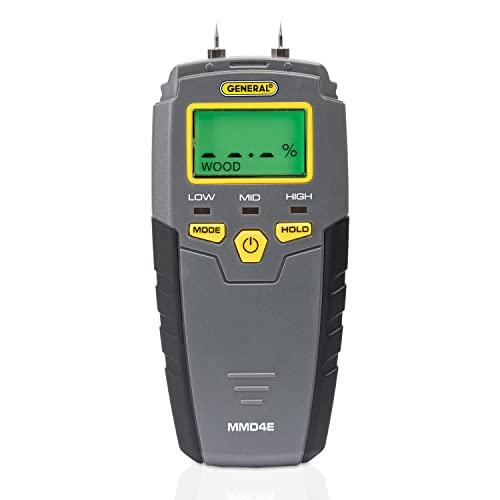
General Tools MMD4E Pin-Type Moisture Meter
Stated 5 to 50% wood range, spare pins and a cap that checks calibration.
Wood 5 to 50%; building materials such as concrete and drywall 1.5 to 33%
Low, medium and high tones with on-screen icons; reading hold
Extra 8 mm stainless steel pins; protective cap doubles as a calibration checker
Backlit LCD with 0.3 in digits; 9V battery included
All figures are taken from the manufacturers' Amazon listings at the time of research. Wood percentages from a pin meter are uncorrected unless a species scale is selected, and building material figures are effectively relative. Where a listing gives no value the cell reads Not stated.
How to Choose a Pin-Type Moisture Meter
Four checks decide the purchase:
Ranges Stated
A pin meter that states its wood and building material ranges can be quoted. Three listings here state ranges; three state none.
A Way to Check It
Pins bend and batteries fade. A cap with a self-test contact or a separate calibration device catches a bad reading before it is written down.
Species Scales
Density changes resistance. The Mecurate states eight wood scales and the coczow six; the rest give one uncorrected wood number.
Reach
Built-in pins are quick on open framing. An extension or remote probe, as on the Protimeter Mini and Extech MO265, reaches corners and sills.
As far as they will go, and always in the same orientation relative to the grain. A pin meter reads the wettest path between the two tips, so shallow insertion reads the surface, which dries first. The MMD4E ships with 8 mm pins; for thick timber, an extension probe with longer pins, as supplied with the Protimeter Mini, reaches the core.
What is the self-test contact on a pin meter cap for?
It is a fixed resistance built into the cap. Touching the pins to it should produce a known reading, which confirms that the pins, the circuit and the battery are working. The General MMD4E, Extech MO50 and Mecurate listings all describe one; use it at the start of each session, since a bent pin or low battery reads low without it.
Why does a pin meter read 0% or refuse to register on dry wood?
Because very dry wood has very high electrical resistance, and the bottom of the meter range, 5% on the MMD4E and MO50 and 2% on the coczow, is where the circuit stops distinguishing. The RDINSCOS firewood listing in our wood guide says the same. A reading at or below the floor means dry, not broken.
Do pin meters damage a finished floor or a painted wall?
Yes, two small holes per reading, and on hardwood the pins can bend. That is why pin readings belong on framing, subfloors, rough lumber and firewood, or on a finished surface only where the holes can be hidden or the material is already coming out. Use a pinless meter on anything that has to stay unmarked.
Can I use one pin meter for both wood and drywall?
The MMD4E and MO50 state separate ranges for wood and for building materials such as drywall, plaster and concrete, and the Mecurate states a wood mode and a building mode. Switch modes for the material. The drywall figure is a relative number rather than a true percentage on any resistance meter, so compare it to a dry reference on the same wall.
Reviews
General Tools MMD4E Pin-Type Moisture Meter Best Overall
The MMD4E is the pin meter that most people should start with, because its listing states the two things a pin meter must state: the ranges and a way to check it. General Tools gives 5 to 50% for wood and 1.5 to 33% for building materials such as concrete and drywall, and the protective cap carries a calibration checker so a bent pin or weak 9V battery is caught before the first reading.
In use it is simple. Push the 8 mm stainless pins in, read the 0.3 in digits on the backlit LCD, and listen for the low, medium or high tone if the display is out of sight. A hold button freezes a reading taken overhead, and spare pins ship in the box, which matters because pins bend in hardwood and framing.
The listing does not state a species scale, so the wood percentage is uncorrected for density, and the marketing leans on mold detection, which no moisture meter does directly. For framing, subfloors and a confirmation reading behind a stain, neither gap matters much.
Protimeter Mini General Purpose Moisture Meter Best Professional Pin Meter
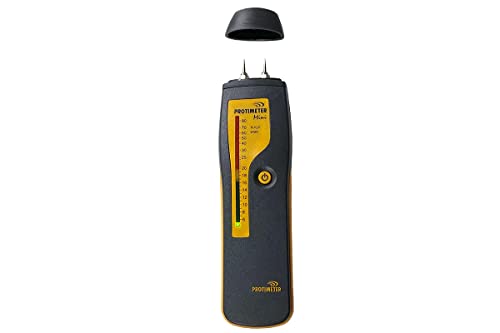
The Protimeter Mini is the pin meter surveyors and inspectors carry when the reading has to be defensible and reachable. Protimeter states built-in pin probes, a display that shows moisture content alongside a three-color classification of dry, borderline or damp, and a calibration device in the box for checking that the instrument is reading correctly.
The extension pin probe is the practical advantage. It plugs into the meter on a lead so the pins can reach into a corner, under a sill, behind a pipe or up a wall without the whole meter going with them, and it accepts deeper probe types for readings below the surface. The Extech MO265 in the table offers a remote probe on the same principle.
The listing is short on numbers: no wood range, no building materials scale and no species settings are stated, so those come from the manual. It is also the premium tier of this group, which is justified when the readings go into a survey report and the calibration check is part of the record.
Strengths
Calibration device included
Extension probe for awkward positions
Dry, borderline, damp classification with a number
General Tools MMP100 Compact Pin Moisture Meter Best Value
The MMP100 is the pin meter for a tool pouch, where the full-size MMD4E does not fit. General Tools describes it as compact and lightweight with the precision of most standard-size meters, reading wood, drywall and other building materials, and the tri-color backlight turns green, yellow or red as the reading moves from low to high so the state of the wood is visible from arm's length.
The details that matter on a jobsite are there: a tethered cap that cannot be lost, a data hold for readings taken in a crawl space, and a low battery indicator. The manufacturer names home inspections, drywall and flooring installation, woodworking and firewood as its jobs.
What the listing leaves out is any number: no wood range, no building materials range, no species scale, no pin length and no calibration check. For checking firewood or spotting a wet sill plate that is fine; for a reading that has to be quoted, the MMD4E states its ranges and the Protimeter Mini its calibration.
Short answer: the General MMD4E is the pin meter to buy first, with a stated 5 to 50% wood range, a 1.5 to 33% building materials range, spare pins and a calibration checker in the cap; the Protimeter Mini is the professional choice when readings go into a survey report, with a calibration device and an extension probe for corners and sills; and the General MMP100 is the pocket-size pin meter for a tool pouch, firewood and quick framing checks where no number has to be quoted.
How a pin meter reads and where it wins
A pin-type meter drives two stainless pins into the material and measures the electrical resistance between them. Water conducts, dry wood does not, so resistance falls as moisture rises and the meter converts that to a percentage. The reading is taken exactly where the pins are, at the depth they reach, which is the whole advantage: no averaging across a 3/4 in volume, no interference from a stud or pipe behind the surface, and no need for a flat contact area. Logs, round posts, narrow trim, rough block and the edge of a sill plate all read cleanly with pins and poorly with a pad. The pin versus pinless guide lays out the physics; this page is about which pin meter to carry.
Ranges, scales and what the listings state
Only three listings state their ranges. The General MMD4E and Extech MO50 both state 5 to 50% for wood and 1.5 to 33% for building materials such as drywall, plaster and concrete. The coczow PM6811A states 2.0 to 75.0% for wood and 1.5 to 30% for building materials, and describes low, medium and high bands of 5 to 12%, 12 to 17% and 17 to 60%. The Protimeter Mini, General MMP100, Mecurate and Extech MO265 listings state no ranges at all, though the Mecurate states 0.1% resolution. Species handling follows the same split: the Mecurate states eight calibrated wood scales with a quick-search index printed on the back, the coczow states six scales and advises selecting type 3 for an unlisted species, and no other listing describes species correction. For wood that has to meet a target, a species scale matters more than the range, and the wood meter method guide explains why.
Calibration checks and extension probes
Pins bend, tips corrode and 9V batteries fade, and each of those reads low. The MMD4E, MO50 and Mecurate build a self-test contact into the protective cap; the Protimeter Mini ships a separate calibration device. The MMP100, coczow and MO265 state nothing, so a known-dry sample has to do the job. Reach is the other practical difference. Built-in pins are quickest on open framing, but a reading under a sill, behind a pipe or at the back of a cabinet needs the pins to travel without the meter. The Protimeter Mini includes an extension pin probe for exactly that, and the Extech MO265 pairs a remote pin probe with a pinless sensor in the same body, which makes it the one meter in the table that scans and confirms. The MO265 and the compact MO50 each have their own review on this site.
The limits: species correction and pin damage
Two limits apply to every pin meter here. First, correction. A resistance reading depends on wood density and on temperature, so an uncorrected percentage from the MMD4E, MMP100 or Protimeter Mini is a comparison number until a species scale or a manual correction is applied; drywall, plaster and concrete figures from the building materials range are relative, not true percentages, and concrete slabs for flooring are tested with relative humidity probe methods rather than pins. Second, damage. Every reading leaves two holes, hardwood bends pins, and a pin driven into a wall can find a wire or a pipe. Keep pins for framing, subfloors, rough stock and firewood, or for a single confirmation reading where a pinless sweep has already found the wet area and the holes can be hidden. The pinless moisture meter guide covers the tool for everything finished.
Size, alerts and the pocket question
The Extech MO50 states 6.7 by 2.6 by 1.2 in and 4.2 oz with a beeper that speeds up as moisture rises, and the coczow states 136 by 54 by 28 mm at about 130 g with a 5-minute auto-off. The MMP100 is described as compact without dimensions. Audible cues are worth more than they sound on a pin meter, because the pins are often in a spot where the display is not visible: the MMD4E gives three tones, the MO50 a variable-rate beeper, the Mecurate and MMP100 colored backlights.
Related guides
For lumber, flooring and firewood specifically, the wood moisture meter guide sets these pin meters against the pinless Wagner Orion range. Inspectors who need both sensing types in one instrument will find the combination meters in the home inspector guide in this cluster.
How We Research
Products were compared on manufacturer listing text: stated wood and building material ranges, species or scale settings, calibration check provisions, probe and pin options, alerts, size and power. Owner feedback was reviewed for recurring reports of pin breakage and readings that vary with insertion depth. We did not run laboratory tests or oven-dry comparisons and publish no moisture measurements of our own. Amazon data supplies images, availability and links only.
A handheld thermal camera with a 160 by 120 infrared detector, a 320 by 240 enhanced image, 40 mK sensitivity, a focus free 40 by 30 degree field of view, a 25 Hz refresh rate and still JPG image capture.
A non contact infrared thermometer for electrical, mechanical, HVAC and automotive surfaces, with dual rotating lasers that mark the edges of the measurement area, minimum, maximum, difference and average readings, and an IP54 rating.
A pinless non invasive moisture meter that reads up to three quarters of an inch into a surface, with scales of 0 to 53 percent for softwood, 0 to 35 percent for hardwood and relative readings on wallboard, drywall and masonry.