As an Amazon Associate, Akermin earns from qualifying purchases. Product links on this page are affiliate links.
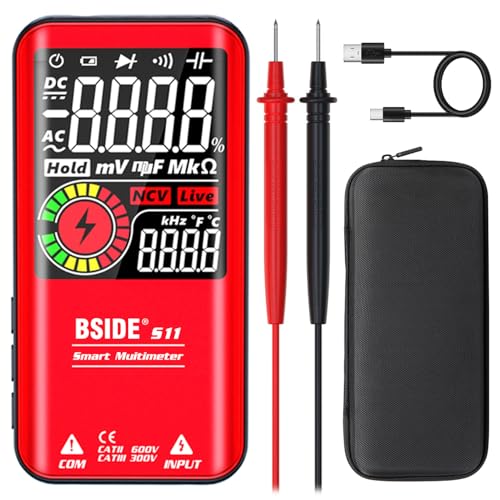
BSIDE · BSIDE Color LCD Digital Multimeter 3 Results Display 9999 Counts Auto-Ranging Ohmmeter, Rechargeable with Smart Mode, Capacitance Ohm Frequency Diode Duty Cycle Live Check Voltage Tester
View on AmazonPrice and availability are shown on Amazon and can change at any time.
The BSIDE is a 9999-count auto-ranging meter with a colour LCD that shows three results at once, a rechargeable battery and a detachable protective case. The listing publishes those points clearly. It does not publish a CAT safety rating, a basic DC accuracy specification, a warranty term or a list of what ships in the box beyond the battery and charging cable. Buy it if you want a readable bench and hobby meter with smart auto-selection. Do not buy it as your only instrument for live mains work until you have confirmed the safety category from the manufacturer, because the listing is silent on it.
The number the listing never prints: a safety category
Every multimeter that will be connected to a live circuit carries a safety rating, written as CAT followed by a Roman numeral and a voltage, for example CAT III 600V. That rating describes the transient energy the meter’s input protection is designed to survive. It is the single most important figure on a mains-capable meter, because it determines whether a mistake produces a blown fuse or an arc flash.
The BSIDE listing does not publish a CAT rating. It does not publish a voltage limit for the inputs either. The bullets describe smart measurement of AC and DC voltage, resistance and continuity, and the title mentions capacitance, frequency, diode, duty cycle and live check. Nowhere in the supplied text is there a statement of the maximum voltage the meter is rated to measure, or the category of installation it is rated for.
That silence is not proof the meter is unsafe. Many meters in this class carry a CAT III rating moulded into the case and printed in the manual rather than in the marketing bullets. But a buyer cannot assume it. If you intend to use the meter inside a consumer unit, on a ring main or on a distribution board, ask the seller for the CAT rating in writing, or look for the marking on the case before you connect it to anything live. For low-voltage bench work, automotive 12V testing and continuity checks on unpowered circuits, the absence of a published category matters much less.
Three results on screen, and no accuracy figure to judge them by
The listing states the meter shows three test results at once, giving voltage, frequency and an analog bar as its example. It states 9999 counts. Counts describe resolution: a 9999-count meter can display four digits, so on a 6V range it resolves to 1mV where a 2000-count meter resolves to 10mV. Resolution is not accuracy. A meter can display a very fine number that is consistently wrong.
Accuracy is normally published as a percentage of reading plus a number of counts, separately for each function and range. The BSIDE listing does not publish any accuracy figure for any function. It also does not publish a DC volts accuracy, an AC volts accuracy, a resistance accuracy or a frequency accuracy. That is the largest gap on the page after the safety rating, because it tells you nothing about whether the third digit on the screen is meaningful.
In practice, a 9999-count display with an unpublished accuracy specification is best treated as a resolution claim, not a precision claim. For checking whether a 12V battery is charging, or whether a socket is live, resolution is plenty. For matching two meters against each other or for calibrating a sensor, you need the accuracy table, and this listing does not give you one.
Smart mode: what the listing says it selects, and what it does not
Smart mode, as described, automatically measures AC and DC voltage, resistance and continuity at what the listing calls the best resolution. The same bullet states all of these measurements can be done manually as well. That is a useful combination: auto-selection for quick checks, manual range selection when you want to hold a range and watch a value move.
The listing does not say how smart mode decides between AC and DC, how quickly it settles, or what it displays when the probes are open. It does not list the functions that are excluded from smart mode. The title names capacitance, diode, duty cycle and live check, but the smart-mode bullet names only voltage, resistance and continuity. A buyer should expect to select capacitance, diode and duty cycle manually, because the listing does not claim smart mode covers them.
Live check is named in the title and not explained in the bullets. It is not the same as a non-contact voltage tester, which senses an electric field without touching a conductor. Do not assume the BSIDE will warn you of a live wire from a distance. If that is the job, a dedicated non-contact voltage tester is the right tool, and the meter is not a substitute for it.
The rechargeable battery, the case, and the parts the listing omits
The listing states the meter comes with a rechargeable battery and a charging cable. It does not state the battery chemistry, the capacity, the charging connector type, the charging time or the runtime per charge. It does not state whether the battery is user-replaceable or soldered in. Those details decide how the meter behaves after two or three years of use, and the listing leaves them open.
The protective case is described as durable, detachable and easy to replace. No drop height, no ingress rating and no case material are published. Treat the case as bump protection, not as a guarantee against a fall onto concrete.
The listing does not publish what else is in the box. Test leads are implied by the functions but not named in the supplied bullets. A carry pouch, a temperature probe and a manual are not mentioned. Before ordering, confirm the lead set, because leads are the part of a meter that fails first and the part most often missing from a stripped-down package. The site’s guide to choosing a digital multimeter explains which accessories are worth insisting on.
Where this meter fits, and where a different instrument is the honest answer
The published feature set points to a bench and general-purpose meter: a large colour screen, three simultaneous readouts and a rechargeable battery suit long sessions at a desk, hobby electronics, automotive 12V checks and household continuity testing. The 9999-count display gives fine resolution for low-voltage work, and the detachable case makes it a reasonable tool to throw in a bag.
It is not the right instrument for three-phase power quality work, where you need a recorder that logs harmonics and captures events over time, which is a different class of device from a handheld meter. It is not a clamp meter, so it cannot measure current by clamping around a conductor without breaking the circuit; the listing does not publish a current range at all, and the title does not claim one. If you need to measure load current, a clamp meter is the correct tool. The site’s clamp meters with inrush page covers that category.
It is also not a substitute for a dedicated insulation tester, a socket tester or a gas detector. A multimeter measures what its probes touch. It does not test insulation resistance at 500V, it does not check a socket’s wiring without adaptors, and it does not detect carbon monoxide. Buy it for the measurements the listing names, and keep the specialist tools for the jobs it does not.
The verdict on the BSIDE colour-screen multimeter
The BSIDE is a readable, rechargeable auto-ranging meter with a genuinely useful three-result display and a 9999-count resolution. The listing is clear about those points and silent on the ones that decide whether it is safe on live mains and how accurate its readings are. If your work is bench electronics, automotive 12V and unpowered continuity testing, the published features are enough to justify a closer look. If you intend to work inside distribution boards, confirm the CAT rating and the input voltage limit with the manufacturer before you buy, because this page cannot tell you what the listing does not say.
Recommended Tools


Products shown because their documented specifications fit this guide. Price and availability are on Amazon and can change.
Frequently Asked Questions
Does the BSIDE have a CAT safety rating?
The listing does not publish one. No CAT category and no maximum input voltage appear in the supplied bullets or title. Check the case marking or ask the seller before using it on a live installation.
How accurate is it?
The listing publishes 9999 counts, which is a resolution figure, but no accuracy specification for any function. You cannot judge accuracy from the supplied text.
Can it measure current?
The listing does not publish a current range and the title does not claim one. The named functions are voltage, resistance, continuity, capacitance, frequency, diode, duty cycle and live check. Do not assume current measurement.
What is in the box?
The listing states a rechargeable battery and a charging cable. It does not name test leads, a pouch or a manual. Confirm the lead set with the seller before ordering.
Does smart mode cover capacitance and diodes?
The smart-mode bullet names AC and DC voltage, resistance and continuity only. Capacitance, diode and duty cycle are named in the title but not claimed for smart mode, so expect to select them manually.
Is live check the same as a non-contact voltage tester?
The listing does not explain live check. It is not described as a non-contact function. If you need to detect live wires without touching them, use a dedicated non-contact tester.
Affiliate disclosure: Akermin earns a commission from qualifying Amazon purchases made through links on this page. Our editorial picks are based on documented specifications and owner feedback, not commissions.
Related Guides

Klein Tools CL900 Clamp Meter Review: What the Listing Leaves Out
A specification-by-specification review of the Klein Tools CL900 that flags every gap in the published listing.
Read More→
Southwire GFCI Receptacle Tester Review: One Button, Seven Checks, and the Cost of Getting It Wrong
The Southwire GFCI receptacle tester is a compact seven-mode wiring checker whose real cost is in the button, the leads and the reference it does not ship with.
Read More→
ALLOSUN EM3082 Pocket Multimeter Review: What the Listing Leaves Out
A specification-led review of the ALLOSUN EM3082 that separates what the listing states from what it omits, and explains the practical consequences of each gap.
Read More→