As an Amazon Associate, Akermin earns from qualifying purchases. Product links on this page are affiliate links.
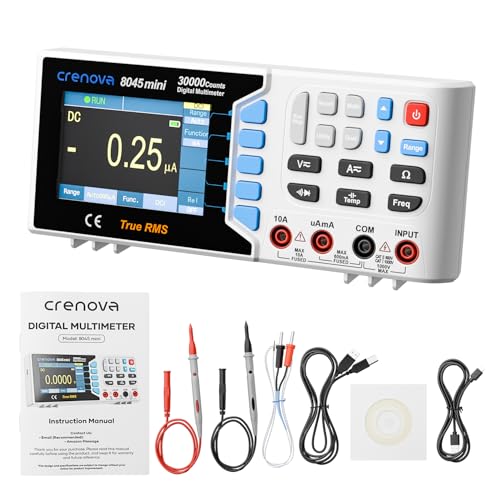
Crenova · Crenova 30000 Counts True RMS Digital Multimeter, Desktop Bench Multimeter | for Lab & Industrial Use. USB Data Logging, CAT II 600V. Measures Voltage, Current, Resistance, Capacitance, Temperature.
View on AmazonPrice and availability are shown on Amazon and can change at any time.
The Crenova 30000 counts meter is the right choice if you want high resolution and PC logging at a fixed workbench and can accept a CAT II 600V ceiling. It is the wrong choice if your work regularly takes you into fixed installation wiring or outdoor distribution panels where a higher category rating is expected. The listing publishes 30000 counts, True RMS, USB connectivity, a 5000mAh battery and CAT II 600V / CAT I 1000V safety ratings. It does not publish basic DC accuracy, which is the number that would let you judge whether the extra counts buy real precision or only a finer display.
The trade-off the design forces: bench resolution in a field-rated body
The Crenova is described as a desktop bench multimeter, and the listing supports that: a 3.5 inch LCD with 30000 counts, a 5000mAh rechargeable battery for up to 10 hours, USB for remote control and data logging, and a dual display. Those are bench-instrument behaviours. A meter that lives on a bench can be larger, can draw power from a battery without worrying about a replacement cell mid-shift, and can stream readings to a PC.
The same listing also markets the meter for field service and gives it a CAT II 600V rating. That is the tension. CAT II 600V covers portable equipment and appliances plugged into ordinary socket outlets. It does not cover the fixed installation upstream of the socket, and it does not cover outdoor distribution wiring. If your work is bench repair, appliance testing, low-voltage DC and electronics, the rating is adequate. If your work is panel wiring, distribution boards or anything you would normally reach for a higher-category meter to test, the listing’s own safety figure tells you to stop.
So the single decision is this: are you buying a high-resolution logging meter that stays near a socket, or are you buying a general-purpose field meter that happens to have a good screen? The Crenova is the first. Treat the CAT II 600V figure as the boundary of the product, not as a footnote.
What 30000 counts actually changes on the display
Counts describe how many distinct values the display can show across a range. A 30000 count meter resolves finer steps than a 6000 count meter on the same range, which is why bench work gravitates to higher counts. On a 30V range, for example, 30000 counts implies a display step of about 0.001V, whereas 6000 counts implies about 0.01V. That is a display-resolution statement, not an accuracy statement.
The listing does not publish a DC accuracy figure, a percent of reading plus counts specification, or a calibration interval. Without those numbers you cannot say that the extra resolution translates into extra truth. A high-count display with a loose accuracy specification shows you more digits of the same uncertainty. If your work needs to distinguish millivolt-level changes, ask the manufacturer for the accuracy table before you buy, because the listing bullets do not carry it.
What the listing does confirm is True RMS. On AC voltage and current, a True RMS meter responds to the heating equivalent of the waveform, so it reads correctly on distorted or non-sinusoidal loads where an averaging meter under-reads. If you are measuring the output of a dimmer, a variable-speed drive or a switched-mode supply, that matters. If you are checking a clean mains sine wave, it changes little. The site explains the mechanism in what True RMS means on a multimeter.
The functions list, and the measurement the bullets never name
The listing claims 11 measurement functions: AC and DC voltage, AC and DC current, resistance, capacitance, temperature, frequency, duty cycle, continuity and diode. It also lists Max, Min, Average, dBW and dBmW calculations and relative mode. That is a broad bench toolkit, and the dual display lets you see two quantities at once, for example a signal and its frequency.
The bullet that is missing is a current range. The listing says the meter measures AC and DC current but does not publish the maximum current, the shunt values or the fuse rating beyond saying there are two premium fuses. A bench meter with a 10A range and a bench meter with a 2A range are different tools for power-supply work. The listing is silent, so treat the current capability as unquantified until you have the manual.
The temperature function is listed without a probe type or a range. Many multimeters accept a K-type thermocouple, but this listing does not say so, and it does not state the temperature range or the included sensor. Do not assume a probe is in the box. The same caution applies to the USB cable and the software CD: the listing mentions both, and says the software can be downloaded if the laptop has no optical drive, but it does not confirm what is included in the package.
USB logging, the 5000mAh battery and the maintenance nobody mentions
USB connectivity is the feature that most clearly separates this meter from a handheld. The listing says you can connect to a PC for remote control, firmware updates and data management, and log, track, review and print measurements from the computer. For long-duration monitoring, for example watching a supply rail drift over an afternoon, that is a genuine workflow change: you set the meter, walk away, and read the trend on screen instead of writing numbers down.
The battery is rated at 5000mAh for up to 10 hours of continuous use. Capacity claims like this are usually measured with the backlight at a stated setting, and the listing does not say what that setting is. The adjustable backlight will shorten runtime when it is bright. For bench use, 10 hours is roughly a working day, so plan to charge it at the end of each day rather than treating it as a battery you check occasionally.
The maintenance point the listing does not address is calibration. A 30000 count meter is only as good as its calibration, and the listing publishes no calibration certificate, no recommended interval and no adjustment procedure. If you need traceable measurements, ask about calibration before purchase. The two fuses are described as premium and as protecting all ranges, but the listing does not publish their ratings or tell you how to check them. A blown current fuse is the most common reason a meter appears dead on one function, so keep the manual’s fuse specification to hand.
Where this meter stops being the right answer
The Crenova stops being the right answer at the CAT II 600V boundary. If you need to test inside a distribution board, on fixed wiring or on outdoor equipment, the listing’s own safety rating says this is not the instrument for that work. A higher-category meter is the correct purchase, and no amount of screen resolution compensates for an inadequate category rating.
It also stops being the right answer if you need a current clamp. The listing describes a multimeter with test leads, not a clamp meter. For measuring high AC or DC current without breaking the circuit, a clamp is the tool, and the site explains the difference in multimeter versus clamp meter. The Klein Tools CL910 is the clamp option already covered on the site if that is your need.
Finally, it stops being the right answer if you want a simple handheld for occasional socket checks. The 30000 count display, the USB port and the rechargeable battery are paid for in size and in the need to keep it charged. A basic handheld is easier to live with for that job. The site’s guide to choosing a digital multimeter sets out the categories in more detail.
The verdict: buy it for the bench, not for the board
The Crenova 30000 counts meter is a coherent bench instrument: high display resolution, True RMS, dual display, USB logging and a battery sized for a working day. The listing supports all of that. What it does not publish is the accuracy table, the current range, the temperature probe type or a calibration statement, and those gaps matter more than the function count. The single trade-off is the CAT II 600V rating: it is adequate for appliance and bench work and not adequate for fixed installation testing. If your work sits inside that boundary, the Crenova is a sensible buy. If it does not, choose a meter rated for the category you actually work in.
Recommended Tools


Products shown because their documented specifications fit this guide. Price and availability are on Amazon and can change.
Frequently Asked Questions
Is the Crenova 30000 counts meter safe for working inside a consumer unit?
The listing gives it a CAT II 600V rating and a CAT I 1000V rating. CAT II covers portable equipment plugged into a socket, not the fixed wiring behind the socket. For work inside a consumer unit or distribution board, the listing's own safety figure indicates a higher-category meter is the correct tool.
Does the box include a temperature probe and a USB cable?
The listing does not state what is included in the package. It lists temperature as a function and describes USB connectivity and a software CD, but it does not confirm a probe or a cable in the box. Check the package contents with the seller before ordering if either is essential.
What is the DC accuracy of this meter?
The listing does not publish a DC accuracy specification, a percent plus counts figure, or a calibration interval. The 30000 count display tells you the resolution, not the accuracy. Ask the manufacturer for the accuracy table if your work depends on it.
Can it measure current, and up to what value?
The listing says the meter measures AC and DC current and mentions two premium fuses, but it does not publish a maximum current or a range. The current capability is unquantified in the listing and should be confirmed from the manual before you rely on it.
How long does the battery really last?
The listing states a 5000mAh battery for up to 10 hours of continuous use. It does not state the backlight setting used for that figure. The backlight is adjustable, so a bright setting will reduce runtime. For bench work, plan to charge daily.
Does the USB connection work with modern laptops that have no CD drive?
The listing says the software can be installed from the provided CD or by downloading the latest version from the website listed in the manual, which covers laptops without an optical drive. It does not name the operating systems supported, so check that before purchase if you use an unusual platform.
Affiliate disclosure: Akermin earns a commission from qualifying Amazon purchases made through links on this page. Our editorial picks are based on documented specifications and owner feedback, not commissions.
Related Guides
Fluke FLUKE-369 FC Leakage Current Clamp Meter Review: What the Listing Leaves Out
A source-led review of the Fluke 369 FC that highlights the unpublished specifications and their practical consequences.
Read More→
HiLetgo LCR-T4 Component Tester Review: The First Hour
A first-hour review of the HiLetgo LCR-T4 kit, covering what it measures, what the listing leaves out, and when a different instrument is the better answer.
Read More→
Klein Tools CL900 Clamp Meter Review: What the Listing Leaves Out
A specification-by-specification review of the Klein Tools CL900 that flags every gap in the published listing.
Read More→