As an Amazon Associate, Akermin earns from qualifying purchases. Product links on this page are affiliate links.
For combustible gas, no: a bedroom does not need a gas leak detector unless the bedroom itself contains a gas appliance, such as a wall furnace, a gas fireplace or a vented gas space heater, or unless the bedroom and the kitchen are the same room, as in a studio. A combustible gas alarm has to be in the room where the leak starts, because natural gas piles up under that room’s ceiling and propane pools on that room’s floor long before either travels down a hallway. What every sleeping area does need is a carbon monoxide alarm, which follows a different rule: outside each sleeping area and on every level of the home.
Why a Bedroom Gas Alarm Gives False Comfort
A gas alarm reports gas that physically reaches its sensor. A leak at a range connector fills the kitchen first; a leak at a furnace union fills the mechanical room first. By the time enough gas has drifted through doorways and up a stairwell to trip a sensor in a bedroom, the room with the appliance may already be well past its own alarm point and into the ignitable range. So a bedroom alarm is not an early warning; it is a late one. The device that gives you warning while you sleep is a loud alarm in the appliance room, not a quiet one on the nightstand. The reasoning is the same one used in counting how many gas detectors a home needs: rooms with gas, not rooms with people.
Carbon Monoxide Follows the Opposite Logic
Carbon monoxide comes from incomplete combustion, has no smell, and mixes with room air rather than layering high or low. It drifts through a house on ordinary air movement and is dangerous at concentrations that give no warning to a sleeping person. That is why CO alarm guidance puts the alarm near the people: outside every separate sleeping area and on each level. A CO alarm’s electrochemical sensor does not respond to methane or propane, so it is not a substitute for a gas alarm elsewhere; does a CO detector detect natural gas explains why the two cannot stand in for each other. In the bedroom hallway, the CO alarm is the one that matters.
Bedrooms That Do Need a Combustible Gas Alarm
| Bedroom situation | Combustible gas alarm | CO alarm |
|---|---|---|
| Ordinary bedroom, gas appliances elsewhere in the house | No; put it in the kitchen or utility room | Yes, outside the sleeping area |
| Bedroom with a gas wall furnace or space heater | Yes, in the room, high or low by fuel, offset from the heater | Yes, at the distance from the heater its instructions require |
| Bedroom with a gas fireplace or log set | Yes, in the room; see the fireplace guide below | Yes |
| Studio apartment where the range shares the room | Yes, placed for the range, not the bed | Yes |
| Basement bedroom next to an open furnace area | In the furnace area; add one in the bedroom only if the space is open to it | Yes, in or just outside the bedroom |
| Bedroom directly above a garage or mechanical room | No; the alarm goes in the garage or mechanical room | Yes |
| RV or camper where the bed is feet from the LP range | Yes, the low-mounted LP alarm covers the whole cabin | Yes, often combined in one 12-volt unit |
The gas fireplace case has its own wrinkles, covered in gas leak detectors for a gas fireplace. For a bedroom heater, the placement rules are the same as any natural gas room: within about 12 inches of the ceiling, away from the heater’s warm plume, the window and the door, as laid out in where to place a natural gas detector.
Making Sure You Hear the Alarm From Bed
The real bedroom problem is audibility, not placement. A few practical points:
- Choose an alarm with a stated sound level for the appliance room. The Kidde plug-in combination units list an 85 decibel alarm; plug-in ppm monitors from smaller brands often state a level on the listing, and where they do not, treat that as unknown.
- Leave the bedroom door open at night if the house layout allows it, or accept that a closed solid-core door will cost you some volume.
- In a large or multi-story house, an interconnected hardwired system that sounds every unit when one trips is the reliable way to hear a basement alarm upstairs. Most plug-in consumer gas alarms are standalone.
- Do not solve the problem by relocating the only gas alarm to the bedroom. Buy a second one if needed.
What to Put in the Bedroom Instead
A carbon monoxide alarm outside the door, and, if you want a display, one that shows the CO reading in ppm. A combination explosive gas and CO plug-in such as the Kidde COPDLG is a reasonable choice for a hallway outlet outside the bedrooms: the manufacturer describes a low-level CO alert starting at 30 to 70 ppm with a distinct pattern, a separate pattern at 70 ppm, and an 85 decibel alarm, plus a GAS indication if explosive gas ever reaches it. Its gas function is a bonus in that spot, not the reason to buy it. The models built for the kitchen and utility room are compared in the natural gas detector roundup and the broader gas leak detector guide. If you are still weighing whether a gas alarm belongs in the house at all, are gas leak detectors worth it sets out the cases.
If an Alarm Wakes You
Treat a gas alarm or a gas smell at night exactly as you would by day: get everyone up and out, do not turn on lights or use a phone until you are outside, and call the gas utility or 911 from the yard or a neighbor’s house. An alarm buys you the warning; it does not change the drill.
Recommended Tools

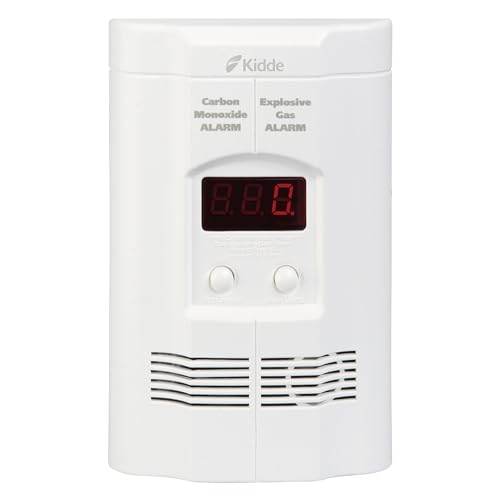

Products shown because their documented specifications fit this guide. Price and availability are on Amazon and can change.
Frequently Asked Questions
Will I hear a kitchen gas alarm from the bedroom?
Usually, if the door is open and the house is small. Plug-in combination alarms such as the Kidde models are listed at 85 decibels, which carries through a typical single-level home. Across two closed doors and a floor it can be muffled. If hearing it from bed matters, choose a loud model for the appliance room or an interconnected hardwired system, rather than moving the alarm into the bedroom.
Can I put a plug-in gas and CO combination alarm in the bedroom?
Yes, and it makes sense as carbon monoxide coverage near a sleeping area. Understand that the gas half of the unit will only respond to gas that reaches the bedroom, which in a house with the range and furnace elsewhere means the leak is already large. Follow the CO placement instructions for that unit; they govern.
My bedroom has a gas wall heater. Where does the alarm go?
In that room, on a wall to the side of the heater rather than above it. Mount within about 12 inches of the ceiling for natural gas or within about 12 inches of the floor for propane, and keep it away from the window, the door and the warm air rising off the heater. A CO alarm belongs in the room too, placed at the distance from the heater its instructions specify.
Is a gas detector in a nursery a good idea?
A carbon monoxide alarm near the nursery is a good idea and widely recommended. A combustible gas alarm is only useful there if a gas appliance is in the room. Otherwise the alarm that protects the nursery is the one in the kitchen or furnace room, where a leak would begin.
Affiliate disclosure: Akermin earns a commission from qualifying Amazon purchases made through links on this page. Our editorial picks are based on documented specifications and owner feedback, not commissions.