As an Amazon Associate, Akermin earns from qualifying purchases. Product links on this page are affiliate links.
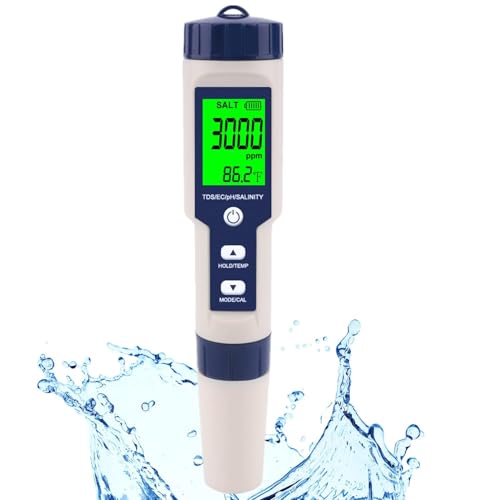
Hofun · Pool Salt Tester & PH Meter, Hofun Digital Salinity Meter and PH Tester for Aquarium and Pool Saltwater Water, 5 in 1 Salinity PH Temp EC and TDS Meter, Aquarium Swimming Pool Hot Tub, Multiparameter
View on AmazonPrice and availability are shown on Amazon and can change at any time.
The Hofun Pool Salt is a single pen that reads salinity, TDS, EC, pH and temperature, and the listing gives salinity as 0-9999 ppm, 10-200 ppt and 0.01-25 percent by mode, with TDS at 0-9999 ppm and 0-200 ppt. It suits someone who tests a salt pool or marine tank casually and wants one body in the kit. It does not suit anyone who needs a calibration certificate, a replaceable probe or a stated accuracy figure, because the listing publishes none of those. The titanium alloy probe is the part that decides whether the pen lasts, and the listing does not say what it costs to keep it working.
The probe is the consumable, and the listing does not price it
The only hardware detail the Hofun Pool Salt publishes is a titanium alloy probe. That is the part in contact with pool water, saltwater, spa water and food, and it is the part that decides whether the pen still reads correctly after a season. The listing does not say whether the probe is replaceable, whether a replacement is sold, or what a replacement involves. It does not publish a storage solution, a calibration schedule or reference buffers. Those are the recurring costs of any pH pen, and here they are absent from the copy.
This matters because pH and salinity fail in different ways. A pH electrode drifts as its glass or reference junction ages, and it needs calibration against known buffers to stay honest. A conductivity cell, which is what produces the salinity, TDS and EC numbers, fouls with scale and oil and needs cleaning. Neither failure announces itself. The pen keeps displaying a number. The listing’s claim of accurate and quick measurement is a claim about a new probe, not about a probe in its second season.
Buyers should read the five-in-one design as five reasons to send one body back for service, not five independent instruments. If the pH side drifts, the salinity side goes with it into the drawer. The listing does not publish a warranty period, a service path or a spare probe, so the practical position is that you replace the pen rather than the probe until the manufacturer says otherwise.
Salinity in three units, and the automatic switch at 9999 ppm
The listing gives salinity in ppm, ppt and percent, and it explains the switch itself: when the ppm figure passes 9999 ppm the meter changes to ppt, with 1 ppt equal to 1000 ppm. The published windows are 0-9999 ppm for pool salt testing, 10-200 ppt for seawater and 0.01-25 percent for food. Those are three different jobs sharing one mode button, and the unit you land in depends on the sample, not on a setting you choose in advance.
For a salt pool the useful window is the ppm one, because pool salt is discussed in ppm. For a marine tank the ppt window is the working one, because seawater is discussed in ppt. The listing does not publish an accuracy figure for any of the three, and it does not say how long the reading takes to settle. A number that appears quickly is not the same as a number that has stabilised, and the listing conflates the two in its wording.
The percent mode is labelled for food, which is a different sample matrix from pool water. The listing does not publish a calibration method for that mode or say whether the same probe is used. Treat the food range as a stated capability, not a tested one. For pool and aquarium work, the ppm and ppt windows are the ones the listing actually describes in detail.
Five functions, one mode button, and no stated accuracy
The pen combines salinity, TDS, EC, pH and temperature. The listing gives TDS as 0-9999 ppm and 0-200 ppt, and it gives no range at all for pH, EC or temperature. That is the largest omission on the page. pH is the measurement most pool and aquarium owners care about, and the listing does not publish its window, its resolution or its accuracy. A pH pen without a stated accuracy is a trend indicator, not a compliance instrument.
The operation described is simple: turn the meter on and press MODE to move between functions. That is adequate for a homeowner checking a hot tub. It is not adequate for anybody recording readings for a log, because the listing does not publish a hold function, a stability indicator or an auto-off time. Whether the pen holds a reading while you move it from the sample to the notebook is not stated.
Temperature is listed as a function but not as a specification. Many conductivity readings are temperature-compensated, and the listing does not say whether this pen compensates, or to what reference temperature. If it does not, the salinity and TDS numbers move with water temperature and the user has to correct by hand. The listing does not answer this, so the safe reading is that the temperature channel is a display, not a documented compensation system.
Where a five-in-one pen stops being the right tool
A pen of this shape is right for spot checks: a pool owner confirming salt after a top-up, a marine keeper checking a new mix, a hot tub owner comparing pH before and after a dose. It is wrong for anything that needs a record. The listing publishes no logging, no memory and no output, so the pen cannot feed a monitoring routine. If you need readings over time, an environmental data logger for building monitoring is the class of instrument that stores them, and a pen is not.
It is also wrong where a certificate matters. The listing publishes no calibration certificate and no stated accuracy, so it cannot stand in for a verified measurement in a commercial pool log or a regulatory check. The same logic applies to any instrument bought for evidence rather than curiosity: the published specification is what you can defend, and here the published specification is thin.
For readers comparing instrument classes rather than pens, the broader question of how to match a meter to a job is set out in how to choose an environmental meter. The short version is that a multi-function pen trades depth for convenience, and the trade is only worth making when the missing depth is depth you do not need.
What the listing publishes, and what it leaves to the buyer
| Item | Published in the Hofun Pool Salt listing |
|---|---|
| Functions | Salinity, TDS, EC, pH, temperature |
| Salinity ranges | 0-9999 ppm; 10-200 ppt; 0.01-25 percent |
| TDS ranges | 0-9999 ppm; 0-200 ppt |
| pH range | Not stated in the listing bullets |
| EC range | Not stated in the listing bullets |
| Temperature range | Not stated in the listing bullets |
| Accuracy | Not stated in the listing bullets |
| Resolution | Not stated in the listing bullets |
| Probe material | Titanium alloy |
| Replaceable probe | Not stated in the listing bullets |
| Calibration buffers | Not stated in the listing bullets |
| Calibration certificate | Not stated in the listing bullets |
The table is the review in one view. The pen’s advertised breadth is real in the sense that the modes exist. The depth that would let a buyer plan maintenance, defend a reading or budget for a replacement is absent. Read the listing as a description of a new pen, and budget for the fact that the probe is the part that ages.
The verdict on the Hofun Pool Salt: buy it for spot checks, not for records
The Hofun Pool Salt is a reasonable single-body pen for a salt pool, a hot tub or a marine tank where the owner wants a quick number and does not need to file it. The salinity and TDS ranges are published and broad, and the unit switching is explained. The pH, EC and temperature ranges are not published, no accuracy figure is given, and the listing is silent on whether the probe can be replaced or calibrated. That silence is the deciding factor. If you need a reading you can defend or a pen you can maintain, this listing does not give you enough to commit. If you need a second opinion on a pool or tank and accept that the pen is a consumable, it does the job the listing describes.
Recommended Tools


Products shown because their documented specifications fit this guide. Price and availability are on Amazon and can change.
Frequently Asked Questions
Does the Hofun pen measure pH accurately enough for a pool?
The listing does not publish a pH range, resolution or accuracy, so there is no figure to judge. A pH pen without a stated accuracy is a trend indicator. For a residential pool that is often enough; for a commercial log it is not.
Can I replace the probe when it wears out?
Not stated in the listing bullets. The listing names a titanium alloy probe but does not say whether it is replaceable or sold separately. Until the manufacturer publishes that, treat the pen as a sealed unit.
What is the difference between the ppm, ppt and percent salinity modes?
They are the same measurement in different units. The listing gives 0-9999 ppm for pool salt, 10-200 ppt for seawater and 0.01-25 percent for food, and it states that the meter switches from ppm to ppt automatically above 9999 ppm, with 1 ppt equal to 1000 ppm.
Does the pen compensate for temperature?
The listing includes temperature as a function but does not state whether salinity, TDS or EC readings are temperature-compensated, or to what reference. Without that, readings taken at different water temperatures are not directly comparable.
Does it come with calibration solution or a certificate?
The listing does not publish calibration buffers or a calibration certificate. Any pH or conductivity pen needs periodic calibration to stay honest, so the buffers are an additional purchase the listing does not mention.
Can I use it for drinking water and hydroponics as the listing says?
The listing names drinking water, RO/DI, aquarium, spa, hot tub and hydroponics as applications. It does not publish separate ranges or calibration for those uses, so the same caveat applies: the pen reports a number, and the listing does not say how accurate that number is.
Affiliate disclosure: Akermin earns a commission from qualifying Amazon purchases made through links on this page. Our editorial picks are based on documented specifications and owner feedback, not commissions.