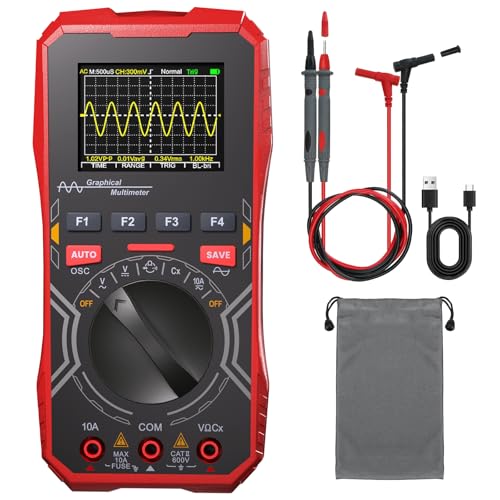
Best Automotive Multimeters: 4 Reliable Picks for Faster Vehicle Diagnostics
Vehicle electrical work is low voltage, high current, mostly DC and almost never stationary, which rules out most of what gets sold as a multimeter. This page keeps only the instruments that can leave a bench, and explains why eight of the twelve listings gathered for this topic were removed rather than padded into the table.
Independent Research
Verified Specifications
Honest Recommendations
Millivolts Matter
Watch the Waveform
Find the Draw
As an Amazon Associate, Akermin earns from qualifying purchases. Product links on this page are affiliate links.
Our Top Picks
Only instruments that can be carried to a vehicle were kept. They were compared on the measurement functions each listing names, display resolution in counts where stated, oscilloscope bandwidth and sampling rate where present, and how directly the tool addresses an automotive fault. Figures are the manufacturers' own and unpublished values read Not stated.
Figures are the manufacturers' own. None of the four publishes a CAT safety rating, an accuracy figure or a dedicated automotive function such as duty cycle, dwell or RPM, which is discussed in the text below. Unpublished values read Not stated. Nothing here is a measurement of ours.
How to Choose an Automotive Multimeter
Vehicle work has its own requirements:
Millivolt Resolution
Voltage drop testing is the core automotive measurement and a good connection drops tens of millivolts. A meter that displays 12.4 volts and nothing finer cannot find a corroded earth.
A Waveform, Not Just a Number
Crank sensors, injectors, coils and bus lines are patterns rather than values. Three of the four instruments here include a scope because a number alone cannot diagnose them.
Current Without Breaking In
Series current measurement wakes every module on a modern vehicle. A dedicated draw tester or a DC clamp avoids restarting the sleep cycle every time you touch something.
It Has to Leave the Bench
Five of the twelve listings gathered for this page were mains-powered laboratory instruments. A vehicle meter must be battery powered, one-hand operable and survive being dropped on concrete.
Why does this page list four when the heading promised nine?
Because eight of the twelve listings gathered for this topic cannot be used on a vehicle. Four are mains-powered 6.5 digit benchtop multimeters designed to sit on a laboratory bench. One is a shunt-based battery monitor that is installed permanently rather than carried. One is an LCR meter that measures inductance and capacitance but neither voltage nor current. One is a Rogowski coil clamp with a 300 mm loop rated to 10,000 amps, built for busbars and switchgear. One is an oscilloscope with no multimeter function stated at all. Listing any of them under automotive multimeters would have been padding.
What automotive measurement matters most?
Voltage drop across a connection, and it is the one that catches out anyone used to household electrics. A vehicle runs at roughly twelve volts and draws hundreds of amps through a starter circuit, so a connection with a fraction of an ohm of resistance produces a drop that cripples the circuit while still showing twelve volts at rest. The test is made under load, across each joint in turn, and a good connection drops tens of millivolts. That needs a meter with millivolt resolution, not a three digit display.
Do I need an oscilloscope for car work?
For anything involving a sensor, an actuator or a data bus, yes. A crank position sensor produces a repeating pattern whose missing tooth is the reference the engine management uses, and a meter shows only an average. An injector or coil driver produces a switched waveform whose shape reveals a failing output stage. A CAN bus carries differential pulses that a meter reads as a meaningless average. Three of the four instruments here include a scope for exactly that reason.
How do I measure parasitic draw without waking the car?
Either with a dedicated tester that stays connected while fuses are pulled, or with a DC clamp around the battery lead so nothing is disconnected at all. The failure mode with a conventional meter in series is that reconnecting anything wakes every module, after which the current is high and meaningless until the vehicle goes back to sleep, which can take a long time. A tool built for the procedure removes that cycle from the job.
Is a CAT rating relevant on a twelve volt system?
Less so than on mains, because the energy available at a low voltage DC system is a different kind of hazard, but it stops being irrelevant the moment you work on a hybrid or an electric vehicle, where traction systems run at hundreds of volts DC. None of the four listings here states a CAT rating or a maximum input voltage. On a conventional twelve volt vehicle that is an acceptable gap. On anything with a high voltage traction battery, do not use an unrated instrument at all.
Reviews
ZOTEK 702S Handheld Automotive Oscilloscope Multimeter Best Overall
Vehicle electrical faults divide neatly into the ones a number finds and the ones only a waveform finds, and the second group has grown every year since engine management became digital. A crank or cam sensor produces a pattern rather than a voltage. A CAN bus carries differential pulses. An injector, an ignition coil and a throttle actuator are all driven by switched signals whose shape tells you whether the driver stage is healthy. A meter reading 6.2 volts on any of those has told you almost nothing.
The ZOTEK 702S is the only instrument in this group whose own listing describes it as automotive, and the specification fits. Single-shot triggering is the function that catches an intermittent, arming the instrument to capture a one-off event while you crank or wiggle a connector. A plus and minus 400 volt input range covers ignition primary waveforms, which is where cheaper scope inputs give up. Vertical sensitivity down to 200 millivolts per division resolves small sensor signals.
The listing does not state the multimeter counts, the accuracy, the input protection or a CAT rating, and 10 MHz is modest bandwidth by bench standards, though far more than any automotive signal requires. It is a diagnostic instrument, not a certification one.
Strengths
Automotive use stated on the listing rather than inferred
Single-shot trigger catches intermittent faults
Plus and minus 400 V input covers ignition primary work
Parasitic Battery Drain Tester with Voltage Display Best for Parasitic Draw
Parasitic draw is the fault where a general purpose multimeter is genuinely the wrong tool, and the reason is procedural rather than electrical. Measuring current with a meter means putting it in series, which means disconnecting the battery terminal. On a modern vehicle that wakes every module the moment the circuit is reconnected, so the first several minutes of readings are meaningless while the systems go back to sleep. Worse, if you pull a fuse with the meter in circuit, some meters open momentarily and the whole sleep cycle restarts.
This tester is built around that problem. It clamps onto the terminals, reads the dark current after the systems have gone to sleep, and is designed so fuses can be removed one at a time while the measurement continues; the circuit whose fuse drops the reading is the one drawing the current. That is the entire diagnostic procedure, and it is a genuinely faster way to run it than a meter and a set of jumper leads.
The trade is that it does nothing else. There is no resistance range, no continuity beeper, no waveform, no temperature. The listing states no measurement range, no resolution and no accuracy figure. Buy it as a second tool for one job rather than as a multimeter.
Strengths
Built around the actual parasitic draw procedure
Fuse pulling does not interrupt the measurement
Voltage display alongside the current reading
Cheapest way to solve a recurring flat battery complaint
Limitations
Single purpose, with no resistance, continuity or waveform functions
No measurement range, resolution or accuracy stated
IMARS 2-in-1 Handheld Oscilloscope Multimeter Best Value
One megahertz sounds unimpressive next to bench oscilloscopes and is entirely adequate for vehicle work. Automotive signals are slow: a crank sensor pattern, an injector drive pulse, a throttle position sweep, a CAN frame and an alternator ripple trace all sit comfortably below a megahertz. What actually limits automotive scope work is triggering, channel count and screen size, not bandwidth, and buying more megahertz than the signal needs adds cost without adding diagnosis.
The IMARS unit combines that scope with an auto-ranging multimeter in one compact body. Auto-ranging is more useful in a workshop than it sounds: with one hand holding a probe on a terminal and the other steadying yourself against a wing, turning a range dial is a two-hand operation you do not have hands for.
Single channel is the real limitation. Many automotive diagnoses are comparative, looking at a sensor signal against the ignition trigger or one injector against another, and that needs two traces. The listing also states no counts, no accuracy, no input protection and no CAT rating. Treat it as an inexpensive way to add waveform capability rather than as a complete diagnostic instrument.
Strengths
1 MHz is ample for every common automotive signal
Auto-ranging suits one-handed work in an engine bay
Compact and cheap enough to justify as a second tool
Adds waveform capability at close to meter-only prices
Limitations
Single channel, so comparative measurements are not possible
Counts, accuracy and CAT rating not stated
No dedicated automotive functions such as duty cycle or RPM stated
Short answer: the ZOTEK 702S is the pick for general vehicle diagnostics because it is the only instrument here whose listing names automotive use, and its single-shot trigger and plus or minus 400 volt input suit intermittent and ignition work; the parasitic battery drain tester is the tool to add for the recurring flat battery complaint, because it reads dark current while fuses are pulled; and the IMARS 2-in-1 is the value way to get a waveform in your hand for close to the price of a meter alone.
Why this page lists four and not nine
This is the biggest reduction on any page in this batch, and it needs explaining rather than glossing. Twelve listings were supplied for this topic and eight of them cannot be used on a vehicle. Four are 6.5 digit benchtop multimeters, from UNI-T, Siglent twice and Hantek, and every one of them is a mains-powered laboratory instrument designed to sit on a bench and be connected to by leads. One is a shunt-based battery monitor, installed permanently into a system rather than carried between jobs. One is an LCR meter measuring inductance, capacitance and resistance but neither voltage nor current. One is a flexible Rogowski coil clamp with a 300 millimetre loop rated to 10,000 amps for busbars and switchgear, and its current function reads alternating current only, which is of no use whatever on a DC vehicle system. One is a handheld oscilloscope with no multimeter function stated anywhere on its listing. Four instruments survive, and each of them earns its place.
What makes automotive different
Three things, and together they eliminate most of what is sold as a multimeter. The first is voltage: a vehicle runs at roughly twelve volts and diagnoses at millivolts, because the measurement that finds bad connections is voltage drop and a healthy joint drops tens of millivolts under load. A display that shows 12.4 and nothing finer cannot do that work. The second is current: a starter circuit pulls hundreds of amps and a parasitic draw is tens of milliamps, a range of five orders of magnitude that no single series measurement handles comfortably. The third is that almost nothing on a modern vehicle is a steady value. Sensors produce patterns, actuators are driven by switched waveforms and modules talk over a bus, so an averaged number often describes nothing real. How to choose a multimeter for automotive diagnostics covers the requirements in more depth.
Voltage drop is the measurement that finds faults
Most electrical complaints on a vehicle are resistance in a connection rather than a component failure, and resistance in a connection is invisible at rest. A corroded earth strap, a green battery terminal, a chafed loom or a spread connector pin all read twelve volts with nothing flowing and collapse the moment current is drawn. The test is made under load, with the probes across each joint rather than from the joint to ground, and the reading is in millivolts. That is why display resolution matters more on a vehicle than absolute accuracy: you are looking for a difference between one connection and another, not certifying a number. Of these four, only the OWON publishes a resolution figure, at 20000 counts, which comfortably resolves single millivolts on a low range.
Why three of four carry an oscilloscope
Because the faults that remain after the obvious ones have been fixed are all signal shape problems. A crankshaft position sensor generates a repeating waveform with a deliberate missing tooth that the engine management uses as a reference, and a meter reading its average voltage is measuring nothing useful. An injector driver switches a coil and then handles the collapse of its magnetic field, and a failing output stage shows in the shape of that collapse long before it shows in any voltage. An ignition primary waveform reaches hundreds of volts, which is why the ZOTEK listing stating a plus and minus 400 volt input matters. A CAN bus carries differential pulses on two wires, and a meter reads a plausible average on a completely dead network. Bandwidth is not the constraint here; automotive signals are slow, and the 1 MHz on the IMARS is sufficient for all of them. Triggering and channel count are what limit real work, which is why the ZOTEK single-shot trigger and the OWON second channel are the features worth paying for.
The parasitic draw problem
A car that goes flat over a weekend is the single most common electrical complaint, and it is also the diagnosis where a general multimeter performs worst. Measuring the draw means putting an ammeter in series with the battery, which means disconnecting the terminal. On any vehicle built in the last twenty years, reconnecting anything wakes every module on the bus, and the current stays high and meaningless until the systems go back to sleep, which can take a great deal longer than most people expect. Then, when you pull a fuse to isolate the circuit, some meters break the circuit momentarily and the entire sleep cycle starts again. The dedicated tester here is built around that reality: it clamps to the terminals, reads dark current once the vehicle has settled, and stays connected while fuses come out one at a time until the reading drops. That is the whole procedure, and it is covered in how to measure parasitic battery drain.
What none of these four publishes
Two whole-category omissions are worth stating plainly rather than leaving as Not stated cells. First, none of these four listings states a CAT safety rating or a maximum input voltage. On a conventional twelve volt vehicle that is a tolerable gap, because the hazard profile is different from mains distribution work. On a hybrid or electric vehicle, where traction systems run at hundreds of volts DC and can deliver enormous current, it is not tolerable at all, and an unrated instrument should not be used on those systems under any circumstances. Second, none of them states the dedicated automotive functions that purpose-built vehicle meters usually carry: duty cycle, dwell angle, RPM from an ignition pickup, or a diode and temperature range specified for engine bay use. These are general instruments applied to vehicle work rather than instruments designed for it, and that is a fair description of what this listing pool contains.
How the four fit together
They are not four alternatives so much as two pairs. The ZOTEK 702S and the OWON HDS242 are the general diagnostic instruments, and the choice between them comes down to channels against automotive focus: the OWON gives two channels and a published 20000 counts, which allows comparative traces and finer voltage resolution, while the ZOTEK gives single-shot triggering, a higher input range and a listing that was written with vehicles in mind. The IMARS is the same idea at a lower price with one channel and less bandwidth, which is enough for most signals and not enough for comparison. The parasitic drain tester is not an alternative to any of them; it is a second tool bought for one recurring job that a general meter handles badly. A sensible workshop kit is one scope meter plus the draw tester.
Only instruments that can be carried to a vehicle and operated on battery power were considered. They were compared on the measurement functions each listing names, display resolution where stated, oscilloscope bandwidth, sampling rate and channel count where present, triggering options, and how directly the tool addresses a recognised automotive diagnostic procedure. Eight products supplied with this group were excluded as off-category and the reasons are given on the page. We ran no laboratory tests and publish no measurements of our own.
A voltage range describes what an instrument will read, a measurement category describes where it may be connected, and a listing that gives one without the other leaves the safety question unanswered.
A meter fuse protects the current input path and its interrupting capacity has to match the fault energy the category implies, but the category itself comes from clearances and input protection rather than from the fuse.
Exceeding a measurement category usually ends in a flashover across internal clearances rather than a blown display, and the most common outcome is an instrument that still reads correctly with its safety margin gone.