Best Budget Multimeters: 10 High-Value Picks That Deliver Accurate Results
Value in a multimeter is not the lowest number on a shelf, it is how many stated functions arrive in one instrument you can trust. This page compares ten meters on the counts, ranges, bandwidth and accuracy their own listings publish, and it names the three products from the research list that were removed because they are not multimeters at all. We publish no prices and no measurements of our own.
As an Amazon Associate, Akermin earns from qualifying purchases. Product links on this page are affiliate links.
Our Top Picks
Every figure below comes from the manufacturer listing for that product. Where a listing publishes nothing for a specification the entry reads Not stated. Nothing here is a measurement of ours, and because affiliate prices move constantly we publish no prices on any page.
Best Overall
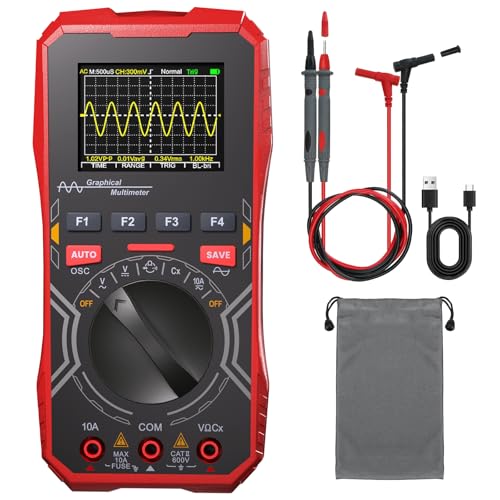
OWON HDS242 Handheld Oscilloscope Multimeter
A 20000 count meter and a 40 MHz scope sharing one battery and one screen.
20000 count digital multimeter stated on the listing
40 MHz handheld oscilloscope stated, two in one
Listing names AC and DC voltage, current and resistance
Listing notes that no standalone lithium batteries ship with the product
Counts, digits, bandwidth and accuracy are quoted from the manufacturer listing for each product at the time of research. Blank specifications are shown as Not stated rather than estimated. No prices appear on this page because affiliate pricing changes without notice.
How to Choose a Value Multimeter
Four questions decide it, and none of them is the price:
Counts Before Features
Counts set the resolution you can actually read. The OWON states 20000 and the FNIRSI 19999, against the 6000 that is normal at this level. Four of the ten state 6.5 digits, which is a bench class figure.
Category Rating
Only the ETCR listing states a working voltage at all, and none of the ten states a CAT rating. Without one, treat the meter as a low energy instrument for appliances and electronics, not for a distribution panel.
Number or Waveform
Four of the ten are scope meters. If the fault is intermittent, noisy or a signal rather than a supply, the waveform answers it and a number will not.
Handheld or Bench
The four 6.5 digit units are mains tied bench instruments for calibration and repeatable readings. They are on this page because they are multimeters, not because they are pocket tools.
Counts are the highest number the display can show before it changes range. A 6000 count meter reads up to 5.999 on a low range, a 20000 count meter up to 19.999 and a 6.5 digit bench unit up to 1,999,999. More counts means finer resolution, which is not the same thing as better accuracy. Accuracy is a separate figure, and only the UNI-T listing publishes one here, at 0.0035 percent.
Is a cheap multimeter safe for household wiring?
Only if the manufacturer states a safety category that covers the work. None of the ten listings on this page states a CAT rating. That absence is the reason we treat every one of them as an electronics and appliance instrument rather than a panel instrument. A meter used above its rating can fail violently even when the voltage on screen looks harmless.
Do I need an oscilloscope function?
You need it when the fault is about the shape of a signal rather than its level. Sensor outputs, PWM drives, switching supply ripple and communication lines all read as a plausible average on a meter while being completely broken on a trace. For replacing fuses, checking continuity and reading supply voltages, a plain meter is enough.
Why are benchtop meters on a budget list?
Because they are multimeters, and the research list for this page contained four of them. They are not budget instruments and we do not pretend otherwise. They appear as table rows with their stated digits so the comparison is complete, while the three full reviews go to handheld tools a value buyer would actually be choosing between.
Why are there no prices on this page?
Affiliate pricing changes daily and a published price is wrong within a week. Every claim here is instead anchored to a specification the manufacturer publishes, which does not move. Check the current price on the retailer listing itself.
Reviews
OWON HDS242 Handheld Oscilloscope Multimeter Best Overall
The reason this sits at the top of a value list has nothing to do with being cheap. A 20000 count multimeter resolves five useful digits, which is roughly three times the resolution of the 6000 count meters that dominate the entry level, and OWON states that figure plainly. The same instrument states a 40 MHz oscilloscope. Buying those two capabilities as separate tools costs far more shelf space and one more thing to charge.
The scope half is what changes the work. A multimeter reports a number, and a number cannot tell you that a supply rail is ringing, that a sensor output is noisy or that a PWM signal has collapsed into a flat line. The waveform shows all three in one glance. For anyone diagnosing electronics rather than replacing fuses, that is the difference between guessing and knowing.
What the listing does not publish is a safety category, an accuracy percentage, an input voltage limit or a battery capacity, and it carries an explicit note that no standalone lithium batteries are sold with the product. Treat the absence of a stated CAT rating as a hard boundary: without one, this belongs on a bench and on low energy circuits, not on a distribution panel.
Strengths
20000 counts stated, unusual at this level
40 MHz scope and a meter in one instrument
AC and DC voltage, current and resistance all named on the listing
ZOTEK 702S Handheld Automotive Oscilloscope Multimeter Best for Vehicle Work
Vehicle electrical faults are signal faults far more often than they are voltage faults. A crank sensor that drops one tooth per revolution, an injector driver that never pulls low, a CAN line dragged down by one corroded module: none of those show up as a wrong number on a meter, and all of them are obvious on a trace. ZOTEK states 10 MHz of bandwidth and 48 MS/s of sampling, which is far more than automotive signal speeds require, plus Auto, Normal and Single trigger modes so a one time event can be caught and held.
The stated plus or minus 400 V input and the 200 mV to 10 V per division vertical range cover the useful automotive span, from a millivolt level sensor output up to the inductive spike on an injector or coil. The 2.8 inch IPS colour screen is a real advantage under a bonnet, where a grey segment display becomes unreadable in daylight.
The listing publishes no count figure for the multimeter half, no accuracy specification and no safety category, and the manufacturer is not a name with a long test equipment record. Buy it as a scope that also reads volts rather than as a precision meter, and keep it away from mains distribution work.
Strengths
Bandwidth and sampling rate both stated
Trigger modes stated, so intermittent events can be captured
IMARS 2-in-1 Handheld Oscilloscope Multimeter Best Value
This is the entry point to waveform work. IMARS states a single channel oscilloscope at 1 MHz and an auto-ranging multimeter in the same handheld body, and describes the combination as a way to simplify circuit debugging. One megahertz will not follow a fast digital bus, but it comfortably covers mains harmonics, PWM fan and dimmer signals, low speed sensor outputs and switching supply ripple, which is most of what a general repair job throws at you.
Auto-ranging matters more than people expect on a first meter. The commonest beginner error is leaving the instrument on a range that is wrong for the measurement and reading a number that looks plausible. An auto-ranging meter removes the error by removing the choice.
The listing gives no counts, no accuracy, no input voltage limit, no sample rate and no safety category. That is a lot of silence, and it sets the honest use case: learning, hobby electronics, low voltage repair and appliance work. It is not an instrument for a panel, and nothing on the listing suggests otherwise.
Strengths
Auto-ranging removes the commonest beginner mistake
Short answer: the OWON HDS242 is the best value buy overall, because its listing states 20000 counts and a 40 MHz oscilloscope in one handheld body; the ZOTEK 702S is the one to pick for vehicle work, with stated 10 MHz bandwidth, 48 MS/s sampling and three trigger modes on a colour IPS screen; and the IMARS 2-in-1 is the lowest barrier entry, auto-ranging so there is no range dial to get wrong. None of the ten listings states a safety category, so treat all of them as electronics and appliance instruments rather than panel instruments.
Three listings were removed, and the count still comes to ten
The research list for this page held thirteen products. Three of them are not multimeters and were removed rather than used to fill the table. The first is a shunt fed battery monitor that is described as a nine in one digital LCD multimeter but is in fact a panel instrument wired permanently into a battery bank, which is a monitoring device and not a handheld meter. The second is a parasitic battery drain tester, a single purpose automotive tool that clamps to the terminals and watches dark current. The third is a handheld oscilloscope whose listing describes scope modes, refresh rate, channels and bandwidth and never states a multimeter function at all. Ten genuine multimeters remained, which is exactly the number promised in the heading, so nothing was padded and nothing was cut short.
Counts, digits and what they actually buy you
Counts describe resolution. The OWON states 20000 counts and the FNIRSI 19999, which means a reading such as 12.345 volts instead of 12.34 volts on a 6000 count meter. That extra digit matters when you are watching a slow drift, a small voltage drop across a connection or a battery settling after load. Digits are the bench equivalent: the UNI-T, both Siglent units and the Hantek all state 6.5 digits, which is 1,999,999 counts and a completely different class of instrument. Resolution is not accuracy, though, and only one listing in the group publishes an accuracy figure. The UNI-T states 0.0035 percent along with true RMS, auto-ranging, a dual display and USB and RS232 leads in the box. Everything else leaves accuracy blank, so the honest comparison column above reads Not stated. For the underlying ideas see how to choose a digital multimeter.
Handheld scope meters are the value story now
Four of the ten combine a meter and an oscilloscope, and that combination is why a value list in this category looks different from one written five years ago. The FNIRSI 2C53P states the most capability of the group: two channels, 50 MHz bandwidth, 250 MS/s sampling, 19999 multimeter counts, five measured values with maximum and minimum, and a DDS signal generator that can inject a test waveform rather than only observe one. The OWON states 40 MHz with 20000 counts. The ZOTEK states 10 MHz and 48 MS/s with a stated input of plus or minus 400 V. The IMARS states a single channel at 1 MHz and auto-ranging operation. The practical dividing line is not brand, it is bandwidth against the signal you are chasing: under a megahertz covers mains harmonics, dimmers, fan drives and most sensors, while anything on a digital bus needs the 40 or 50 MHz units.
The clamp and the component meter
Two entries measure things the others cannot. The ETCR6920B uses a flexible Rogowski coil rather than a rigid jaw, and its listing states AC current from 0 mA to 10,000 A, AC voltage to 750 V, DC voltage to 1000 V, resistance from 0 to 2 kilohm and continuity, with a 300 mm coil. A flexible coil wraps around a busbar or a bundle of cables that no clamp jaw would close over, which is the whole reason the format exists. The Proster LCR meter goes the other way and measures inductance and capacitance alongside resistance, which is component bench work rather than circuit work. Neither is a general purpose meter, and both are in the table because the research list contained them and they genuinely are multimeters.
What none of these listings tells you
No listing in this group states a safety category. That single gap shapes how all ten should be used. A CAT rating is not about the voltage on the screen, it is about the transient energy the instrument is built to survive at a given point in an installation, and an unrated meter on a distribution panel is a risk that no specification sheet is offsetting. Nine of the ten also publish no accuracy figure, and six publish no count or digit figure at all. None of that makes them bad tools, it makes them tools whose limits you have to establish from the manual rather than the listing. If readings will not settle for you once the meter arrives, how to test continuity with a multimeter and how to measure DC voltage with a multimeter cover the usual technique causes.
Listings were compared on stated counts or digits, stated ranges, bandwidth and sample rate, stated accuracy, display type and what the listing names as included. Owner feedback was reviewed for recurring reports of drifting readings and early failure. We ran no laboratory tests, we publish no measurements of our own, and no figure appears on this page unless the manufacturer published it first.
A circuit tracer works by injecting a signal onto a conductor and detecting the resulting field with a receiver, so its usefulness depends on the signal path and the wiring topology.
A plain explanation of where energy monitor accuracy comes from, how to read the specifications, and the cases where a whole-home monitor is the wrong instrument.
A practical explanation of why outlet testers fail to light, misread, or mislead, and how to tell whether the fault is in the tool, the outlet, or the circuit.