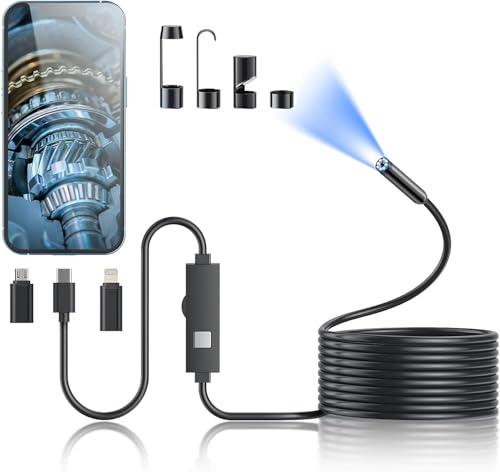
Best Endoscope Cameras: 9 Flexible Picks for Precise Visual Inspection
An endoscope camera is defined by its flexible probe: it goes where a rigid rod cannot, round bends, into cavities and along ducts. This page compares nine flexible scopes on what their listings actually publish, and explains why two rigid probes and two replacement cables were left out of the count.
As an Amazon Associate, Akermin earns from qualifying purchases. Product links on this page are affiliate links.
Our Top Picks
Only flexible-probe cameras were included. They were compared on the number of lenses and whether a side view is available, articulation or steering, stated probe diameter, stated resolution, cable length and whether the unit carries its own screen. All figures are the manufacturers' own, and unpublished values read Not stated rather than being estimated.
Best Overall
Teslong 5 Inch Dual Lens Borescope Camera
Front and side cameras with their own LEDs, on a 5 inch screen.
Two cameras, forward and side facing, switched on the handle
Each camera has independent LEDs, stated on the listing
5 inch screen built into the unit, so no phone is needed
Listing names wall and engine cylinder inspection directly
Figures are the manufacturers' own. Only three of the nine publish a probe diameter and only three publish a resolution, which is poor disclosure in a category where fit and image quality are the entire purchase. The last two rows are barrel inspection probes included because both use flexible or slim probes at diameters no general-purpose scope reaches.
How to Choose an Endoscope Camera
Four decisions, roughly in this order:
Diameter, Then Everything Else
The probe fits or it does not. Published figures here run from 0.2 inch to 8 mm, and six of the nine listings do not state one at all, which is the single worst disclosure gap in the category.
Side View or Articulation
Most faults sit on a surface parallel to the probe. A dual or triple lens tip switches view instantly; an articulating tip aims anywhere but costs diameter and is the part that wears out.
Independent Lighting
On a dual lens probe, a side camera lit by a forward LED array gives a dim, glared image. The Teslong dual lens states independent LEDs for each camera, which is what makes the second view usable.
Screen or Host Device
A built-in screen works with gloves and keeps your phone out of a hot engine bay. A phone-connected scope is cheaper, shows more detail and drops images straight into a job record.
Because four of the thirteen listings gathered for this topic are not flexible endoscope cameras. Two are replacement camera cables, described on their own listings as unusable alone and matched to one specific monitor, which makes them spare parts. Two more are rigid probes, one a 26 inch rigid rod with a monitor and one a rigid gun barrel scope, and a rigid rod is the opposite of what the word flexible in the heading promises. The remaining nine all use a flexible or semi-flexible probe.
What is the difference between an endoscope and a borescope?
In marketplace use, very little, and the two words appear interchangeably in almost every listing on this page. The traditional distinction is that a borescope has a rigid or semi-rigid tube designed to look down a bore, while an endoscope has a flexible probe that follows a path. Most modern inspection cameras are flexible and are sold under both names, so buy on probe diameter, lens arrangement and articulation rather than on the word in the title.
Why do two rifle barrel scopes appear in the table?
Because both use probes at diameters no general-purpose inspection camera reaches. The 45 inch probe is explicitly flexible and passes from muzzle to chamber in one pass, and the 0.2 inch unit is about 5.1 mm with a close-focusing sensor. Anyone inspecting a long, narrow bore of any kind is looking at a tool built for exactly that geometry, so they stay in the table with their intended use stated. For wall, duct and engine work the other seven are the relevant entries.
Does more resolution mean a better inspection?
Only up to a point, and light matters more. Inside a cavity the LEDs beside the lens are the entire light source, so image quality is usually limited by reflection and glare rather than by the sensor. A 1080p camera with adjustable lighting will beat a higher-resolution one with a fixed bright array on any wet, oily or polished surface. Three listings here state a resolution and one states adjustable lighting.
How long do these actually last?
The camera rarely fails first. The cable does, at the point where it flexes near the handle, and on articulating scopes the bending section wears out with use. That is worth factoring into the purchase: a scope used weekly in engine bays is a consumable, and a cheaper unit replaced every couple of years can be the better buy than an expensive one treated carelessly.
Reviews
Teslong 5 Inch Dual Lens Borescope Camera Best Overall
The listing headline is unusually honest about what this tool is for: see inside walls and engine cylinders without guessing. Both of those are side-view jobs. You do not care what is at the far end of a wall cavity, you care about the joint next to the probe; you do not care about the piston crown, you care about the bore wall. A forward-only camera shows you the wrong thing in both cases.
Two details make this the pick rather than the other dual-lens units. The cameras switch between forward and side on the handle, so aiming is a button press rather than a withdrawal and a mirror fitting. And each camera has its own LEDs, which is the part most dual-lens designs get wrong. If the side camera is lit by a forward-facing array, the side image is dim on one edge and glared on the other; independent lighting means each view is lit from where it is looking.
A 5 inch screen on the tool keeps the phone in your pocket, which is the right answer in an engine bay or a loft. The listing does not state probe diameter, resolution, cable length, LED count or waterproof rating, so anyone inspecting a specific bore should check the manual for the probe size before ordering.
Strengths
Front and side cameras switched from the handle
Independent LEDs for each camera, which most rivals lack
5 inch screen, so no phone goes into the engine bay
Explicitly listed for wall and cylinder inspection
LumenScope 2-Way Articulating Borescope Best Articulation
Articulation and slimness pull against each other, because the control wires that bend the tip need room inside the sheath. At 0.24 inch, roughly 6.1 mm, this is about as slim as an articulating probe gets, and that diameter is the one that matters for automotive work because it will pass through a spark plug or glow plug hole where an 8 mm probe will not.
Two-way articulation through 210 degrees is the more durable arrangement than full 360 degree steering: fewer wires, a simpler mechanism and less to wear out, while still letting you look back along a bore wall or round the inside of a bend. Combined with the 5.3 foot cable it covers cylinder inspection, gearbox ports, duct runs and the sort of pipe work where the fault is always just past where a rigid probe stops.
The listing gives the three numbers that matter and stops. There is no stated resolution, no LED count, no waterproof rating, no field of view and no statement about whether it carries a screen or relies on a host device. Articulating mechanisms are also the most failure-prone part of any endoscope, so this is a tool to use deliberately rather than to force round a corner it does not want to take.
Strengths
6.1 mm probe passes access holes an 8 mm probe cannot
210 degree two-way articulation, simpler and more durable than 360 steering
5.3 foot cable covers cylinders, ports and short duct runs
Explicitly listed for automotive engine inspection
Limitations
Resolution, LED count and field of view not stated
No waterproof rating stated on the listing
The articulating section is the part most likely to fail with use
Nine listings, and only three publish a probe diameter and only three publish a resolution. Kinpthy publishes both, and that alone makes it the sensible budget purchase, because a borescope you cannot size before buying is a gamble on whether it fits the hole and whether the image will be readable once it is inside.
The 7.9 mm probe is the general-purpose size. It goes into wall cavities, drains, ducts, inspection ports and most automotive access panels without complaint, and it stops at anything tighter, which is the trade for the larger sensor and better light that a wider sheath allows. The 1920 by 1440 snapshot figure from a 2.0 megapixel sensor is enough to read a casting number or see the edge of a crack, which is generally what an inspection comes down to.
Eight adjustable LEDs is the feature that will surprise anyone used to fixed lighting. Inside a cavity the LEDs are the only light source and they sit beside the lens, so anything wet, oily or polished directly ahead reflects them straight back and whites out the image. Being able to dim them is often the difference between a usable picture and a glare field. The limitations are a single forward lens with no side view, and no stated cable length, ingress rating or field of view.
Strengths
Publishes both probe diameter and image resolution
Eight adjustable LEDs prevent wash-out on wet or shiny surfaces
1920 by 1440 snapshots from a 2.0 MP sensor
Lowest price here for a fully specified flexible probe
Limitations
Single forward lens, so a side view needs a mirror attachment
7.9 mm will not enter a spark plug or glow plug hole
Cable length, ingress rating and field of view not stated
Short answer: the Teslong dual lens borescope is the best general choice because it has forward and side cameras with independent LEDs and a 5 inch screen, which covers the two jobs its own listing names, walls and engine cylinders; the LumenScope articulating scope is the pick for tight access, at 0.24 inch with 210 degree two-way articulation; and the Kinpthy endoscope is the value choice and one of only three listings here that publishes both a probe diameter and a resolution.
Why this page lists nine and not ten
Thirteen listings were gathered and four of them are not flexible endoscope cameras. Two are replacement camera cables, and their own listings are explicit: camera cable only, cannot be used alone, must match a specific monitor. They are spare parts, and putting a spare part in a comparison of cameras is the padding this page is written to avoid. The other two are rigid probes, a 26 inch rigid rod sold with a 5 inch monitor and a rigid 0.2 inch rod for gun barrels, and rigid is the opposite of the flexible probe the heading promises. That leaves nine, and every one of them has a probe that bends.
Endoscope, borescope, inspection camera
These three terms are used interchangeably across every listing on this page, which is why two of the nine entries have borescope in their titles and endoscope in their descriptions. The historical distinction is real but no longer commercially meaningful: a borescope was a rigid or semi-rigid tube for looking down a bore, an endoscope a flexible probe that follows a path, and the word stuck to whichever market the manufacturer was selling into. What actually distinguishes these products is probe diameter, how many directions the tip can look, whether it articulates, and whether you view on the tool or on a phone. Buy on those four and ignore the noun. What a borescope is and when it is useful covers the applications in general.
The probe is the product
Published diameters here run from 0.2 inch, about 5.1 mm, up to 8 mm, and six of the nine listings state nothing at all. That is the single worst disclosure gap in this category, because diameter is a hard constraint: a probe that does not enter the hole cannot be compensated for by resolution, lighting or software. In practice 7.9 and 8 mm cover wall cavities, drains, ducts and most inspection ports. Anything through a spark plug or glow plug hole needs 6 mm or less, which is where the LumenScope at 0.24 inch and the Teslong 0.2 inch probe sit. Below about 5 mm the sensor and lens become small enough that image quality drops noticeably and articulation stops being physically possible.
Looking sideways is the whole problem
Almost everything worth inspecting sits on a surface parallel to the probe rather than at the end of it. A cylinder bore, a cavity wall, the inside of a duct, the wall of a pipe: in every case a forward-facing lens shows you the far end of the void and not the thing you went in to see. There are two real solutions and one bad one. The bad one is a clip-on mirror, which falls off inside the cavity, reflects the LEDs back into the lens and reverses everything. The good ones are multiple lenses, as on the Teslong dual and triple lens units and the T TAKMLY dual lens, or an articulating tip as on the LumenScope, the Soliluxelink and the steerable HKRVPXD. Multiple lenses switch instantly and never jam; articulation aims anywhere but costs diameter and eventually wears out.
Independent LEDs are not a detail
Dual lens scopes vary enormously in how well the second view actually works, and the reason is lighting rather than optics. If both cameras share a forward-facing LED array, the side camera is looking at a surface that is lit obliquely, producing a dim image with a glare band across it. The Teslong dual lens listing specifically states independent LEDs for each camera, which means the side view is lit from where it is looking. The Kinpthy takes a different route with eight adjustable LEDs, letting you dim the array when the surface ahead is wet or polished and would otherwise bounce the light straight back into the lens. Fixed bright lighting is the most common cause of an unusable borescope image.
Screen or phone
Four of these nine carry their own display: the two Teslong units at 5 inch and 4.5 inch, the HKRVPXD at 5 inch IPS, the Soliluxelink and the T TAKMLY at 4.3 inch. The Soliluxelink listing makes the argument for that design directly, describing viewing without requiring phone apps or wireless connections. A built-in screen works with gloves, survives a workshop, and does not stop mid-inspection because a call came in. A phone-connected scope is cheaper, shows far more detail on a larger and better display, and drops photographs straight into whatever you use for records. For occasional home use the phone wins; for daily trade use the screen usually does.
What wears out
Not the camera. The failure that ends most endoscopes is the cable, at the point just behind the handle where it flexes every time the tool is used, and on articulating models the bending section that carries the control wires. That has a purchasing consequence worth stating plainly: an inspection camera used weekly is a consumable rather than a lifetime instrument, and it is often smarter to buy a well-specified mid-price scope and expect to replace it than to buy an expensive one and treat it as permanent. Coiling the cable loosely rather than tightly, and never forcing an articulating tip past a bend it resists, both extend the life meaningfully. How to choose a borescope for inspection work covers the specification decisions in more depth.
Only flexible-probe cameras were considered. They were compared on stated probe diameter, number of lenses and side-view availability, articulation range, stated resolution, cable or probe length, lighting arrangement and whether the unit carries its own display. Four products supplied with this group were excluded and the reasons are given on the page. Owner feedback was reviewed for recurring reports of cable and articulation failure. We ran no laboratory tests and publish no optical measurements of our own. Amazon data supplies images, availability and links only.
Yes, a pyrometer needs power, but the source depends on the type: batteries for handheld guns, mains or loop power for fixed sensors, and sometimes no local power for passive optical types.