Best USB Borescope Cameras: 7 Affordable Picks for Detailed Inspections
A USB borescope is the cheapest way to see inside a wall cavity, an engine cylinder, a drain or a duct without opening anything. This page compares seven general-purpose inspection scopes on the figures their listings publish, and explains why six of the thirteen listings gathered for this topic were left out.
As an Amazon Associate, Akermin earns from qualifying purchases. Product links on this page are affiliate links.
Our Top Picks
Scopes were compared on the probe diameter each listing states, the number of lenses and whether a side view is available, stated image resolution, cable length and reach, articulation or steering, and lighting. Figures are the manufacturers' own. Where a listing publishes no value the entry reads Not stated. We ran no laboratory tests and publish no optical measurements of our own.
Best Overall
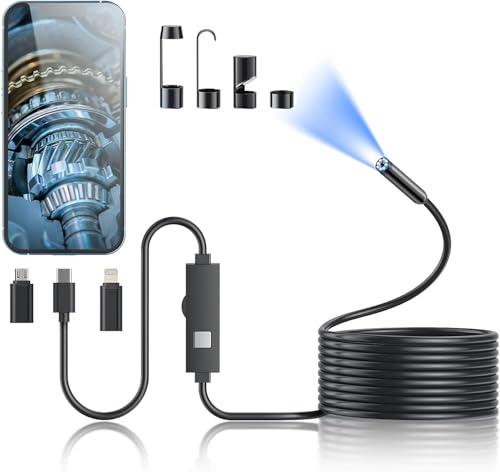
Teslong Triple Lens 5FT Borescope Camera
Three cameras in one probe tip, toggled by a single button.
Three cameras built into the probe tip, stated on the listing
One button toggles between the front-facing and side views
Five foot probe, stated for automotive, home, wall and pipe use
Combined field of view is wider than any single lens can give
Diameters and resolutions are the manufacturers' own figures. Only three of the seven publish a probe diameter and only three publish a resolution, which is poor disclosure for a category where those two numbers decide whether the tool fits and whether the image is usable. Unpublished values read Not stated.
How to Choose a USB Borescope
Five things decide whether a scope works for your job:
Diameter Before Anything
The probe either fits the access hole or the rest of the specification is irrelevant. These range from 0.24 inch up to 8 mm, and only three listings publish the figure at all.
Which Way It Looks
A single forward lens shows the end of the hole. Most faults are on the side. A dual or triple lens tip, or an articulating one, removes the mirror attachment that falls off and blocks the light.
Articulation Costs Diameter
Control wires need room. The steerable scopes here are 6.1 mm and 8 mm, and a truly slim probe cannot articulate. Choose reach and aim, or choose access, but rarely both.
Adjustable Lighting
The LEDs sit beside the lens and a reflective surface ahead bounces them straight back. Adjustable brightness is what makes a wet pipe or a polished bore readable instead of white.
Why does this page list seven when the heading used to promise ten?
Because six of the thirteen listings gathered for this topic are not general-purpose USB inspection scopes. Two of them are replacement camera cables, stated on their own listings as unusable alone and compatible only with a specific monitor. Four are firearm bore scopes, sold with barrel mirrors and rigid rods for inspecting rifle barrels for fouling and erosion. Putting those in the table to reach ten would have made the number honest and the page useless.
What probe diameter do I actually need?
Measure the smallest hole you are willing to drill or the smallest existing opening you have. A 7.9 mm probe covers most wall cavities, drains, ducts and gearbox inspection ports. Engine cylinder inspection through a spark plug hole usually needs 6 mm or less, which is where the LumenScope at 0.24 inch sits. Going smaller costs image quality and usually costs articulation, so buy the largest probe that fits rather than the smallest available.
Is a side view really worth paying for?
In a bore or a cavity, yes. The surface you are inspecting is almost always parallel to the probe rather than in front of it, so a forward-only lens shows you the end of the hole and not the walls. Mirror attachments work but fall off inside cavities, reverse the image and block part of the light. The Teslong triple and dual lens tips and the articulating scopes solve it properly.
Do I need one with its own screen?
It depends where you work. A built-in screen means no phone in a dirty or wet space, no app compatibility to worry about, and operation with gloves on. A phone-connected scope is cheaper, has a much better display and puts images straight into a job record. Four of these seven carry a screen and the rest rely on a phone or computer.
Will a borescope work in water?
Usually the probe and cable are rated for immersion while the handle and screen are not, which is the arrangement that makes drain and tank work possible. Only the T TAKMLY listing states an ingress rating here, and even then the rating applies to the probe rather than the whole instrument. Check the manual before putting any part of one in standing water.
Reviews
Teslong Triple Lens 5FT Borescope Camera Best Overall
The limitation that ruins most borescope inspections is not resolution, it is direction. A single forward-facing lens shows you what is in front of the tip, and the thing you need to see is almost always on the wall beside it: the bore surface rather than the piston crown, the joint on the side of the cavity rather than the far end of it. The usual workaround is a stick-on mirror that falls off, blocks the light and reverses the image.
Teslong solves it with hardware. The listing states three cameras built into the end of the probe for a wider combined field of view, with one button toggling between the front-facing and side views. In a cylinder that means looking straight down the bore and then at the wall without withdrawing and refitting anything. In a wall cavity it means seeing the stud beside you rather than guessing where it is.
The listing publishes the lens count, the five foot length and the intended applications, and not much else. Probe diameter, image resolution, LED count, waterproof rating and whether it works with a computer as well as a phone are all unstated, which for a product sold on its optics is a meaningful gap.
Strengths
Three lenses remove the need for a mirror attachment
Side view selected with one button rather than a fitting
Five foot reach suits cavities, bores and short duct runs
Explicitly listed for automotive, home, wall and pipe work
Limitations
Probe diameter not stated on the listing
Image resolution not stated
Three lenses in one tip means a larger tip than a single-lens probe
HKRVPXD 360 Degree Steering Industrial Endoscope Best for Steering
Everything a fixed borescope cannot do comes down to the same problem: once the probe is inside, you can push, pull and rotate it, and that is the whole of your control. If the fault is behind a lip, around a bend or on a surface the tip is not pointing at, the inspection ends there. A steerable tip changes the tool from a viewer into something you can actually aim.
This listing states 360 degree steering on an 8 mm probe, with single and dual lens configurations and a 5 inch IPS screen built into the handle. The 8 mm diameter is a sensible compromise for a steering mechanism, which needs room inside the probe for the control wires and simply cannot be built at 3 or 4 mm without becoming fragile. The integrated screen means no phone, no app and no cable in a workshop where both hands are already occupied.
The listing text is unusually sparse, describing the product mainly as video inspection equipment. Cable length, image resolution, LED brightness, waterproof rating, battery life and recording capability are all unstated, and steerable scopes are the category where build quality varies most, because the articulation is the part that wears out.
Strengths
Steerable tip aims at the fault instead of past it
8 mm probe is a realistic diameter for articulation
Built-in 5 inch IPS screen needs no phone
Single and dual lens options
Limitations
Listing text states almost nothing beyond video inspection equipment
Cable length, resolution and waterproof rating not stated
Articulation mechanisms are the part most likely to wear out
Across seven listings that mostly describe features rather than specify them, Kinpthy publishes the two numbers that determine whether a borescope will do your job: a 7.9 mm probe and a 2.0 megapixel sensor producing 1920 by 1440 snapshots. Diameter decides where the probe fits, resolution decides whether you can read a casting number or identify a crack once it is in there, and having both stated means you can judge the tool before buying it.
Eight adjustable LEDs is the other detail that matters more than it sounds. Inside a cavity there is no ambient light at all, the LEDs sit next to the lens, and any reflective surface directly ahead bounces the light straight back and washes out the image. Being able to turn the brightness down is what makes a wet pipe or a polished bore readable rather than a white blur.
At 7.9 mm this is a general-purpose probe rather than a tight-access one. It will not enter a glow plug hole or a 6 mm pilot bore, and the listing does not state cable length, waterproof rating, field of view or whether the probe is semi-rigid enough to be pushed round a bend. It also has no side view, so anything on a cavity wall needs a mirror or a different scope.
Strengths
Publishes both probe diameter and image resolution
1920 by 1440 snapshots from a 2.0 MP sensor
Eight adjustable LEDs, which prevents wash-out on reflective surfaces
Lowest price here for a fully specified probe
Limitations
Single forward lens, so a side view needs a mirror
7.9 mm will not enter a spark plug or glow plug hole
Cable length, field of view and waterproof rating not stated
Short answer: the Teslong triple lens borescope is the pick for most inspection work because three cameras in the tip give front and side views from one button, which removes the mirror attachment that ruins most cavity inspections; the HKRVPXD 360 degree steering scope is the choice when the fault is around a bend, with an 8 mm steerable probe and a 5 inch screen; and the Kinpthy endoscope is the value pick and one of only three listings here that publishes both a probe diameter and an image resolution.
Why this page lists seven and not ten
Thirteen listings were gathered for this topic and six of them do not belong on a page about general-purpose USB inspection scopes. Two are replacement camera cables, and both listings say so plainly: camera cable only, cannot be used alone, must be matched to a specific monitor. They are spare parts. The other four are firearm bore scopes: a 45 inch flexible rifle probe with six barrel mirrors, a 26 inch rigid probe with a monitor, and two more rigid gun cleaning cameras sized for .20 calibre and larger. Those are real tools that do a real job, but the job is inspecting rifle barrels for fouling, erosion and tool marks, not looking inside a wall or an engine. Reaching ten by including them would have been exactly the padding this page exists to avoid, so the count is seven.
Diameter decides everything else
A borescope specification reads from the probe outward, because a scope that does not fit the opening has no other properties worth discussing. The published figures here run from the LumenScope at 0.24 inch, roughly 6.1 mm, through the Kinpthy at 7.9 mm to the HKRVPXD at 8 mm, and four of the seven do not state a diameter at all. That omission is remarkable in a category where it is the first question every buyer asks. In practice 7.9 and 8 mm probes cover wall cavities, drains, ducts, gearbox ports and most automotive access panels comfortably. A cylinder inspection through a spark plug or glow plug hole needs 6 mm or less. Below that, image quality drops quickly because a smaller sensor and a smaller lens gather less light, and articulation becomes impossible.
The mirror problem
Almost every borescope inspection that fails does so for the same reason: the lens points forward and the thing you need to see is to one side. Look down a cylinder and you see the piston crown, when the scoring you care about is on the bore wall. Push a probe into a wall cavity and you see the far side of the cavity, when the fault is the joint beside you. The traditional fix is a clip-on 45 degree mirror, which falls off inside the void, reflects the LED straight back into the lens and reverses everything you see. Three scopes here solve it in hardware. The Teslong triple lens states three cameras in the tip with a single button to toggle front and side. The Teslong dual lens states two cameras with independent LEDs for each. The LumenScope and the Soliluxelink articulate instead, bending the tip to aim it, and the HKRVPXD steers through 360 degrees. Those are the two legitimate answers, and both cost either tip size or money.
Articulation and why it needs diameter
A steerable tip works by pulling control wires that run the length of the probe, and those wires need physical space inside the sheath alongside the camera cable and the LED wiring. That is why the steerable scopes here are 6.1 mm and 8 mm rather than 3 or 4 mm, and why a genuinely slim probe is always a fixed one. The LumenScope states two-way articulation through 210 degrees on a 5.3 foot cable, which is the more common and more durable arrangement, while the HKRVPXD states 360 degree steering, which aims anywhere but has more mechanism to wear. Articulation is also the part of a borescope most likely to fail with use, so it is worth treating a steerable scope as a consumable rather than a lifetime tool.
Lighting matters as much as the sensor
There is no ambient light inside anything worth inspecting, so the LEDs beside the lens are the entire light source, and that geometry causes the problem. Light leaving the tip hits a surface directly ahead and returns straight into the lens, which washes the image to white on anything wet, oily or polished. That is why the Kinpthy listing making a point of eight adjustable LEDs is worth more than it looks: turning the brightness down is often the difference between a readable image and a glare field. The Teslong dual lens goes further with independent LEDs for each camera, so the side view is not lit by the forward array. When a borescope image looks unusable, the light is usually the reason, not the sensor.
What the listings do not publish
Three of seven state a probe diameter. Three state a resolution, all of them either 1080p or the Kinpthy 1920 by 1440 snapshot figure. One states an ingress rating. None states a field of view, and only two state a working length. For a category in which fit, reach and image quality are the whole purchase, that is thin disclosure, and it means the manual or the manufacturer page has to be checked before buying for a specific access hole. What a borescope is and when it is useful covers the applications and how to choose a borescope for inspection work goes through the specification in detail.
Scopes were compared on stated probe diameter, number of lenses and side-view availability, stated image resolution, articulation or steering, cable length, lighting and whether the unit carries its own screen or relies on a phone or computer. Six products supplied with this group were excluded as off-category and the reasons are given on the page. Owner feedback was reviewed for recurring reports of cable failure and articulation wear. We ran no laboratory tests and publish no optical measurements of our own. Amazon data supplies images, availability and links only.
Nine flexible-probe endoscope cameras compared on lens count, articulation, screen size and resolution, after two rigid scopes and two spare cables were cut.
Nine thermal imagers judged against under-bonnet work, compared on stated detector resolution and whether a listing separates it from an upscaled figure.