Best VOC Detectors: 10 Accurate Picks for Smarter Air Monitoring
Volatile organic compounds cover everything from solvent fumes in a workshop to formaldehyde off-gassing from new furniture, and the instruments split into two very different groups. This hub compares industrial analyzers that publish a range and a resolution against consumer room monitors that publish neither.
Independent Research
Verified Specifications
Honest Recommendations
TVOC Is A Sum
Range Then Resolution
Ventilate First
As an Amazon Associate, Akermin earns from qualifying purchases. Product links on this page are affiliate links.
Our Top Picks
Ten instruments, split between handheld industrial analyzers that publish a measurement range and a resolution, and multi-sensor room monitors that publish a sensor list and little else. That split is the most useful thing on this page, and the table makes it visible. We did not test these instruments and we publish no measurements of our own.
Best Overall
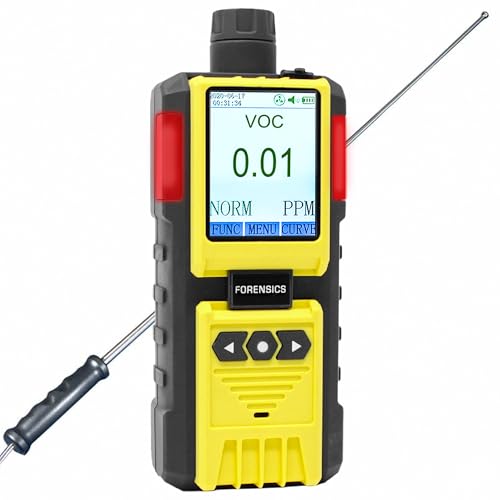
Forensics Detectors VOC Detector, 0 to 100 ppm
A stated range, a stated resolution, a pump and traceable calibration.
Stated range 0 to 100 ppm at 1 ppm resolution
Built-in pump for fast sampling rather than waiting for diffusion
USA NIST traceable calibration performed in Los Angeles
The top seven rows are instruments that publish a measurement range. The bottom three are room monitors that publish a sensor list only. Comparing a number from one group against a number from the other is not meaningful. All figures come from the manufacturer listings.
How to Choose a VOC Instrument
Work down this order and the shortlist writes itself:
Range Before Resolution
Decide the concentrations you expect first. A 0 to 10 ppm analyzer pins at 10 and tells you nothing above it; a 0 to 1,000 ppm unit cannot see a fraction of a ppm.
Total VOC or One Compound
TVOC is a single number summing many different compounds with different toxicities. If formaldehyde is the actual concern, buy a formaldehyde instrument rather than reading it off a TVOC channel.
Pump or Diffusion
A pump lets you hunt a source by walking toward it and watching the number climb. Diffusion is fine for a monitor that sits in a room and reports a trend.
Calibration
Only the Forensics listings state traceable calibration. Consumer monitors generally report a relative index, which is useful for trends in one room and useless for comparison against an exposure limit.
Total volatile organic compounds, reported as one number that sums the response of the sensor to many different compounds. It does not identify which compounds are present, and it weights them by whatever the sensor happens to respond to rather than by their toxicity. It is a useful trend indicator and a poor exposure measurement.
Is formaldehyde included in a TVOC reading?
Usually it contributes to the reading, but a TVOC channel will not tell you how much of the total is formaldehyde. If formaldehyde is the specific concern, for example after new flooring or furniture, use an instrument with a dedicated HCHO channel. Two of the instruments here are formaldehyde-specific.
Why do two instruments in the same room show different numbers?
Because they respond to different compounds with different sensitivities, and because low-cost sensors report a relative index rather than a calibrated concentration. Compare an instrument against itself over time rather than against another instrument, and compare readings between brands only when both publish a range and a calibration method.
What is the difference between ppm and milligrams per cubic metre?
ppm is a volume ratio and mg per cubic metre is a mass concentration, so converting between them depends on the molecular weight of the specific compound and on temperature and pressure. That is why the formaldehyde instruments on this page use different units, and why their numbers cannot be compared directly without knowing the compound.
What should I do about a high reading?
Ventilate first, because dilution is the fastest and cheapest response, then look for a source: a recently installed material, a solvent container left open, a printer, a cleaning product, an attached garage. Watch whether the reading falls after ventilation and whether it returns, which tells you whether the source is still active.
Reviews
Forensics Detectors VOC Detector, 0 to 100 ppm Best Overall
This is the pick because it answers all three questions an instrument should answer before you trust a number: what range does it cover, how finely does it divide that range, and against what was it calibrated. Forensics states 0 to 100 ppm, 1 ppm resolution, a built-in pump and NIST traceable calibration carried out in Los Angeles. Six of the ten products on this page answer none of those.
The pump matters more than it sounds. A diffusion sensor waits for air to reach it, which is slow and makes it hard to say where a reading came from. A pump draws a sample continuously, so you can walk a workshop and watch the number respond as you approach a solvent store or a paint booth, which turns the instrument from a display into a search tool.
The range is the thing to check against your job. A 0 to 100 ppm span with 1 ppm steps is an industrial band. For indoor air quality where the interesting concentrations are fractions of a ppm, it is too coarse, and the 0 to 10 ppm analyzer below is the right instrument instead.
Forensics Detectors VOC Analyzer, 0.01 ppm Resolution Most Sensitive
The trade between range and resolution is the central decision in this category, and this model is the other end of it. Forensics states 0 to 10 ppm with 0.01 ppm resolution, which is a hundred times finer than the 0 to 100 ppm unit above but covers a tenth of the span. If your concern is whether a newly furnished room is off-gassing at a level worth ventilating for, that fine resolution is what makes the difference visible.
The same built-in pump and NIST traceable calibration apply, so this is the same instrument class with a different sensor configuration rather than a cheaper alternative. Both come from the same manufacturer, which is convenient because their numbers are at least comparable to each other.
The limitation is the ceiling. A workshop event that takes the concentration above 10 ppm simply pins the display, and you learn nothing about how far above. If a single instrument has to cover both a normal room and a solvent spill, the wider range model is the safer buy even though it hides the small stuff.
Thrustmax 16-in-1 Indoor Air Quality Monitor Best for Whole-Room Context
A VOC number on its own is hard to act on. The same reading means something different in a room where CO2 has climbed to 1,500 ppm because nobody has opened a window, and in a well-ventilated room where it must be coming from a source. This monitor puts both numbers on one screen, along with particulates and formaldehyde, which is why it earns a place here despite publishing no measurement specifications at all.
Thrustmax states a smart sensor with a double ventilation structure for faster refresh, and a sensor list covering PM2.5, CO2, TVOC, HCHO, PM1 and more. What it does not state anywhere is a range, a resolution, an accuracy figure or a calibration method for any of those channels, and low-cost TVOC sensing in consumer monitors is typically a metal-oxide sensor reporting a relative index rather than a calibrated concentration.
Use it the way it is good for: watching trends in one room over days, seeing whether opening a window changes anything, and noticing when a new piece of furniture arrives. Do not use its numbers to make a compliance judgment or to compare against an exposure limit.
Strengths
VOC shown in the context of CO2 and particulates
Continuous room monitoring format
Formaldehyde channel included
Lowest tier here
Limitations
No range, resolution or accuracy stated
Consumer TVOC sensing is typically relative, not calibrated
Short answer: the Forensics VOC Detector at 0 to 100 ppm with 1 ppm resolution is the instrument to buy for workshop and industrial work, because it states a range, a resolution, a pump and traceable calibration. The Forensics VOC Analyzer covers only 0 to 10 ppm but resolves to 0.01 ppm, which is the right choice for low indoor concentrations, and the Thrustmax 16-in-1 is the room monitor that puts a VOC trend next to CO2 and particulates for context.
Two categories wear the same name
The word detector covers two quite different products here. Seven rows in the table are measuring instruments: they publish a range, most publish a resolution, several state a pump and a calibration method, and they are shaped to be carried to a suspected source. Three rows are room monitors: they publish a list of sensors, they sit on a desk, and they publish no range, no resolution and no accuracy for any channel. Both are legitimate purchases and they solve different problems. What is not legitimate is comparing a number from one against a number from the other, or quoting a consumer monitor reading against an occupational exposure limit. The table is ordered so the split is visible at a glance.
Range and resolution pull against each other
The clearest illustration on this page is the pair of Forensics analyzers. One covers 0 to 100 ppm in 1 ppm steps; the other covers 0 to 10 ppm in 0.01 ppm steps. Same manufacturer, same format, same calibration claim, opposite ends of a trade-off. Choose the wide one and a room quietly off-gassing at 0.4 ppm reads as zero. Choose the fine one and a solvent event pins the display at 10 ppm with no indication of how far past it went. The ATO instrument sits at the far end with a stated 0 to 1,000 ppm span and no resolution figure at all, which suits an industrial process and is useless for indoor air. Decide the concentration band you expect before you shortlist anything.
TVOC is a sum, not a measurement of a substance
A total VOC reading adds together the sensor response to dozens of compounds that have nothing in common except that they evaporate at room temperature. Limonene from a cleaning product, ethanol from a hand sanitizer, benzene from a fuel can and formaldehyde from a new cabinet all push the same number up, and the sensor does not weight them by how harmful they are. That is why the number is excellent for noticing change and poor for judging risk. If a specific compound is the concern, buy an instrument for it: two rows here are formaldehyde-only, the Forensics HCHO detector at 0 to 10 ppm with 0.01 ppm resolution and the ZYKYCX at 0 to 5 mg per cubic metre with 0.001 mg per cubic metre resolution.
A pump turns a display into a search tool
Diffusion sampling means waiting for the air to reach the sensor, which is slow and blurs the connection between where you are standing and what the number says. The two pumped Forensics units draw a sample continuously, so the reading responds while you walk, and that is what lets you follow a rising number to a solvent store, a paint booth, an open container or a duct. The trade is power draw and noise. For a monitor that lives on a shelf and reports a daily pattern, diffusion is fine and quieter. For finding out where something is coming from, the pump earns its cost.
Units, and why the two formaldehyde instruments cannot be compared
One formaldehyde instrument here reports parts per million and the other reports milligrams per cubic metre. These are not the same kind of quantity: ppm is a ratio of volumes and mg per cubic metre is a mass in a volume, so converting between them requires the molecular weight of the compound plus temperature and pressure. For formaldehyde the conversion is well known, but it only works because the compound is known. That is another reason a TVOC number in ppm cannot be converted to a mass concentration at all, since the mixture is unknown. When you record a reading, record the unit and the instrument with it.
Instruments were compared on manufacturer listing text: what each sensor reads, stated measurement range, stated resolution, sampling method, stated calibration and physical format. A photoionization sensor module sold as an OEM component, a radon monitor and a vaguely described multi-gas pump unit were left out so all ten rows are finished instruments a buyer can use. We ran no tests and publish no measurements. Amazon data supplies images, availability and links only.
A normal oxygen meter reading outdoors or in a ventilated room is about 20.9 percent by volume; readings below 19.5 percent or above 23.5 percent usually trigger alarms because they indicate oxygen deficiency or enrichment.
Carbon monoxide detectors read in parts per million, but the display is often a peak hold or a status indicator, not a live measurement; the alarm threshold is set by safety standards, not by what is healthy.
A methane detector is a combustible gas instrument that converts a catalytic or infrared sensor signal into a percentage of the lower explosive limit, and it is not the same thing as a natural gas alarm or a CO meter.