As an Amazon Associate, Akermin earns from qualifying purchases. Product links on this page are affiliate links.
The combustible gas alarm goes in the same room as the furnace or water heater, mounted high on the wall for natural gas or low for propane, offset several feet to the side of the appliance rather than above it or beside the burner, and clear of the flue, the combustion air openings and any window or door. The carbon monoxide alarm is a separate device with separate rules and usually does not belong right next to the appliance. That is the whole answer for a typical basement or utility room; the sections below handle closets, garages, attics and the common mistakes.
Why the Appliance Room Gets Its Own Alarm
A furnace and a water heater together account for most of the gas fittings in a house: the shutoff valve, the drip leg, the union, the flexible connector, the gas valve on the appliance itself and, on a furnace, the manifold and burner orifices. Leaks at these points happen in a room people rarely stand in for long, often behind a closed door. Gas that leaks there stays there. An alarm in the kitchen upstairs will not hear about it until the mechanical room is well past its own alarm point, which is why counting detectors by room always includes this one.
Height: Match the Fuel
Natural gas is lighter than air and collects under the ceiling, so its alarm is mounted high, typically within roughly 12 inches of the ceiling per the manufacturer’s instructions. Propane is heavier than air and pools on the floor, so a propane alarm is mounted low, within roughly 12 inches of the floor. A house with a natural gas furnace is a natural gas house for this purpose; check the appliance rating plate if you are not sure which fuel you have. The general room rules are in where to place a natural gas detector and where to place a propane detector; what follows is specific to the appliance room.
Distance From the Appliance
Close, but not on top of it. Three things around a furnace or water heater can confuse a gas sensor.
- Heat. The flue pipe, draft hood and cabinet get warm. Semiconductor gas sensors are temperature sensitive, and mounting the alarm in the warm plume above the appliance invites drift.
- Exhaust. A backdrafting water heater or a furnace with a cracked heat exchanger releases combustion products. Some combustible gas sensors react to hydrogen and other products of incomplete combustion, so a sensor in the exhaust path can alarm for the wrong reason, or become desensitized.
- Air currents. The furnace blower, the combustion air inlet and the return grille all move air. A sensor sitting in a strong draft sees diluted air and responds late; a sensor in a dead-air corner sees nothing at all.
The practical placement is high (or low) on a wall to the side of the appliance, in the same room, in reasonably still air, at the distance the manufacturer specifies. Most instructions also call for keeping the alarm away from windows, exterior doors and vents.
Room-by-Room
| Where the appliance is | Natural gas alarm | Propane alarm | Avoid |
|---|---|---|---|
| Open basement | High on a wall near the appliances, ceiling side of any beam that could trap gas | Low on a wall near the appliances, not in the sump area | Directly above the flue; next to the dryer vent; a corner behind the appliance |
| Utility closet with solid door | Inside the closet, high, if there is room | Inside the closet, low | Outside the door only; the closet can fill before the hall alarm notices |
| Closet with louvered door | Inside if possible, otherwise just outside the door near the ceiling | Inside if possible, otherwise just outside near the floor | On the door itself |
| Attached garage (water heater) | High, away from the garage door and vehicle exhaust | Low, away from the garage door threshold and floor drain | Where a vehicle bumper or stored items will hit it |
| Attic furnace | High, near the ridge close to the furnace, out of direct sun | Rare; follow manufacturer guidance for the specific unit | Near roof vents; anywhere above the alarm’s rated temperature |
| Outdoor closet (tankless water heater) | Usually not needed; ventilation to outdoors disperses gas | As above | Indoor alarms are not rated for weather exposure |
If Your Alarm Is a Plug-In Unit
Plug-in combination alarms such as the Kidde explosive gas and CO models sit at outlet height because that is where outlets are. The manufacturer’s instructions accept that height for both hazards. In a mechanical room the important thing is which outlet: choose one on a wall to the side of the appliance rather than the one the furnace is plugged into, which is often directly behind the cabinet in the warmest, stillest air in the room. Plug-in monitors with a live ppm display, such as the Orabal 4-in-1, follow the same logic. The plug-in versus battery comparison covers what you give up and gain with each power type.
Where the CO Alarm Goes Instead
Carbon monoxide is produced when the furnace or water heater burns badly, so it feels natural to put the CO alarm beside the appliance. Most CO alarm manufacturers say not to, and specify a minimum distance from fuel-burning appliances, because normal start-up can release a brief puff of CO that would cause nuisance alarms up close. The CO alarm’s job is to protect the people, so it goes on each level and outside sleeping areas, per its own instructions. If you want to see actual CO numbers in the mechanical room, a meter with a display is the right tool; how to choose a carbon monoxide meter explains that category.
Checking the Fittings Themselves
A fixed alarm watches the room; a handheld sniffer checks the joints. After any service visit, filter change that involved moving the appliance, or a new water heater installation, sweep the shutoff valve, union, drip leg, flexible connector and gas valve with a probe such as the gooseneck-equipped TopTes PT520A or, for a tighter cabinet, the UEi CD100A that HVAC technicians carry. Do this with the room ventilated and no ignition sources active, as described in using a combustible gas detector safely. If either device responds strongly, stop, leave, and call the utility rather than trying to tighten the fitting yourself; a detector helps you find a leak, but the utility’s leave-and-call procedure is still the one to follow when you do.
Fixed alarms suited to mechanical rooms are compared in the combustible gas detector roundup and the broader gas leak detector guide.
Recommended Tools
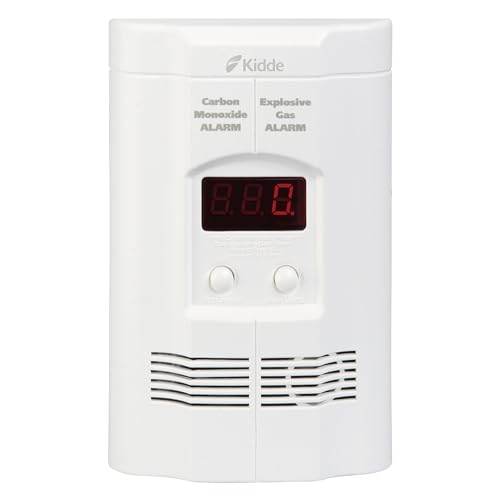


Products shown because their documented specifications fit this guide. Price and availability are on Amazon and can change.
Frequently Asked Questions
Can I mount the gas alarm directly above the water heater?
Not directly above it. The draft hood and flue release warm air and, if the appliance ever backdrafts, combustion products, both of which can disturb the sensor. Mount the alarm high on a nearby wall, offset to the side, following the distance the manufacturer specifies.
Does a gas alarm need to be in a furnace closet if the door is louvered?
Yes. The louvers admit combustion air; they do not guarantee that a leak inside the closet will reach an alarm in the hallway before the closet itself is full of gas. Put the alarm inside the closet or, if the closet is too small, immediately outside the louvered door at the correct height.
Should the CO alarm and the gas alarm be in the same spot?
No. They follow different rules. The combustible gas alarm goes high or low depending on fuel and in the appliance room. The CO alarm is placed outside sleeping areas and on each level, and most manufacturers specify a minimum distance from fuel-burning appliances to avoid nuisance alarms during normal start-up.
What if the furnace is in the attic?
Natural gas rising into an attic collects at the ridge, so mount the alarm high near the furnace, on a rafter or truss, away from the roof vents and out of direct sun. Check the alarm's rated temperature range, since attics exceed what some consumer alarms tolerate.
Affiliate disclosure: Akermin earns a commission from qualifying Amazon purchases made through links on this page. Our editorial picks are based on documented specifications and owner feedback, not commissions.
Related Guides

WiFi Natural Gas Alarm Review: One Unit Reveals the Whole Design
A WiFi natural gas alarm with an LCD showing gas concentration status and temperature, a stated response within 30 seconds, an alarm of at least 85 decibels and notifications to a phone app.
Read More→
Forensics Detectors Cl2 Review: 5 Percent of Full Scale Is 2.5 ppm
A rechargeable chlorine detector with an electrochemical sensor reading 0 to 50 ppm at 0.1 ppm resolution, a response time under 30 seconds, adjustable audible, visual and vibrating alarms and a supplied calibration certificate.
Read More→
Smart Sensor SO2 Detector Review: 0.1 ppm Steps, No Accuracy Figure
A clip on sulfur dioxide monitor built on an electrochemical sensor, reading 0 to 20 ppm in 0.1 ppm steps, with adjustable high and low alarms signalled by sound, flash and vibration and a rechargeable cell quoted at 8 to 9 hours.
Read More→