As an Amazon Associate, Akermin earns from qualifying purchases. Product links on this page are affiliate links.
Put the monitor at about 1.5 m on a shelf or wall a meter or more from the pillow, away from the window, with the buzzer off and the display dimmed. Read the overnight curve each morning: the peak is the number that matters. Then change one thing per night (door ajar, window cracked, trickle vent open, fan in the doorway) and compare peaks. Most bedrooms drop from 2,500 ppm to under 1,500 with the door open, and under 1,000 with a window cracked. Calibrate the monitor outdoors every few months, because a bedroom never reaches fresh air and automatic correction will drift.
Why bedrooms
Two people in a closed bedroom produce more CO₂ than the room’s leakage removes, so the level climbs all night and peaks near dawn, often at 2,000 to 3,000 ppm. Studies of bedroom ventilation report better sleep quality and next-day alertness with lower overnight CO₂. See why indoor CO₂ rises overnight.
Setting up
- Placement: shelf or wall, 1.2 to 1.5 m up, a meter or more from the bed, not on the windowsill. See how to place a CO₂ monitor.
- Display: night mode or e-ink; no glow. Buzzer off.
- Interval: 5 minutes is plenty; the curve is slow.
- Alerts: none overnight, or light-only at 2,500 ppm. See how to set useful alerts.
- Calibrate outdoors before starting so the baseline is right.
The one-week test
| Night | Setting | What to record |
|---|---|---|
| 1 | As usual (door and window closed) | Morning peak; this is the baseline |
| 2 | Door ajar | Peak; usually halves |
| 3 | Door closed, window cracked | Peak; depends on wind and temperature |
| 4 | Trickle vents open, door closed | Peak |
| 5 | Door ajar plus window cracked | Peak; often under 1,000 |
| 6 | Small fan on the floor in the doorway, blowing in | Peak; effective where the door must stay open anyway |
| 7 | Best of the above | Confirm |
Keep the setting that gives a peak under 1,500 ppm with acceptable noise, privacy, security and warmth. See does opening a window always lower CO₂ and can a fan lower CO₂ levels.
Obstacles
- Noise: trickle vents and a door ajar are quieter than an open window.
- Cold: a window on the smallest crack loses less heat than expected; a door ajar loses none.
- Security: window restrictors allow a locked crack.
- Allergies and pollution: if outdoor air is the problem, use the door and rely on the rest of the house; see CO₂ vs PM2.5.
- Mechanical ventilation: if the home has it and the bedroom still peaks high, the bedroom valve is closed, blocked or under-sized; that is a finding worth acting on.
Calibration for bedrooms
Automatic baseline correction assumes the room hits outdoor air each week; a bedroom rarely does. Either disable it and calibrate manually every two to three months, or move the monitor to a ventilated room for a day every few weeks. See why automatic calibration can be wrong. Suitable monitors are compared in best CO₂ monitors for home and office.
Recommended Tools
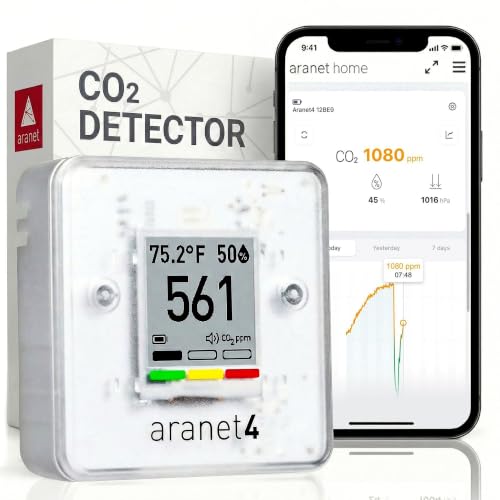

Products shown because their documented specifications fit this guide. Price and availability are on Amazon and can change.
Frequently Asked Questions
What CO₂ level should a bedroom be overnight?
Under 1,000 ppm is very good; under 1,500 ppm is a realistic target for a closed room. Above 2,500 ppm by morning is common with two sleepers and a shut door and is worth fixing.
Where should the monitor go in a bedroom?
On a shelf or wall at about 1.5 m, at least a meter from the pillow, away from the window. A bedside table reads breath and overstates the room.
Does a bedroom CO₂ monitor need to glow or beep?
No. Choose one with a night mode or e-ink display and turn the buzzer off. Read the morning peak instead of reacting overnight.
Affiliate disclosure: Akermin earns a commission from qualifying Amazon purchases made through links on this page. Our editorial picks are based on documented specifications and owner feedback, not commissions.