Best Solar Current Meters: 9 Precision Picks for Accurate Output Measurement
Solar current meter covers four different instruments that answer four different questions. A shunt monitor watches a system day after day, a DC clamp finds leakage without breaking a conductor, a Rogowski coil reads fast waveforms on an oscilloscope and a panel gauge simply shows what a 12 volt circuit is doing. This hub sorts nine current listings by the range and resolution each manufacturer publishes.
As an Amazon Associate, Akermin earns from qualifying purchases. Product links on this page are affiliate links.
Our Top Picks
Instruments were sorted by the current range and resolution each manufacturer listing actually publishes, the voltage the same listing claims, and how the meter connects to the circuit. We did not run laboratory tests and publish no measurements of our own. Where a listing gives no figure the entry reads Not stated.
Best Overall
MORNING GROUP DC 0-300V 100A Battery Monitor
A shunt monitor that reads amps, volts, watts and accumulated energy on one screen.
Listing states voltage 0 to 300 V and current 0 to 100 A
Power stated to 90000 W and consumption to 999 kWh
Current and power consumption direction shown, per the listing
Every figure here is taken from the manufacturer listing for that product at the time of research. Where a listing publishes no value the cell reads Not stated rather than an estimate. Nothing on this page is a measurement of ours.
How to Choose a Solar Current Meter
Four questions settle the purchase:
Permanent or Portable
A shunt monitor lives in the system and accumulates energy over time. A clamp lives in a bag and answers one question per visit. Buying the wrong one is the usual mistake.
AC or DC Current
A Rogowski coil works by induction, so it reads AC only. String current is DC. The ETCR6300D and the shunt monitors are the DC instruments in this group.
Range Against Resolution
A 10000 A instrument cannot resolve a 3 mA leak and a 6 A leakage clamp cannot read a 40 A string. Match the range to the smallest number you need to see.
What the Listing Omits
Only the JESSINIE analog meter states an accuracy figure here, at plus or minus 2.5 percent. Everything else leaves accuracy blank, so confirm it with the manufacturer before quoting a reading.
Can a normal clamp meter measure solar string current?
Only if it states a DC current range. A clamp that lists AC amps alone works by induction around an alternating field and will read close to zero on a DC string. Look for the letters DC beside the amp range, and check that the range covers the short circuit current of the string rather than stopping just above it.
Why does a Rogowski coil not work on a PV string?
A Rogowski coil produces a voltage proportional to the rate of change of current, which means a steady DC current produces nothing at all. The three coil probes in this group are for AC waveform work on an oscilloscope, typically inverter output or motor drives, not for reading what a panel is delivering.
What does a shunt actually do?
It is a precisely known low resistance placed in the negative line. The meter measures the small voltage across it and converts that to amps. The advantage is that it can read hundreds of amps continuously; the disadvantage is that it has to be wired into the circuit, so it belongs in a permanent installation rather than a tool bag.
How small a leakage current is worth worrying about on a PV array?
That depends on the system and the local wiring rules, so treat any figure you read online with suspicion. The practical point is that the fault currents which matter are often in the single or double digit milliamp range, which is why the ETCR6300D states resolution down to 0.1 mA while a general purpose clamp resolves at best 10 mA.
Do any of these meters state an accuracy figure?
One does. The JESSINIE 85C1 analog panel ammeter states plus or minus 2.5 percent, which is a normal class figure for a moving coil movement. The digital instruments in this group publish ranges and resolutions but no accuracy specification, and resolution is not accuracy: a display can show 0.1 mA steps and still be several percent out.
Reviews
MORNING GROUP DC 0-300V 100A Battery Monitor Best Overall
A handheld meter tells you what the array was doing while you were holding the leads. A shunt monitor tells you what it did all week, which is the measurement that settles arguments about whether a system is underperforming. This one is the most complete set of stated numbers in the group: the listing publishes 0 to 300 V, 0 to 100 A, power up to 90000 W and accumulated consumption up to 999 kWh, with the direction of both current and energy shown on screen.
Direction is the feature that matters on a battery system and it is easy to overlook. A monitor that reads only magnitude cannot tell you whether the battery is charging or discharging at 12 amps, and on a hybrid system that is the whole question. This listing states bidirectional indication, so a single glance separates a charging array from a load that has been left running.
The listing does not state an accuracy figure, a shunt tolerance, a sampling interval or a logging depth, so treat the readings as indicative rather than metrological. It is also a panel instrument, not a portable one: it wants a cut-out, a shunt in the negative line and a permanent home. For a system you visit rather than live with, a clamp is the better buy.
Strengths
Widest set of stated ranges in this group
Direction of current and energy shown
Shunt supplied rather than sourced separately
Accumulated kWh turns output into a running total
Limitations
No accuracy or shunt tolerance stated
Needs a permanent installation and a panel cut-out
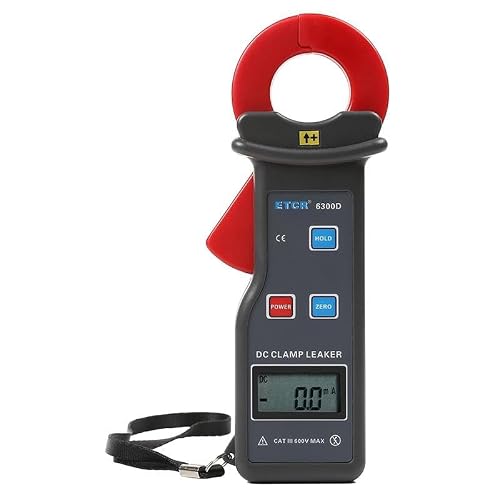
ETCR6300D DC Clamp Leakage Current Meter Best for Earth Leakage
Most DC clamps are built for the hundreds of amps a battery bank can deliver, and at that scale a few milliamps of leakage is invisible. This one is built the other way around. The listing states a range of 0.0 mA to 6.0 A with resolution reaching 0.1 mA, and describes the instrument as designed for measuring DC leakage current and small DC current.
That is exactly the measurement a PV array needs when an insulation fault is suspected. Current that should be flowing down a string conductor and is instead finding a path through damp glass, a chafed cable or a wet connector shows up as a small imbalance, and the only way to see it without disconnecting anything is a clamp sensitive enough to resolve it. A standard 600 amp clamp will read zero on the same fault.
The listing does not publish an accuracy percentage, a jaw diameter, a frequency response or a bandwidth figure, so confirm the jaw fits your cable before you commit. This is also a single-purpose instrument. It will not measure a 40 amp string current usefully at the top of its range, and it is not a substitute for a proper insulation resistance test on the string, which is a different measurement with a different instrument.
MGI SpeedWare 2-in-1 Digital Voltmeter Ammeter Best Value
Small off-grid systems do not need a 300 volt monitor. A single panel on a shed, a van roof or a gate opener runs at 12 volts and a few amps, and the only two numbers that matter are the voltage the battery is sitting at and the current the panel is pushing into it. This gauge shows both at once, which is the whole point of a two-in-one display: you can see a low voltage and a low charge current together and know the panel is shaded rather than the battery being flat.
The LED display is a practical choice for an outdoor enclosure or a van bulkhead, because it stays readable in poor light without a backlight button. The listing states a maximum of 10 amps, which comfortably covers a 100 W panel and sits close to the limit of a 150 W one.
The listing publishes no accuracy figure, no resolution, no shunt detail and no maximum voltage beyond the 12 V description. Treat the 10 amp ceiling as a hard limit rather than a nominal one, and do not carry this design over to a 24 V or 48 V system without confirming the input rating with the manufacturer.
Short answer: the MORNING GROUP 300 V 100 A shunt monitor is the best general buy for a system you own, because it states the widest set of ranges here and shows direction as well as magnitude; the ETCR6300D is the one to carry when the question is leakage rather than output, since its listing states 0.1 mA resolution; and the MGI SpeedWare 2-in-1 gauge is the value pick for a single 12 volt panel, provided you respect its stated 10 amp ceiling.
Four instruments hiding behind one phrase
Solar current meter is a search term, not a product class, and the nine listings above belong to four families that barely overlap. A shunt monitor is wired into the negative line and stays there, reading amps continuously and accumulating kilowatt hours. A DC clamp opens around a live conductor and reads without disconnecting anything. A Rogowski coil is a thin flexible loop that feeds an oscilloscope and reads alternating current only. A panel gauge is a simple display for a small fixed circuit. Buying badly almost always means buying the wrong family rather than the wrong model, which is why the comparison column asks what each listing states its range to be rather than trying to rank all nine on one number.
Direct current is the dividing line
A photovoltaic string produces direct current, and that single fact rules out three of the nine listings for string work. The Micsig RCP300XS and the two Bonzon FCP1608 probes are Rogowski coils, which generate a signal from the rate of change of current. Hold one around a conductor carrying a steady 12 amps of DC and the output is zero. They are here because they are genuinely useful on the alternating side of a solar installation, where inverter output, switching waveforms and inrush events are what you want to see, and because a 1.6 mm flexible loop threads into places a rigid jaw will never reach. For measuring what the panels themselves are doing, look at the shunt monitors and the DC clamp instead, and read how to measure solar panel current before the first reading.
Range and resolution pull in opposite directions
The ETCR6920B states a range of 0 mA to 10000 A, which sounds like the most capable instrument here and is the least suitable for a leakage hunt. An instrument built to swallow ten thousand amps cannot resolve three milliamps, and an instrument that resolves 0.1 mA saturates long before a battery bank inrush. The ETCR6300D sits at the opposite end with a stated 0.0 mA to 6.0 A and 0.1 mA resolution. Neither is better; they answer different questions. Decide on the smallest current you need to see first, then check that the range still covers the largest, and if the two numbers are too far apart, accept that you need two instruments. Clamp meters with flexible current probes and leakage current clamp meters go into that trade properly.
What almost none of these listings publish
Accuracy is the missing specification across this whole category, and it is worth saying plainly. Eight of the nine listings publish ranges, resolutions and feature counts, and eight of the nine publish no accuracy figure at all. Only the JESSINIE 85C1, an analog moving coil movement, states plus or minus 2.5 percent. A display that shows 0.1 mA steps is telling you about its resolution, which is the smallest change it can show, not about how close the number is to the truth. If a reading is going into a commissioning document or a warranty claim, get the accuracy specification from the manufacturer in writing, or use an instrument with a published calibration certificate. The same gap affects PV testers generally, as our solar power meter hub explains.
Where the panel meters earn their place
Two entries in the table are not diagnostic instruments at all. The MGI SpeedWare gauge and the JESSINIE 85C1 are panel meters, meant to be cut into a bulkhead and looked at rather than carried and pointed. That is a real job on a van conversion, a shed array or a gate opener, where the value is a number that is always visible rather than a number that is precise. The 85C1 is worth a second look for anyone building a small monitoring panel, because a 50 microamp movement is the classic front end for a home-built meter scaled by an external shunt or multiplier. It is also the only instrument here whose accuracy class the manufacturer is willing to state.
Listings were compared on stated current range, stated resolution, stated voltage and accuracy where published, AC or DC capability, the connection method and whether the instrument is portable or permanently installed. Owner feedback was reviewed for recurring reports of drifting readings and shunt failures. We did not run laboratory tests, we publish no measurements of our own, and no figure appears on this page unless the manufacturer published it. Amazon data supplies images, availability and links only.
A solar insulation resistance tester that works on energised PV strings up to DC 1000 V, with test voltages of 125, 250, 500 and 1000 V, a range to 4000 megohms, automatic discharge, 1000 stored result sets and USB or Bluetooth transfer.
A 12 volt battery, cranking and charging system tester covering 100 to 2000 CCA that reports state of health, state of charge, voltage, current and CCA, drawing its own power from the battery under test.
A handheld solar irradiance meter reading 0 to 1999 watts per square metre or 0 to 634 BTU per square foot per hour, with a selectable 199.9 or 1999 scale, maximum and minimum tracking, data hold and manual zeroing.