Best VOC Monitors: 10 Smart Picks for Detecting Harmful Indoor Pollutants
Volatile organic compounds come off paint, adhesives, cleaning products, new furniture and fuel, and unlike carbon dioxide they are a family of hundreds of chemicals rather than one gas. That makes the specification on the box matter more than usual. This hub compares the current VOC monitors on stated range, resolution and sensor type, and links down to the specific measurement guides on this site.
Independent Research
Verified Specifications
Honest Recommendations
Range Then Resolution
TVOC Is a Sum
Ventilate to Confirm
As an Amazon Associate, Akermin earns from qualifying purchases. Product links on this page are affiliate links.
Our Top Picks
Every monitor here was compared on what its own listing states: the measurement range in ppm, the resolution, whether a sensor technology is named, whether the unit pumps a sample or waits for diffusion, and what else it reports. We did not run laboratory tests and publish no gas measurements. Blanks are marked Not stated rather than estimated.
Figures are taken from each manufacturer's own listing. TVOC readings from different sensor technologies are not directly comparable because each responds to different compounds with different strength. Where a listing gives no value the cell reads Not stated.
How to Choose a VOC Monitor
Four decisions, in this order:
Range Before Resolution
A 0 to 10 ppm analyzer resolves 0.01 ppm but saturates in a solvent store. Pick the range that covers your worst case first, then take the best resolution inside it.
Sensor Technology
Photoionization responds broadly across many compounds. Electrochemical and metal oxide sensors respond selectively and are calibrated against one reference gas. The same air can read differently on each.
Pumped or Diffusion
A pump gives a reading in seconds at the inlet, which suits hunting a source. Diffusion suits leaving a monitor in a room to log an average.
Portable or Fixed
Fixed wall mounts watch a space continuously and cannot be misplaced. Handhelds go where the smell is. Many workplaces need one of each.
What is the difference between VOC and TVOC on a display?
VOC names the family of compounds. TVOC is a single summed number the instrument reports for total volatile organic compounds present, weighted by how strongly its particular sensor responds to each one. Two monitors in the same room can show different TVOC values without either being faulty, because they are summing different things with different weightings.
Why does my VOC monitor spike when I clean?
Because it is working. Alcohol-based cleaners, sprays, polishes and air fresheners are themselves volatile organic compounds, and most sensor types respond strongly to alcohols in particular. A spike during and just after cleaning that decays over the next hour is normal behaviour, not a fault. Ventilate and re-read before drawing any conclusion.
Do VOC monitors need calibration?
Manufacturers that state calibration, as Forensics Detectors does on several units here, supply it against a specific reference gas at the factory. Sensors drift with age and exposure, so a monitor used for anything consequential should be checked against a known source on a schedule set by the maker. Consumer desktop monitors generally publish no calibration procedure at all, which is one reason to treat their numbers as relative.
Is a photoionization detector better than an electrochemical sensor?
It depends what you are looking for. Photoionization responds broadly to many organic compounds and is the usual choice for industrial survey work, which is why the Feikteey module in this list is a PID. Electrochemical sensors are selective and often cheaper, so a low reading can mean the compound present is simply one the sensor does not see. Match the sensor to the chemistry you expect.
Where should a VOC monitor sit in a room?
At breathing height, away from doorways, extract fans, open windows and the cleaning cupboard, and not directly above a heat source. Some solvent vapours are denser than air and pool low, so for a workshop where a specific heavy solvent is the concern, a low-mounted fixed detector makes more sense than a desktop unit. Placement rules for air monitors generally are covered in our placement guide.
Reviews
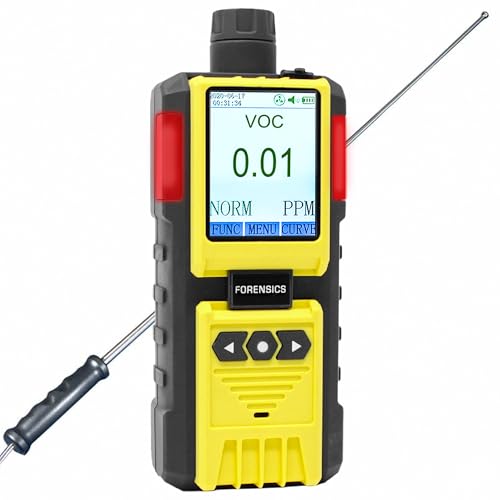
Forensics Detectors VOC Analyzer, 0.01 ppm Resolution Best Overall
This is the instrument on the page for anyone who needs to see small changes rather than confirm a large one. Forensics Detectors states a 0 to 10 ppm range with 0.01 ppm resolution, which is a hundred times finer than the 1 ppm resolution of the same maker's 0 to 100 ppm units, and a built-in pump that pulls the sample to the sensor instead of waiting for it to drift in.
The pump is the part that changes the working routine. A diffusion monitor needs air movement and time; a pumped analyzer gives a reading within seconds of putting the inlet where the problem is, which is what you want when you are walking a room looking for the source rather than logging a room average. The listing also states NIST traceable calibration carried out in Los Angeles and a certificate in the box, which is the paperwork an employer or a client may ask for.
The limits are scope and consumables. The narrow 0 to 10 ppm range that buys the resolution will saturate in a strongly contaminated space, so this is a trace-level tool rather than a high-concentration one. The listing names no sensor technology, so there is no way to work out from the page which compounds it responds to most strongly, and electrochemical and photoionization sensors differ sharply on that.
Strengths
0.01 ppm stated resolution, the finest here
Built-in pump for fast response
NIST traceable calibration certificate stated
Portable and USB rechargeable
Limitations
0 to 10 ppm range saturates in heavy contamination
Sensor technology not named on the listing
Pumped instruments cost more than diffusion monitors
Forensics Detectors VOC Detector, Industrial Wall Mount Best Fixed Installation
A portable analyzer answers the question you are asking today. A wall-mounted unit answers the question nobody thought to ask at three in the morning. Forensics Detectors positions this one as a heavy duty fixed detector covering 0 to 100 ppm, with the same NIST calibration claim as its handheld range, and the listing sums up the intent in four words: turn on and forget.
That suits a paint store, a print room, a solvent cabinet area, a small laboratory or a workshop where the risk is a slow accumulation rather than a single event. The 0 to 100 ppm span is a hundred times wider than the trace analyzer above, which is the right choice for a space where a genuine problem will be well clear of the noise floor.
What it is not is portable, and the listing publishes no resolution figure, no response time, no alarm threshold and no output specification, so anyone integrating it into a building system will need the manufacturer datasheet rather than the product page. Mount it low or high according to the density of the solvent you are worried about, not by convenience: some VOCs are heavier than air and pool at floor level.
Strengths
0 to 100 ppm stated range for general workspace use
Built for continuous unattended monitoring
NIST calibration stated
Fixed mounting removes the risk of the tool walking off
Thrustmax 16-in-1 Indoor Air Quality Monitor Best Multi-Pollutant Monitor
Most households asking about VOCs are not asking only about VOCs. They are asking why a room smells after decorating, whether the new furniture is off-gassing, and whether the air feels stale. A multi-parameter desktop monitor answers that better than a single-gas analyzer, because the answer is usually a combination of TVOC, particulate and carbon dioxide rather than one number.
Thrustmax lists TVOC, PM2.5, PM1, carbon dioxide and formaldehyde among sixteen reported values, and credits its readings to a double ventilation structure that keeps air moving past the sensors instead of letting it stagnate inside the case. That design detail matters more than it sounds: a sealed desktop monitor lags badly behind the room.
The honest caveat is specification. The listing publishes no TVOC range, no resolution and no sensor technology, so this is a monitor for seeing change and comparing rooms, not for producing a figure anybody will act on professionally. Treat the TVOC channel as a relative indicator: useful when it climbs after you open a tin of adhesive, not useful as an absolute exposure number.
Strengths
TVOC in context with particulate, CO2 and formaldehyde
Ventilation design aimed at faster response
Lowest tier here for whole-room air quality
Single screen for a household decision
Limitations
TVOC range and resolution not stated
Sensor technology not named
Relative indicator rather than a professional measurement
Short answer: the Forensics Detectors VOC Analyzer is the pick for trace work, with a stated 0 to 10 ppm range at 0.01 ppm resolution and a built-in pump; the Forensics Detectors wall mount covers 0 to 100 ppm continuously in a fixed space; and the Thrustmax 16-in-1 is the household choice, putting TVOC next to PM2.5, carbon dioxide and formaldehyde so a room can be judged as a whole.
Why a VOC number is harder to read than a CO2 number
Carbon dioxide is one molecule, and an NDIR sensor measures it directly, so two decent CO2 monitors in the same room agree. Volatile organic compounds are hundreds of different molecules: ethanol from cleaning products, formaldehyde from board and adhesives, toluene and xylene from paints and solvents, terpenes from timber and citrus cleaners, benzene from fuel. No affordable sensor identifies them separately. What a VOC monitor reports is a single summed figure, TVOC, weighted by how strongly its own sensor responds to each compound present. That is why the sensor technology column in the table matters more than the headline number, and why comparing TVOC readings between two different brands tells you very little.
Range and resolution: pick the range first
The listings here divide neatly by span. The Forensics VOC Analyzer states 0 to 10 ppm with 0.01 ppm resolution. Two other Forensics units state 0 to 100 ppm with 1 ppm resolution. The ATO handheld states 0 to 1000 ppm of total VOC. Those are three different jobs. A narrow span with fine resolution shows small changes in ordinary indoor air but will peg at full scale in a solvent store or a spray booth. A wide span will not notice the difference between a clean room and a slightly stuffy one. Decide what the worst case in your space looks like, choose the range that comfortably covers it, and only then take the finest resolution available inside that range. Buying resolution you cannot use is the most common mistake on this category.
Pumped sampling versus diffusion
Two of the Forensics units state a built-in pump. A pump pulls air through the sensor chamber, which gives a reading within seconds of putting the inlet somewhere, and makes the instrument useful for hunting: sweeping along a joint, into a cabinet, over a drum, around a fume hood. Everything else here is a diffusion monitor, which waits for air to reach the sensor by natural movement. Diffusion is correct for a monitor that sits in a room and logs an average, and it is quieter and uses less power, but it lags and it under-reads in still air. If the job is finding a source, take the pump. If the job is characterising a room over hours, diffusion is fine and cheaper.
Fixed detectors and where to mount them
The Forensics wall mount is the only purpose-built fixed unit in the group, and the reason to choose one is that a fixed detector is watching when nobody is. Mounting height should follow the chemistry rather than convenience. Many common solvent vapours are denser than air and accumulate near the floor, particularly in a pit, a basement store or behind a plinth, so a detector at eye level can read clean while the floor is not. Where the compound of concern is lighter or where the risk is general room air quality, breathing height is right. The listing publishes no alarm threshold or output specification, so if the detector needs to trigger ventilation or feed a building system, get the manufacturer datasheet before specifying it.
Multi-pollutant monitors and honest expectations
Four of the ten entries report several pollutants at once: the Thrustmax 16-in-1, the Sacnahe dual chip monitor, the POWERTEC workshop monitor and the SunRADON luft. For a home or a small office this is usually the more useful purchase, because indoor air complaints are rarely caused by one thing. A stuffy meeting room is carbon dioxide. A smell after decorating is VOC. A haze from a laser cutter or a sander is particulate. Seeing all three lets you act on the right one, and our air quality monitor hub compares these devices as whole-room instruments. What none of them publishes is a VOC range or resolution, so read their TVOC channels as relative trend indicators rather than measurements.
Formaldehyde is a special case
Formaldehyde is a VOC, but it is the one that most people are actually worried about after new flooring, cabinetry or furniture arrives, and general TVOC sensors respond to it weakly and non-specifically. Dedicated HCHO monitors exist for exactly this reason and use a sensor calibrated against formaldehyde itself. If the question is specifically about a new engineered-wood floor or a batch of MDF units, a dedicated formaldehyde instrument will answer it better than any general TVOC reading. If the question is broader than that, a TVOC channel plus ventilation experiments will tell you more. Either way, the diagnostic move is the same: read, ventilate hard for an hour, read again, and see how quickly the level recovers.
Monitors were compared on manufacturer listing text: stated measurement range, stated resolution, named sensor technology, sampling method, calibration claims, form factor and any additional parameters reported. Owner feedback was reviewed for recurring comments on drift, warm-up and false readings after cleaning. We did not run laboratory tests, did not expose any unit to reference gas and publish no concentration measurements of our own. Amazon data supplies images, availability and links only.
A handheld particle counter can indicate whether a room is likely to be within a guideline but cannot demonstrate compliance, because published limits are averages over hours or classifications with defined sampling plans and traceable instruments.
Most disagreement between two particle monitors in the same room comes from the two instruments sampling different air, different calibration aerosols and different humidity response, rather than from one of them being broken.
A smallest channel of 0.3 micron is an optical limit rather than a physical one, and the particles below it are invisible to the instrument while often outnumbering everything it does count.