Best Water Quality Testers: 12 Reliable Picks for Fast, Accurate Testing
Water quality is not one measurement. Drinking water is usually judged on dissolved solids, hydroponics on conductivity and pH together, and a pool on chlorine, pH and salinity at the same time. This hub sorts twelve current testers by exactly which parameters their manufacturers state, so you buy the one that answers your question rather than the one with the longest feature list.
Independent Research
Verified Specifications
Honest Recommendations
TDS Is Not Purity
Calibrate Then Read
Temperature Matters
As an Amazon Associate, Akermin earns from qualifying purchases. Product links on this page are affiliate links.
Our Top Picks
Testers were compared on what each manufacturer states: which parameters are measured, any published range or accuracy, the probe material, whether calibration is described and the physical form. We did not run laboratory tests, did not compare any tester against a reference solution and publish no water measurements of our own.
Best Overall
Apera Instruments PC60 5-in-1 Waterproof Tester
pH, conductivity, TDS, salinity and temperature in one waterproof pocket tester.
Measures pH, EC, TDS in ppm, salinity and temperature
Values come from each manufacturer own listing. TDS readings are derived from electrical conductivity using a conversion factor that differs between manufacturers, so two pens can legitimately report different ppm figures for the same water. Where a listing publishes no value the cell reads Not stated.
How to Choose a Water Quality Tester
Start from the water, not the feature list:
Match the Parameters
Drinking water usually needs TDS. Hydroponics needs EC and pH together. A pool needs chlorine, pH and often salinity. Buying more parameters than you use adds probes to maintain.
Probe Material and Life
Conductivity electrodes foul and corrode, and pH probes are consumables with a limited life. Titanium alloy probes and replaceable pH sensors are what keep a tester honest after the first year.
Calibration
A pH meter that cannot be calibrated against buffer solutions cannot be trusted after a few months. Check that buffer powders or solutions are supported before buying.
Temperature Compensation
Conductivity and pH both shift with temperature. A tester that reads temperature can compensate; one that does not is reporting a number that depends on how cold the water was.
No. TDS is calculated from electrical conductivity, so it reflects dissolved ionic content such as minerals and salts. Lead at harmful concentrations, most bacteria, chlorine byproducts, pesticides and many organic contaminants either do not conduct meaningfully or are present in quantities too small to register. A TDS pen is excellent for checking whether a filter is working and for tracking change over time, and it is not a safety test.
Why do two TDS meters give different numbers for the same water?
Because TDS is not measured directly. The meter measures conductivity and multiplies by a conversion factor, and manufacturers use different factors, commonly based on sodium chloride, potassium chloride or a 442 mixture. The same water can read several percent apart on two honest meters. Compare a meter against itself over time rather than against another meter.
How often does a pH meter need calibrating?
More often than most owners expect. pH electrodes drift as the reference junction ages and the glass membrane changes, and a meter left dry drifts faster. For anything consequential, calibrate against buffer solutions before each session; for casual use, monthly is a reasonable minimum. Store pH probes wet, in storage solution rather than plain water, which extends their life considerably.
What is ORP and why do pool testers measure it?
ORP is oxidation reduction potential, measured in millivolts, and it describes how strongly the water can oxidise contaminants rather than how much sanitiser is in it. It is the number commercial pool systems control to, because it reflects actual sanitising power, which depends on chlorine concentration and pH together. A pool can show acceptable chlorine and poor ORP if the pH has drifted up.
Do I need a separate meter for hydroponics?
Not necessarily, but you need EC and pH together and you need them to be reliable. Nutrient strength is judged by conductivity, expressed as EC or converted to ppm, and nutrient availability depends on pH sitting in a narrow band. Several testers here combine both, and the multi-parameter meters with replaceable probes are the ones that stay usable through repeated immersion in nutrient solution.
Reviews
Apera Instruments PC60 5-in-1 Waterproof Tester Best Overall
Most water testing questions turn out to need two numbers rather than one, and the two are usually pH and conductivity. A hydroponic nutrient solution at the right strength but the wrong pH will lock out nutrients; a pool with correct chlorine but wrong pH will not sanitise properly; tap water with high dissolved solids and neutral pH is a different problem from water that is acidic. The PC60 measures pH, EC, TDS in parts per million, salinity and temperature in one waterproof body, which is why it leads this page.
The waterproof rating is not a luxury item on a tester that spends its life being dipped into things. Pocket testers die from water getting into the body around the probe joint, and a sealed instrument survives a drop into the tank that would end a cheaper pen.
Temperature is the fifth parameter and the one most buyers overlook. Both conductivity and pH readings are temperature dependent, so an instrument that measures temperature can compensate for it, and one that does not is quietly reporting a number that depends on how cold the water happened to be. Apera does not publish range or accuracy figures on this listing, so those cells read Not stated; the Premium Series documentation carries them.
Strengths
Five parameters including salinity and temperature
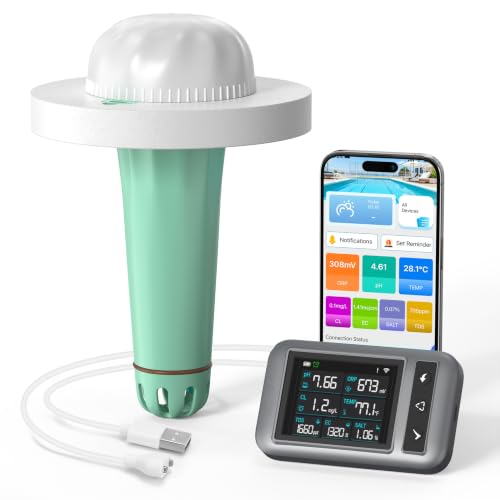
LKBird 7-in-1 Smart Pool Water Tester Best for Pools and Spas
Pool water is the hardest case on this page because the parameters interact. Free chlorine is what sanitises, but its effectiveness collapses as pH rises; ORP describes the oxidising power of the water and is the number commercial systems actually control to; salinity matters if the pool has a salt chlorine generator; TDS climbs over a season and eventually interferes with everything. Testing one of those in isolation produces confident wrong decisions.
The LKBird states all seven: pH, free chlorine, temperature, EC, ORP, TDS and salinity, with an app for reading and history. The history is the part that makes it more than a convenience, because pool chemistry is managed by trend. A chlorine level falling steadily over a week is a different problem from one that dropped after a storm, and strips thrown in the bin tell you nothing about which it was.
LKBird publishes no ranges, no accuracy figures and no calibration procedure on the listing, and electronic free chlorine sensing is generally less settled than pH or conductivity measurement. Keep a strip or drop kit as a cross-check, particularly on chlorine, and treat the electronic readings as the day-to-day tool rather than the final word.
Strengths
Seven interacting pool parameters in one device
Free chlorine and ORP, which most testers omit
App history for managing by trend
Removes the need for several separate meters
Limitations
No ranges or accuracy stated
Electronic free chlorine sensing benefits from a cross-check
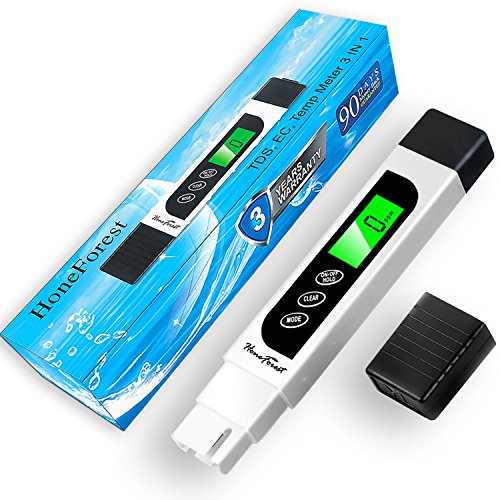
HoneForest TDS Meter Digital Water Tester Best Value
For the single most common question, which is how many dissolved solids are in the tap water or in the output of a filter, a TDS pen is the right instrument and this is the one to buy. HoneForest states TDS, EC and temperature measurement with a titanium alloy probe, and the probe material is the specification that separates pens that last from pens that drift.
The electrodes on a conductivity pen sit in water constantly and corrode or foul over time, which shifts readings gradually enough that you do not notice. Titanium resists that better than the plated steel used in the cheapest pens. Temperature measurement matters for the same reason it does on the Apera: conductivity rises with temperature, so a reading taken from a cold tap and one from a warm tank are not comparable without compensation.
The important limitation is conceptual rather than technical. TDS is inferred from electrical conductivity, so it measures dissolved ionic content, not safety. Lead, most bacteria, most pesticides and many organic contaminants either do not conduct or are present in quantities far too small to register, and a water with very low TDS can still be unsafe. Use a TDS pen for checking filter performance and for tracking change, not for judging whether water is fit to drink.
Strengths
Titanium alloy probe resists fouling and corrosion
Short answer: the Apera PC60 is the best all-round water tester here, giving pH, EC, TDS, salinity and temperature in one waterproof pocket body; the LKBird 7-in-1 is the pool and spa choice because it adds free chlorine and ORP, the two numbers pool chemistry actually turns on; and the HoneForest TDS meter is the value pick for checking tap water and filter performance with a titanium probe.
Decide what question you are asking first
Water quality tester is a label covering at least three different jobs. Testing drinking water usually means dissolved solids, to see what a filter is removing and whether the supply has changed. Testing a hydroponic reservoir means conductivity and pH together, because nutrient strength is measured as conductivity and nutrient availability depends on pH sitting inside a narrow band. Testing a pool means chlorine, pH, and often salinity and ORP at once, because those parameters interact and none of them can be interpreted alone. Buying the instrument with the longest list of parameters is not the same as buying the right one; every extra parameter is another electrode to calibrate, foul and eventually replace.
What TDS actually measures, and what it does not
Seven of the twelve testers here report TDS, and it is the most misunderstood number in domestic water testing. No meter at this price measures dissolved solids directly. They measure electrical conductivity, then multiply by a conversion factor to report an equivalent parts per million figure. That works because most of what dissolves in ordinary water is ionic, but it has two consequences. First, manufacturers use different conversion factors, so two honest meters can differ by several percent on the same glass of water. Second, anything that does not conduct is invisible: most organic contaminants, pesticides, and crucially the pathogens and heavy metal traces people worry about most. A low TDS reading tells you the water is low in dissolved minerals, which is not the same as clean.
pH, and why the probe is the product
Five testers here measure pH: the Apera PC60, the Bluelab Combo, the VIVOSUN pen, the GIDIGI 3-in-1 and the Hofun pool tester. On any of them, the electrode is the part that determines whether the readings are worth anything. A pH electrode is a consumable. Its glass membrane and reference junction age, and a probe left to dry out degrades quickly. That is why the Bluelab listing naming a laboratory quality glass probe is a meaningful distinction, and why a meter with a replaceable sensor is a better long-term purchase than a sealed pen. Calibration is the other half: pH meters are calibrated against buffer solutions of known value, and any pH instrument that offers no calibration route should be treated as an indicator rather than a meter after the first few months.
Pool chemistry needs more than one number
Two testers here, the LKBird 7-in-1 and the EZTOCH 8-in-1, target pools specifically, and the reason they carry so many parameters is that pool chemistry is a system. Free chlorine is the sanitiser, but its disinfecting power falls sharply as pH rises, so a pool can show a comfortable chlorine reading and still be sanitising poorly. ORP, measured in millivolts, captures the combined effect and is what commercial installations control to. Salinity matters where a salt chlorine generator is fitted, since the cell needs the salt level inside a specified band to produce chlorine at all. TDS rises across a season as chemicals accumulate and eventually interferes with everything. Any of these read in isolation will produce confident wrong decisions, which is the argument for a multi-parameter tester over a strip.
Temperature is not a bonus feature
Most of the testers here report temperature, and it is easy to dismiss as padding on a feature list. It is not. Electrical conductivity rises with temperature, typically by a couple of percent per degree, so the same water sampled from a cold tap and from a warm reservoir will give different EC and TDS readings with nothing else changed. pH is temperature dependent too. An instrument that measures temperature can apply automatic compensation and report a figure normalised to a reference temperature, which is what makes readings comparable across days and seasons. A tester with no temperature channel is reporting a number that quietly depends on the weather.
Keeping a cheap tester honest
Three habits keep these instruments useful. Rinse the probe in clean water after every use and never let a pH electrode dry out; store it wet in the solution the manufacturer specifies. Calibrate on a schedule rather than when a reading looks odd, because drift is gradual and by the time it looks wrong it has been wrong for weeks. And keep a baseline: record the reading from a known source, such as a bottle of distilled water or a fresh buffer solution, every few months, so that a drifting instrument announces itself. The EKOOTIMO pen is the only one here stating a range, 0 to 9999 ppm, and none states an accuracy figure, so the discipline of self-checking is what turns these into reliable tools.
Guides in This Category
Best pH meters for readers who need pH specifically rather than a multi-parameter water tester.
Testers were compared on manufacturer listing text: which parameters are measured, stated ranges and accuracy where published, probe materials, calibration method, waterproofing and physical form. Owner feedback was reviewed for recurring comments on drift, probe life and disagreement between meters. We did not run laboratory tests, did not compare any tester against a reference solution and publish no water quality measurements of our own. Amazon data supplies images, availability and links only.
A thermocouple is a temperature sensor made from two dissimilar metals that generates a small voltage proportional to the temperature difference between its measuring junction and a reference junction.
Thermocouples win on range, speed and ruggedness, and lose on absolute accuracy and cold-junction compensation; this explains the mechanism behind each.
A guide to reading a decibel meter's accuracy claims, choosing weighting and response settings, and knowing when a handheld meter is the wrong instrument.