As an Amazon Associate, Akermin earns from qualifying purchases. Product links on this page are affiliate links.
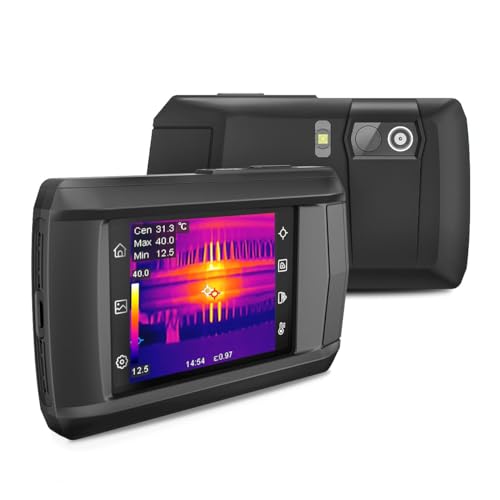
HSFTOOLS · HP96 Thermal Imaging Camera,3.5" Touch Screen, Intelligent Scene Detection | Thermal Camera with Visual Camera, 25 Hz Video Recording, 240 x 240 Super Resolution, 96 x 96 IR Resolution, -4°F to 662°F
View on AmazonPrice and availability are shown on Amazon and can change at any time.
The HP96 is a sensible first thermal camera for somebody who wants a screen, a visible-light camera and a touch interface in one handheld unit. Its 96×96 infrared sensor is modest, and the listing does not publish thermal accuracy, so treat it as a screening tool rather than a measurement instrument. The IntellFault scene detection is the headline feature, but the listing itself warns that it gives no moisture readings. Buy it if you want a self-contained camera for electrical and building walk-arounds; look elsewhere if you need documented temperature accuracy.
From box to first frame: what the HP96 asks of you before it shows a picture
The listing describes a handheld unit with a 3.5 inch touchscreen and a phone-style interface. It does not publish a battery type, a charge time, a boot time or a box contents list. Those are the first things you will want to know, and the listing is silent on all of them. What it does say is that the screen responds to swiping and tapping, that brightness, image mode, colour palette and temperature range are adjusted on screen, and that a swipe down turns on an LED flashlight.
The practical consequence is that the first hour is mostly menu learning. A touch interface on a thermal camera is a real convenience in the field, because you can change palette and range with a gloved finger instead of a keypad sequence. It also means the screen is the instrument. If the touch layer fails, the camera is a paperweight, and the listing does not describe a physical fallback. Treat the screen accordingly.
The listing mentions built-in eMMC storage and microphones for live video and audio recording and playback. It does not state the storage capacity, the recording format or the file export method. Before you rely on it for a report, record a short clip and confirm you can get it off the device. That is the first-hour test the listing cannot answer for you.
The IntellFault mode is scene detection, not a moisture meter
HSFTOOLS markets IntellFault as deep-learning scene detection that identifies water leaks and insulation gaps. The listing is careful to add a note: no moisture readings. That note matters more than the marketing line. A thermal camera sees surface temperature, not water. A damp patch usually looks cooler because evaporation and thermal mass change the surface temperature, but so do draughts, shadow, metal studs and emissivity differences. IntellFault is a pattern-recognition aid that points you at a region; it does not confirm moisture.
To use it, the listing says you download the latest firmware from the HSFTOOLS website and select Scene in the settings. That is a firmware-dependent feature, so the version you receive may not have it enabled out of the box. Check the settings menu before you assume the camera is faulty.
For the underlying physics, see how a thermal camera sees heat and whether thermal imaging can find water leaks. The short version: the camera narrows the search, and a moisture meter confirms it. If leak detection is your main job, read how to use thermal imaging for moisture problems before you buy any camera, including this one.
96×96, 240×240 and the resolution question the listing answers only halfway
The infrared sensor is 96 by 96 pixels. The listing says Live Super Resolution raises the displayed and captured image to 240 by 240 in real time. That is an interpolation and enhancement process, not a larger detector. It can make a picture easier to read, but it does not create detail that the detector did not capture. The distinction matters when you are trying to spot a small thermal bridge on a wall or a warm terminal in a crowded panel. For the general principle, see thermal camera resolution explained and how to compare thermal camera resolution.
The listing also states a thermal sensitivity below 50 mK and a 25 Hz frame rate. A lower mK figure means smaller temperature differences become visible, and 50 mK is a reasonable figure for building and electrical screening. The 25 Hz frame rate is smooth enough for handheld scanning. The 50 degree field of view is wide, which suits large-area sweeps of a wall or a switchboard, at the cost of less detail per pixel than a narrow lens would give.
The visible-light camera is 640 by 480. The listing says there are five imaging modes: Thermal, Visual, Fusion, PIP and Blending, plus eight colour palettes. Fusion and PIP overlay the visible image on the thermal one, which helps you locate a hot spot on a real object rather than a coloured blob. That is the most useful feature on the camera for a beginner, and it is the one to try first.
Temperature tracking, alarms and the accuracy figure that is not published
The HP96 tracks maximum, minimum and centre temperature points in real time and lets you set custom thresholds that trigger visual or audible alerts. That is a screening workflow: you set a limit, sweep the area, and the camera tells you when something crosses it. For electrical inspection, a threshold alarm turns a slow visual scan into a fast pass. For building work, it helps you find the coldest point on a wall without staring at the numbers.
What the listing does not publish is the temperature measurement accuracy, the measurement range, or the emissivity adjustment. Those are the three figures that decide whether a reading is a measurement or an indication. Without a stated accuracy, you cannot say a terminal is 12 degrees above ambient to any defensible tolerance. You can say it is hotter than its neighbours, which is often enough for screening but not for a report.
Emissivity is the other gap. Shiny metal, clean copper busbar and foil-faced insulation all emit less than the matte surfaces the camera assumes. The listing does not say whether you can set emissivity per material. If you cannot, readings on shiny metal will mislead you. Read why shiny metal can mislead a thermal camera and how to set emissivity before you trust a number on a busbar.
Where the HP96 stops being the right camera
The HP96 is a self-contained handheld with its own screen, storage and microphones. That makes it convenient, and it also makes it a fixed configuration. If you already carry a phone and want a camera that feeds it, the USB-C models covered in the Android thermal camera round-up are a different answer. The listing for this camera does not state a connection to a phone or a tablet, so do not assume one.
It also stops being the right tool when you need documented accuracy, a calibration certificate, or a narrow lens for small targets. The listing publishes none of those. For professional electrical work where a temperature difference must stand up in a report, read how to choose a thermal camera for electrical work and compare the stated accuracy of the alternatives before committing. The HP96 is a screening camera, and the listing’s own silence on accuracy is the clearest signal of that.
The HP96 in one paragraph
The HSFTOOLS HP96 is a well-equipped screening camera with a genuinely useful touch interface, a wide 50 degree lens and a visible-light overlay that helps you locate what you are looking at. Its 96×96 sensor and 50 mK sensitivity are adequate for finding hot and cold anomalies at a distance. The IntellFault mode is an aid, not a moisture meter, and the listing says so. The missing accuracy, range and emissivity figures are the reason to treat it as a first-pass tool rather than a measuring instrument. Buy it to find problems; use something else to prove them.
Recommended Tools


Products shown because their documented specifications fit this guide. Price and availability are on Amazon and can change.
Frequently Asked Questions
Does the HP96 measure moisture?
No. The listing explicitly states no moisture readings. IntellFault identifies patterns that may indicate water leaks or insulation gaps, but a thermal camera reads surface temperature, not water content. Confirm with a moisture meter.
What is the actual thermal resolution?
The detector is 96 by 96 pixels. Live Super Resolution produces a 240 by 240 image in real time, but that is an enhancement of the 96x96 capture, not a larger sensor. The extra pixels improve readability, not true detail.
Does the listing state temperature accuracy?
No. The listing does not publish a temperature accuracy figure, a measurement range or an emissivity setting. Without those, treat displayed temperatures as indications for screening, not as measurements for a report.
Can I record video and get it off the camera?
The listing says the camera supports live video and audio recording and playback using built-in eMMC storage and microphones. It does not state the storage capacity, the file format or the export method. Test a short recording and its transfer before relying on it.
Is IntellFault available out of the box?
The listing says you download the latest firmware from the HSFTOOLS website and select Scene in the settings. That implies the feature depends on the firmware version installed. Check the settings menu first.
What is in the box?
The listing does not publish a box contents list. It does not state a battery, a charger, a case or a cable. Confirm the contents with the seller before ordering, because the listing alone will not tell you.
Affiliate disclosure: Akermin earns a commission from qualifying Amazon purchases made through links on this page. Our editorial picks are based on documented specifications and owner feedback, not commissions.
Related Guides

FLIR One USB-C Thermal Imaging Camera Review: The Phone-Attachment Baseline
A detailed review of the FLIR One USB-C thermal camera for Android, explaining its Vivid IR upscaling, MSX image blending, stated accuracy and the practical limits of a phone-attachment design.
Read More→
Wagner Meters Orion 950 Pinless Wood Moisture Meter: A Review for Thermal Inspection Work
A review of the Wagner Meters Orion 950 pinless wood moisture meter, explaining its dual depth measurement, Bluetooth reporting, and where it stops being the right instrument next to a thermal camera.
Read More→
Tramex Moisture Encounter ME5 Review: The Dual-Depth Pinless Meter
A detailed look at the Tramex ME5 pinless moisture meter, centered on its dual-depth measurement and its practical limits.
Read More→