As an Amazon Associate, Akermin earns from qualifying purchases. Product links on this page are affiliate links.
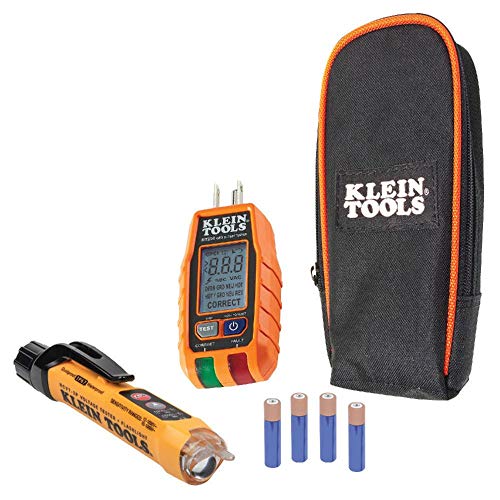
KLEIN TOOLS · Klein Tools RT250KIT Non-Contact Voltage Tester and GFCI Receptacle Tester with LCD and Flashlight, Voltage Electrical Test Kit
View on AmazonPrice and availability are shown on Amazon and can change at any time.
The RT250KIT is a two-piece kit: the NCVT3P non-contact voltage tester and a GFCI receptacle tester with a backlit LCD. The listing states the pen detects 12 to 1000 V AC or 70 to 1000 V AC depending on the range selected. That dual range is the specification that decides whether the kit suits your work. If you need to confirm absence of voltage on standard branch circuits, the 70 to 1000 V AC band is the relevant one. If you work on low-voltage control wiring, the 12 to 1000 V AC band is the reason to pick this kit over a single-range pen. The GFCI tester adds trip-time display and open neutral and open ground detection. The listing does not publish a trip-time threshold, an accuracy figure for the pen, or an IP rating, so treat those as unknowns rather than assume them.
The two voltage bands, and why the lower one changes the job
Most non-contact voltage testers are sold with one detection range. The NCVT3P in this kit is listed as detecting 12 to 1000 V AC or 70 to 1000 V AC. Those are two separate bands, not one continuous specification. The lower band starts at 12 V, which is the range you want when you are checking thermostat wiring, doorbell transformers, irrigation control circuits or other low-voltage work. The upper band starts at 70 V, which is the range you want on standard 120 V and 240 V branch circuits and feeders.
Why does the split matter? A non-contact tester works by sensing the electric field around a conductor. At low voltages the field is weak, and a tester set to a 70 V floor will not respond to a 24 V control line at all. That is not a fault; it is the band doing its job. The practical consequence is that you must know which band you are on before you trust a silent pen. A silent pen on the 70 V band tells you the conductor is below 70 V, not that it is dead. On the 12 V band, a silent pen tells you something different. The listing does not state how the band is selected, whether by a switch or a button, and it does not publish a tolerance for either band.
For readers new to the technology, the mechanism is worth understanding before you rely on it: how non-contact voltage detection works explains the field-sensing principle and its limits.
What the GFCI tester’s LCD actually reports
The second piece in the kit is a GFCI receptacle tester with a large backlit LCD. The listing states it shows the time required to trip a GFCI device and that it detects and identifies common wiring faults. It also states patent-pending open neutral and open ground detection.
Trip time is the useful number here. A GFCI that trips is not necessarily a GFCI that trips fast enough. The listing does not publish the threshold the tester uses to judge a pass, and it does not state the resolution of the displayed time. So the readout is best treated as a comparative tool: you can see that one receptacle trips noticeably slower than another on the same circuit, or that a receptacle’s trip time changes between visits. What the listing does not give you is a pass or fail limit you can quote.
Open neutral and open ground detection are the other reason to carry this rather than a three-light plug tester. A three-light tester can show a wiring fault, but the listing here claims specific identification of open neutral and open ground. The listing does not state how those conditions are displayed, so read the manual before you interpret the screen.
The kit format: what is in the box and what is not stated
The title describes the product as a voltage electrical test kit containing a non-contact voltage tester and a GFCI receptacle tester with LCD and flashlight. The listing bullets describe the GFCI tester’s LCD, trip time display, wiring fault detection and open neutral and open ground detection. The dual-range bullet describes the NCVT3P non-contact tester.
The listing does not publish the case, the lead length, the battery type, the battery life, the operating temperature range, the IP rating, the CAT safety rating, or the dimensions and weight of either piece. Those are the figures a buyer would normally check, and they are simply absent from the supplied text. Do not assume a CAT rating from the brand or the kit format. If your work requires a rated instrument for a specific environment, confirm that from the manufacturer’s documentation before purchase.
The flashlight is mentioned in the title but the listing does not state its output, whether it is on the pen or the receptacle tester, or whether it is a separate light. Treat it as a convenience feature, not a specification you can plan around.
Where a non-contact pen stops being the right answer
A non-contact voltage tester confirms the presence of voltage. It does not confirm absence of voltage with the certainty that a contact measurement does. The standard safe practice is to verify the tester on a known live source, test the target conductor, then verify the tester again. The listing does not state whether the NCVT3P has a self-test function, so you should plan to prove it against a known source each time.
The kit also does not measure voltage as a number. If you need to record 123.4 V or confirm a 240 V split, you need a contact meter. The site’s guide to measuring AC voltage with a multimeter covers that procedure. For readers comparing pen-style testers more broadly, the non-contact voltage tester comparison sets this kit against single-range alternatives. And if you need to trace a circuit rather than confirm voltage on a known point, a fault finder is a different tool; the electrical fault finder guide explains the difference.
For a wider view of what belongs in a basic electrical kit, including clamp meters and multimeters, see the electrical tester comparison. The RT250KIT covers voltage presence and GFCI testing; it does not cover current measurement, resistance, continuity or insulation resistance.
Maintenance and the checks nobody mentions
Two maintenance points matter with this kit. First, the non-contact pen’s sensitivity depends on its antenna and its battery. A weak battery can make a pen behave erratically, and the listing does not state a low-battery indicator. Replace the battery on a schedule rather than waiting for a symptom. Second, the GFCI tester’s prongs and the receptacle contacts they enter accumulate wear. A loose fit can give a misleading result. Inspect the prongs and replace the tester if they are bent or pitted.
The listing does not publish a calibration interval or a method for verifying the trip-time display. If you use the trip-time figure for compliance records, confirm with the manufacturer whether the unit is intended for that purpose. For most users this is a troubleshooting aid, not a calibrated instrument.
Who the RT250KIT suits, and who should look elsewhere
Buy the RT250KIT if you want one kit that covers two jobs: confirming voltage presence on standard circuits and on low-voltage control wiring, and testing GFCI receptacles with a trip-time readout and open neutral and open ground detection. The 12 to 1000 V AC band is the reason to choose this over a single-range pen. The listing is silent on accuracy, CAT rating, IP rating and battery details, so if any of those is a hard requirement for your work, confirm them from the manufacturer before you buy. If you need to measure voltage as a number, or to measure current or continuity, this kit is not that instrument; a multimeter or clamp meter is. The RT250KIT is a presence and fault tester, not a measuring instrument.
Recommended Tools


Products shown because their documented specifications fit this guide. Price and availability are on Amazon and can change.
Frequently Asked Questions
Does the non-contact tester detect 12 V and 120 V on the same setting?
The listing states two bands: 12 to 1000 V AC and 70 to 1000 V AC. It does not state whether the band is selected manually or automatically. You should confirm the selected band before relying on a silent reading.
What trip time should a GFCI show?
The listing does not publish a pass threshold or a resolution for the trip-time display. It states that the LCD shows the time required to trip a GFCI device. Use it for comparison between receptacles and over time, not as a quoted pass limit unless the manufacturer provides one.
Is the RT250KIT a multimeter?
No. The listing describes a non-contact voltage tester and a GFCI receptacle tester. It does not state that the kit measures voltage as a number, current, resistance or continuity. For those measurements you need a multimeter or clamp meter.
Does the kit include a case and batteries?
The listing does not state what accessories are included beyond the two testers described in the title and bullets. It does not publish battery type or whether batteries are supplied.
Can I use the non-contact pen to confirm a circuit is dead before working on it?
A non-contact tester indicates the presence of voltage. It is not a substitute for a contact measurement and a lockout procedure. The listing does not state a self-test function, so prove the pen on a known live source before and after each use.
What safety rating does the kit carry?
The listing does not publish a CAT rating or any other safety rating for either tester. Do not assume one from the brand or the kit format; confirm it from the manufacturer's documentation if your work requires a rated instrument.
Affiliate disclosure: Akermin earns a commission from qualifying Amazon purchases made through links on this page. Our editorial picks are based on documented specifications and owner feedback, not commissions.
Related Guides

Klein Tools CL900 Clamp Meter Review: What the Listing Leaves Out
A specification-by-specification review of the Klein Tools CL900 that flags every gap in the published listing.
Read More→
Southwire GFCI Receptacle Tester Review: One Button, Seven Checks, and the Cost of Getting It Wrong
The Southwire GFCI receptacle tester is a compact seven-mode wiring checker whose real cost is in the button, the leads and the reference it does not ship with.
Read More→
ALLOSUN EM3082 Pocket Multimeter Review: What the Listing Leaves Out
A specification-led review of the ALLOSUN EM3082 that separates what the listing states from what it omits, and explains the practical consequences of each gap.
Read More→