Skip to content
AkerminMeasure. Monitor. Improve. Compare Products

Best Digital Multimeters: 10 Precision Picks for Reliable Electrical Testing

Digital multimeter covers three very different instruments: a six and a half digit bench reference, a clamp that reads current without breaking a circuit, and a handheld that puts a waveform beside the number. This page compares ten of them on what their listings actually publish, and says plainly which specification every single one of them omits.

  • Independent Research
  • Verified Specifications
  • Honest Recommendations

Know the Group
Check the Counts
Check the Rating

As an Amazon Associate, Akermin earns from qualifying purchases. Product links on this page are affiliate links.

Our Top Picks

Meters were grouped by what they physically are, then compared on the display resolution each listing states in counts or digits, any published accuracy figure, the measurement functions named, and the interfaces offered. Figures are the manufacturers' own. Where a listing publishes no value the cell reads Not stated. We ran no laboratory tests and publish no measurements of our own.

Best Overall
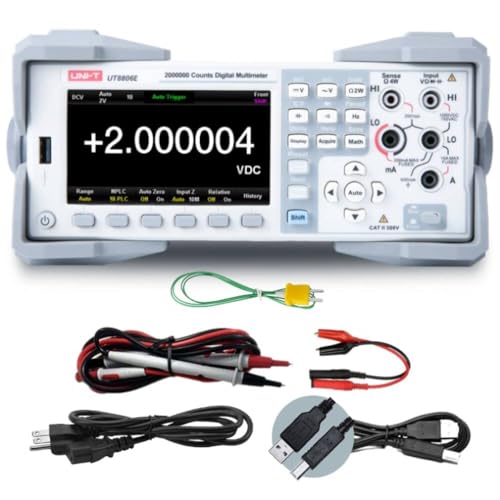
UNI-T UT8806E 6.5 Digit Benchtop Multimeter

UNI-T UT8806E 6.5 Digit Benchtop Multimeter

The only listing on this page that publishes an accuracy figure.

  • 6.5 digit display with 1,999,999 counts, stated
  • 0.0035 percent accuracy stated, the only accuracy figure published here
  • True RMS and auto-ranging, stated on the listing
  • Dual display on a 4.3 inch TFT, with USB and RS232 interfaces
View on Amazon Read Full Review→
Best for Repeat Testing
Siglent SDM3065X-SC with SC1016 Scanner Card

Siglent SDM3065X-SC with SC1016 Scanner Card

A six and a half digit bench meter that steps through sixteen channels by itself.

  • 6.5 digit digital multimeter, stated on the listing
  • Supplied with the SC1016 scanner card
  • 4.3 inch TFT-LCD at 480 by 272, stated
  • Accuracy figure not published on this listing
View on Amazon Read Full Review→
Best Value
OWON HDS242 Handheld Oscilloscope Multimeter

OWON HDS242 Handheld Oscilloscope Multimeter

A 20000 count meter with a 40 MHz two-channel scope behind it.

  • 20000 count digital multimeter, stated on the listing
  • 40 MHz two-channel handheld oscilloscope in the same instrument
  • Measures AC and DC voltage and current, plus resistance, per the listing
  • Listing notes no standalone lithium batteries are supplied with the product
View on Amazon Read Full Review→

Comparison Table

View Full Comparison→
ProductGroupStated resolutionStated accuracyOther stated detail
UNI-T UT8806EBenchtop6.5 digit, 1,999,999 counts0.0035 percentTrue RMS, auto-ranging, dual display 4.3 inch TFT, USB and RS232View
Siglent SDM3065X-SCBenchtop with scanner6.5 digitNot statedSC1016 scanner card, 4.3 inch TFT-LCD at 480 by 272View
Siglent SDM3065XBenchtop6.5 digitNot stated4.3 inch TFT-LCD at 480 by 272View
Hantek HDM3065XBenchtop6.5 digitNot statedReading resolution is the only figure on the listingView
BTMETER 3-phase power clampClamp multimeter9999 countsNot statedTrue RMS, AC and DC volts and amps, inrush, capacitance, diode, continuity, temperature, kWView
ETCR6920B Rogowski clampFlexible coil clamp meterNot statedNot statedAC current 0 mA to 10,000 A, 750 V AC and 1000 V DC, resistance 0 to 2 kilohm, 300 mm coilView
OWON HDS242Handheld scope meter20000 countsNot stated40 MHz two channel scope, AC and DC voltage, current, resistanceView
FNIRSI 2C53PHandheld scope meter19999 countsNot stated50 MHz two channel, 250 MS/s, DDS signal generator, 5 measured valuesView
ZOTEK 702SHandheld scope meterNot statedNot stated10 MHz, 48 MS/s, 2.8 inch IPS, plus and minus 400 V input, auto, normal and single triggerView
IMARS 2-in-1 testerHandheld scope meterNot statedNot stated1 MHz single channel scope with an auto-ranging multimeterView

Figures are the manufacturers' own. One of the ten publishes an accuracy figure and six publish a resolution in counts or digits. Not one publishes a CAT safety category or a maximum input voltage, which is discussed in the text below. Nothing here is a measurement of ours.

How to Choose a Digital Multimeter

Four things, and the first is not a specification:

Which Group You Need

A bench reference, a clamp that reads current without breaking the circuit, and a scope meter that shows a waveform are three different tools. Almost none of them substitutes for another.

Counts Are Not Accuracy

Counts describe how finely the display divides a range. Accuracy describes how close the number is to reality. Only the UNI-T listing publishes the second, at 0.0035 percent.

True RMS on Distorted Waveforms

Drives, LED supplies and switching loads distort the current waveform, and an averaging meter reads them low. Two listings here state true RMS: the UNI-T bench meter and the BTMETER clamp.

The Rating Nobody Prints

No listing on this page states a CAT category or a maximum input voltage. Until the manual confirms one, treat every instrument here as a low-energy tool, not a panel instrument.

Frequently Asked Questions

View All FAQs→
Why does none of these listings state a CAT rating?

Partly because most of them are not intended for mains distribution work. The four benchtop instruments are laboratory equipment, and the scope meters are electronics tools. The clamp meters are the entries where the omission matters, because a clamp is used around live conductors by definition. The rating usually exists in the manual, so the practical rule is simple: do not use any of these on a circuit until you have read what it is rated for, and never above that rating.

What is the difference between counts and digits?

They describe the same thing two ways. A 6000 count meter can display any value from 0 to 6000 before it has to change range. A 6.5 digit meter displays six full digits plus a leading digit limited to 1 or 2, which is where 1,999,999 counts comes from. More counts means finer resolution on the display, and says nothing at all about whether that finely divided number is correct.

Do I need true RMS?

If you measure anything fed by a drive, an inverter, an LED driver, a switching supply or a dimmer, yes. Those loads distort the waveform, and an averaging meter calibrated for a clean sine wave reads them low, sometimes badly. On a clean mains sine wave the two methods agree closely. Two listings here state true RMS, the UNI-T bench meter and the BTMETER clamp, and the rest are silent on it.

Is a scope meter a real multimeter?

The four here are, and their listings state the meter specifications directly: 20000 counts on the OWON, 19999 on the FNIRSI, and auto-ranging multimeter functions on the IMARS and ZOTEK. What you gain is the ability to see what the number is hiding, which matters on any circuit with a switching or pulsed signal. What you usually give up is input protection and safety rating, because these are electronics instruments rather than electrician tools.

Reviews

UNI-T UT8806E 6.5 Digit Benchtop Multimeter

UNI-T UT8806E 6.5 Digit Benchtop Multimeter Best Overall

Across ten listings for digital multimeters, exactly one states how accurate the instrument is. UNI-T publishes 0.0035 percent alongside a 6.5 digit display and 1,999,999 counts, and that combination is the reason this is the overall pick rather than one of the more famous bench names. Counts describe how finely the meter divides its range, which is resolution; accuracy describes how close the displayed number is to the real value. A meter can have enormous resolution and be wrong, and a listing that quotes only counts is telling you half the story.

The practical value of 1,999,999 counts is that a reading does not have to change range to gain a decimal place. At 4.5 digits a meter jumps from 19.999 to 199.99 volts and you lose resolution at the transition. At 6.5 digits the same instrument holds six significant figures across the range, which is what makes it a reference the other meters in the room get checked against.

The listing also states true RMS, auto-ranging, a dual display on a 4.3 inch TFT, and USB and RS232 with alligator leads supplied. What it does not state, along with every other product on this page, is a CAT safety rating or a maximum input voltage. A bench instrument is a bench instrument: it belongs on low-energy circuits, not on a distribution panel.

Strengths

  • The only published accuracy figure in this group, 0.0035 percent
  • 6.5 digits and 1,999,999 counts of resolution
  • True RMS and auto-ranging both stated
  • USB and RS232 for logging, with leads supplied

Limitations

  • No CAT rating or maximum input voltage stated
  • Mains powered bench format, not a field instrument
  • Temperature coefficient and calibration interval not stated
View on Amazon
Siglent SDM3065X-SC with SC1016 Scanner Card

Siglent SDM3065X-SC with SC1016 Scanner Card Best for Repeat Testing

A scanner card changes what a bench meter is for. Without one, measuring sixteen points means sixteen manual connections, sixteen chances to touch the wrong terminal and a transcription step between each. With one, the instrument steps through the channels on its own and records each reading against its channel number. For production test, temperature profiling across a heatsink, insulation checks on a loom or any repeated sequence, that is the difference between a morning and a coffee break.

The base instrument is the SDM3065X, a 6.5 digit meter with a 4.3 inch colour display at 480 by 272, and Siglent is a name that turns up in laboratories rather than tool bags. This variant bundles the SC1016 card in the box, which is usually the cheaper route than buying the card separately later.

The listing is oddly minimal, stating the digit count, the card and the display and nothing else. There is no accuracy figure, no count figure, no function list, no input protection statement and no interface list. Those all exist in Siglent documentation, but a buyer comparing this against the UNI-T on the listings alone has no accuracy figure to compare.

Strengths

  • Scanner card included rather than bought separately
  • 6.5 digit resolution on a recognised laboratory brand
  • Colour 4.3 inch display at 480 by 272
  • Turns a repeated manual sequence into an automated one

Limitations

  • No accuracy figure published on the listing
  • Counts, functions and interfaces not listed
  • Highest price here, and the card is wasted on single-point work
View on Amazon
OWON HDS242 Handheld Oscilloscope Multimeter

OWON HDS242 Handheld Oscilloscope Multimeter Best Value

A number tells you the average of something. A waveform tells you what that something is doing. On a modern circuit that distinction decides whether a fault is findable at all, because a drive output, a PWM signal, a sensor pulse train and a noisy supply rail can all produce a perfectly reasonable number on a meter while being obviously wrong on a screen. The HDS242 puts both in one hand for roughly what a mid-range meter alone costs.

The meter side is genuinely specified rather than an afterthought: 20000 counts, which is more resolution than most 6000 count field meters, and AC and DC voltage and current plus resistance. The scope side states 40 MHz across two channels, which is enough bandwidth for control signals, communication buses and switching supplies, if not for radio frequency work.

Two caveats. The listing notes that no standalone lithium batteries are sold with the product, which is a shipping restriction worth knowing before ordering. And like every other instrument on this page, it publishes no CAT rating and no maximum input voltage, which for a handheld that will inevitably be used near a panel is the gap that matters most.

Strengths

  • 20000 counts, better resolution than most 6000 count field meters
  • 40 MHz two-channel scope included
  • Handheld, so it goes to the fault rather than the other way round
  • Lowest price here for a combined meter and scope

Limitations

  • No CAT rating or maximum input voltage stated
  • No accuracy figure published
  • Battery supply restrictions noted on the listing
View on Amazon

Buying Guide

Short answer: the UNI-T UT8806E is the pick for bench work and the only instrument on this page whose listing publishes an accuracy figure, stating 0.0035 percent alongside 6.5 digits and 1,999,999 counts; the Siglent SDM3065X-SC is the one to buy if you measure the same sixteen points repeatedly, because the SC1016 scanner card is in the box; and the OWON HDS242 is the value pick, a 20000 count handheld with a 40 MHz two-channel scope behind it.

Why this page lists ten and not twelve

Fifteen listings were supplied and five of them are not digital multimeters. The uxcell item is a set of test leads with alligator clips, which is an accessory. The HANMATEK HO52 is a two-channel 50 MHz oscilloscope with no multimeter function stated anywhere on its listing. The Morning Group unit is a battery monitor that installs with an external shunt and displays voltage, current, power and accumulated capacity continuously; it is wired into a system and left there, which is monitoring rather than testing. The Proster item is an LCR meter, measuring inductance, capacitance and resistance but neither voltage nor current, which makes it a component instrument rather than a multimeter. And the parasitic drain tester is a single-purpose automotive tool for reading dark current at the battery terminals. Each is a legitimate product and none of them is a digital multimeter, so the number in the heading is ten.

Three instruments, one label

The table leads with a group column because that is the decision that actually matters. Four of these ten are benchtop instruments: the UNI-T UT8806E, both Siglent SDM3065X variants and the Hantek HDM3065X, all 6.5 digit, all mains powered, all designed to sit on a bench and be the meter other meters get checked against. Two are clamp meters, the BTMETER three-phase power clamp and the ETCR6920B flexible Rogowski coil, both of which read current without breaking into a circuit. Four are handheld scope meters, the OWON HDS242, FNIRSI 2C53P, ZOTEK 702S and IMARS unit, each combining a digital multimeter with an oscilloscope in one hand-held body. A bench meter cannot go up a ladder, a clamp cannot measure resistance the way a bench meter does, and a scope meter shows you something neither of the others can. Naming the job first is the whole of this purchase.

Counts, digits and the figure nobody quotes

Six of these ten publish a resolution figure and one publishes an accuracy figure, and the distinction between those two things is the most commonly misunderstood point in meter buying. Counts and digits describe how finely the display divides its range: 20000 counts on the OWON, 19999 on the FNIRSI, 9999 on the BTMETER clamp, and 1,999,999 counts or 6.5 digits on the bench instruments. Accuracy describes how close the displayed number is to the actual value, and is quoted as a percentage of reading plus a number of counts. A meter with six digits of resolution and unstated accuracy will happily display a wrong number to six significant figures. UNI-T is the only manufacturer here that publishes both, at 0.0035 percent, and that is the single strongest reason it takes the overall pick. What resolution means on a digital meter covers the relationship in more depth.

The rating that is missing from every listing

Not one of these ten listings states a CAT safety category, and not one states a maximum input voltage. That is a whole-category omission rather than a gap on one product, and it needs saying plainly rather than being papered over with Not stated cells. CAT II, CAT III and CAT IV describe how much transient energy an instrument is built to survive at different points in an electrical installation, and the classification exists because a meter that is perfectly safe on a benchtop power supply can fail violently across a distribution board where the available fault energy is orders of magnitude higher. The absence of the rating from these listings does not mean the instruments are unrated; it means the rating lives in the manual. Until you have read it, treat every instrument on this page as a low-energy tool. Never use any meter above its stated category or voltage rating, and prove a circuit dead with a rated tester rather than assuming. Understanding CAT II, CAT III and CAT IV ratings explains what each category covers.

What the bench instruments are actually for

Four 6.5 digit meters on one page looks like repetition until you look at what separates them. Resolution at this level is not about reading a battery more precisely; it is about being able to see a change. A 4.5 digit field meter reading 5.001 volts cannot tell you whether a reference has drifted by a hundred microvolts, and a 6.5 digit instrument can. That is why these instruments are used for calibration checks, for characterising components across temperature, for verifying that a supply is stable over hours rather than instants. The SDM3065X-SC extends that into automation with its scanner card, stepping through sixteen channels without a human moving leads, which is how insulation checks on a loom or temperature profiling across a heatsink get done without transcription errors. The Hantek listing, by contrast, states nothing but the digit count, which makes it impossible to compare on anything else.

Clamps and the Rogowski exception

The BTMETER three-phase clamp is the most function-dense instrument here, its listing naming AC and DC voltage and current, inrush current, resistance, capacitance, diode, continuity and temperature, plus true power and kilowatt readings at 9999 counts with true RMS. That combination makes it a genuine electrician instrument rather than an electronics one. The ETCR6920B is the odd entry and a useful one: instead of a rigid jaw it uses a flexible Rogowski coil 300 mm across, which wraps around a busbar, a cable bundle or an awkward conductor that no fixed clamp would close over, and reads up to 10,000 amps. Its limitation is inherent to the physics: a Rogowski coil responds to a changing magnetic field, so it measures alternating current and cannot read DC at all. Its voltage and resistance functions still work, but anybody buying it for a battery system or a solar string would be disappointed.

Scope meters and why the waveform matters

A multimeter reduces a signal to one number several times a second, and that number is an average. On a clean DC rail or a sine wave that is a fair summary. On anything switched it is not. A PWM output feeding a motor, a sensor sending a pulse train, a supply rail with ripple, a drive output with a carrier on it: all of these can produce a plausible reading while the actual waveform is obviously faulty. The four scope meters here put the waveform beside the number, at 40 MHz and two channels on the OWON, 50 MHz and two channels plus a DDS signal generator on the FNIRSI, 10 MHz on the ZOTEK with a 2.8 inch IPS screen and plus or minus 400 volt input, and 1 MHz on the single-channel IMARS. The signal generator on the FNIRSI is worth noting because it makes the instrument capable of stimulating a circuit as well as observing it, which halves the equipment needed for board-level fault finding.

Guides in This Category
How We Research

Instruments were first grouped as benchtop meters, clamp meters or handheld scope meters, since those are different tools sold under one label. Within each group they were compared on stated display resolution in counts or digits, any published accuracy figure, stated measurement functions, true RMS where claimed, and interfaces. Five products supplied with this group were excluded as off-category and the reasons are given on the page. We ran no laboratory tests and publish no measurements of our own. Amazon data supplies images, availability and links only.

Read our full review methodology→