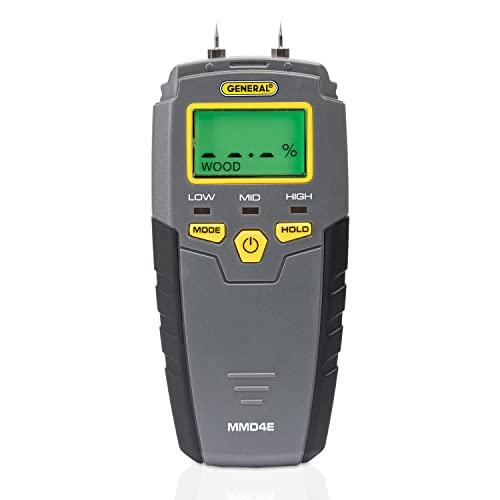
How to Use a Moisture Meter on Wood
Set the species, read along the grain at the right depth, take several readings, and compare with the target for the job.
Read Guide→Research-based buying guides that compare the leading options by documented specifications, real use cases and value.

Set the species, read along the grain at the right depth, take several readings, and compare with the target for the job.
Read Guide→
Roof survey cameras: the native 320x240 FLIR E8 Pro for surveys, the phone-linked FLIR Edge Pro for ladder work and the MiLESEEY TR20 with a stated NETD.
Read Guide→
Select the drywall or reference scale, zero on a dry area, scan in a grid, confirm with pins, and mind the studs and wiring.
Read Guide→
Leak-tracing cameras: the pocket FLIR C8, the Wi-Fi FLIR E5 Pro for restoration reports and the FLIR ONE Pro with a guided moisture inspection in the app.
Read Guide→
Ask what you need to know: where the moisture is, or how much. That answers most of it.
Read Guide→
HVAC cameras sorted by the call: the FLIR E6 Pro for coils and compressors, the laser-marked FLIR TG268 for spot readings and the 15-hour TOPDON TC004 Mini.
Read Guide→
Pinless to find, pins to prove, material scales that match your work, and a reference reading habit.
Read Guide→
Eleven current cameras sorted by form factor and native detector: the FLIR E8 Pro for reports, the pocket FLIR C8 and the Android TOPDON TC001 Plus.
Read Guide→
Distance-to-spot ratio for your targets, a range that covers them, adjustable emissivity, and a laser that shows the spot, not just the center.
Read Guide→
Scan for cool patches that do not match the framing, then prove them with a moisture meter. Never open a wall on the image alone.
Read Guide→
Cold morning, heating on, locked span, scan every exterior wall and ceiling from inside. The gaps draw themselves.
Read Guide→
Leave it at 0.95 for buildings, set reflected temperature, and use tape or a known-emissivity trick for metal.
Read Guide→