As an Amazon Associate, Akermin earns from qualifying purchases. Product links on this page are affiliate links.
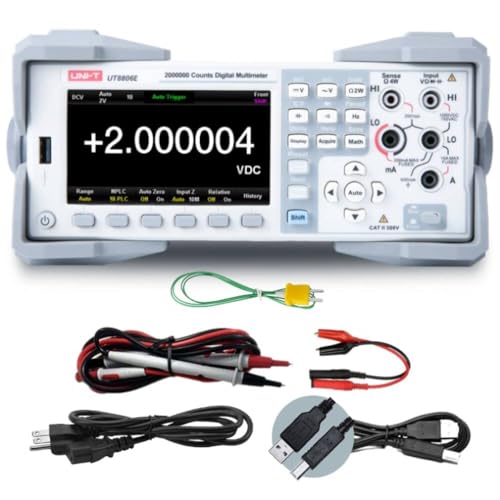
UNI-T · UNI-T UT8806E 6.5 Digit Performance-Series Benchtop Digital Multimeter 1,999,999 Counts Auto-Ranging TRMS Dual Display 4.3 inch Touchscreen 0.0035% Accuracy
View on AmazonPrice and availability are shown on Amazon and can change at any time.
Verdict
The UNI-T UT8806E is a benchtop instrument for people who need to see small differences. The listing states 6.5 digit resolution at 1,999,999 counts, 0.0035 percent accuracy, auto-ranging True RMS, a 4.3 inch TFT touchscreen with number, bar graph, trend graph and histogram views, dual display of an AC measurement alongside its frequency, and a supplied calibration report with USB and RS232 interfaces. For calibration work, component matching, production testing or any measurement where the last three digits matter, it does what a handheld cannot.
Documented Specifications
| Item | Manufacturer listing |
|---|---|
| Resolution | 6.5 digits, 1,999,999 counts |
| Accuracy | 0.0035 percent |
| Measurement | Auto-ranging True RMS |
| Display | 4.3 inch TFT touchscreen, dual display |
| Display modes | Number, bar graph, trend graph, histogram |
| Interfaces | USB printing cable, RS232 interface cable |
| Supplied | Alligator clip leads, probe pen, K type temperature probe, power cord, calibration report |
What Six and a Half Digits Buys
A handheld meter at 6000 counts shows a 5 V supply as 5.000 V. A 6.5 digit meter shows it as 5.000000 V, and that is not vanity. It means you can see a supply drift by a hundred microvolts as a room warms, match two resistors to a tolerance far tighter than either is sold at, watch a reference settle after power on, or detect a thermal EMF in your own connections. None of those measurements exist on a handheld, because the information is below its last digit.
The distinction between resolution and accuracy is worth keeping straight. Resolution is how finely the number is divided, accuracy is how close the number is to reality. A meter with enormous resolution and poor accuracy shows you differences precisely while getting the absolute value wrong, which is still useful for comparisons and useless for calibration. This listing publishes both, which is the right way round.
Four Ways of Looking at One Measurement
The display modes are more than decoration. A number tells you the present value. A trend graph shows drift over time, which is how you see a circuit warming up or a battery discharging. A histogram shows the distribution of readings, which is how you distinguish random noise from a systematic shift, and it is the fastest way to see that a measurement is unstable rather than simply wrong. A bar graph gives an analogue feel for adjustment, which is what you want while turning a trimmer.
RS232 and USB Say Something About the Intended User
An RS232 interface on a modern instrument is a sign that it is expected to live in a test rack talking to a system, not on a hobby bench. Combined with the supplied calibration report, the picture is of an instrument meant for documented measurement: production test, incoming inspection, calibration of other tools. If that is your world, those two details matter more than the touchscreen.
Getting Six Digits of Value
- Let the meter warm up. Precision instruments specify a warm-up period and readings drift before it elapses.
- Use four-wire measurement for low resistance if the meter supports it; lead resistance swamps small values otherwise.
- Watch for thermal EMF at connections. Dissimilar metals generate microvolts, which is visible at this resolution.
- Keep the calibration report and note the interval. A precision meter out of calibration is just a precise-looking meter.
Strengths
- 6.5 digits with a published 0.0035 percent accuracy.
- Four display modes including histogram and trend.
- Calibration report and a full accessory set supplied.
- Dual display showing AC measurement and frequency together.
Limitations
- Mains powered and bench bound, so no field use.
- No safety category rating in the bullets.
- Resolution is wasted on ordinary electrical work.
- A calibration report is a snapshot; keeping it meaningful means paying for recalibration.
How It Compares
The Siglent SDM3065X is the closest alternative at the same digit count with sensor measurement software. For field work at high resolution, the Fluke 289 offers logging in a handheld instead. Our ranking is in the multimeter roundup.
How We Research
All figures come from the manufacturer listing. We did not run laboratory tests and publish no measurements of our own.
Recommended Tools
UNI-T UT8806E 6.5 Digit Performance-Series Benchtop Digital Multimeter 1,999,999 Counts
View on Amazon

Products shown because their documented specifications fit this guide. Price and availability are on Amazon and can change.
Frequently Asked Questions
What does 6.5 digits mean?
The display resolves 1,999,999 counts, so a 2 V range reads to a microvolt. That is roughly 300 times the resolution of a 6000 count handheld, and it is what allows small drifts and differences to be seen at all.
What accuracy does it state?
The listing states 0.0035 percent. Accuracy and resolution are different things: resolution is how finely the reading is displayed, accuracy is how close it is to true. A bench meter needs both, and this listing publishes both.
Does it come with a calibration report?
The listing includes a calibration report among the supplied accessories, along with USB and RS232 cables, alligator clip leads, a probe pen, a K type temperature probe and a power cord.
What is the dual display for?
The listing states that when measuring AC voltage or current you can display frequency at the same time, so two properties of the same signal appear together rather than requiring two measurements.
Affiliate disclosure: Akermin earns a commission from qualifying Amazon purchases made through links on this page. Our editorial picks are based on documented specifications and owner feedback, not commissions.
Related Guides

Hioki PD3129 Review: A Non-Contact Phase Rotation Meter and Its Ownership Costs
A single-product review of the Hioki PD3129, focused on its non-contact measurement method, published CAT III 600V rating, and the consumable and maintenance questions the listing does not answer.
Read More→
Klein Tools RT110 Outlet Tester Review: What the Listing Does Not Say
A close reading of the Klein Tools RT110 listing, covering the published specifications, the missing fault-code table, and where a three-light tester stops being the right tool.
Read More→
Testo 770-2 Clamp Meter Review: The Hook-Clamp That Decides the Job
A mechanism-first review of the Testo 770-2 hook-clamp meter, including what the listing states, what it omits, and where the hook design stops being the right answer.
Read More→