Best Multimeters for Electronics Repair: 5 Picks for the Bench
Field multimeters are built around safety ratings and rugged cases. A bench meter for electronics is built around resolution, stability and getting numbers into a computer, which are different problems entirely.
As an Amazon Associate, Akermin earns from qualifying purchases. Product links on this page are affiliate links.
Our Top Picks
Meters were compared on display count and digits, stated accuracy, logging depth and export route, computer interfaces and remote control support, display arrangement and power. We did not run laboratory tests and publish no measurements of our own.
Best Overall
Labloot LB1041 Bench Multimeter
55,000 counts with a stated 0.05 percent DC accuracy, 1000 point logging and SCPI support.
55,000 counts on a 3.5 inch 480 by 320 TFT with backlight
DC voltage accuracy stated up to 0.05 percent, dual line display supported
Manual and automatic data recording, up to 1,000 points, exportable to a computer
True RMS AC voltage and current, trend analysis in chart mode, SCPI support
None of these listings states a safety category rating. Bench instruments for electronics are not intended for mains distribution work; use a properly rated handheld for anything upstream of a socket.
How to Choose a Bench Meter for Electronics
Resolution is what you notice first and stability is what you end up caring about.
Counts Are Not Accuracy
Counts describe how finely the display divides a range. Accuracy describes how close the number is to true. A meter quoting only counts is telling you half the story.
Relative Mode Is the Bench Workhorse
Null out lead resistance or a standing offset and measure the difference. It is how small changes are actually observed, and it is on almost every meter here.
Interfaces Turn a Meter Into a System
SCPI or a supplied software package lets a meter be scripted, logged and combined with other instruments. That is the difference between a display and a test setup.
Histograms Separate Noise From Drift
A distribution shows whether readings are scattered or shifting. A single number cannot distinguish an unstable measurement from an inaccurate one.
These Are Not Mains Meters
No listing here states a safety category rating. Keep a properly rated handheld for anything at or above outlet level and use these for low voltage electronics.
Let It Warm Up
Precision instruments specify a warm-up period, and readings drift before it elapses. Switch on, make tea, then measure anything that matters.
How many counts do I actually need for repair work?
For finding a dead rail, a shorted capacitor or an open track, 6,000 counts is plenty and a cheap handheld does the job. Higher resolution earns its place when you are comparing two similar parts, watching a supply drift, or measuring something whose variation is smaller than a handheld last digit.
What is the difference between counts and digits?
Counts describe how many increments the display can show, so 6,000 counts means readings up to 6000 before the range changes. Digits is the older convention, where 6.5 digits means roughly 1,999,999 counts. Both describe resolution, neither describes accuracy.
Do I need SCPI support?
Only if you intend to control the meter from a computer. It is the standard command language test instruments use, and it matters for automated test, batch characterisation and long unattended measurements. For hand-operated repair work it is irrelevant.
Are bench meters safe for mains work?
None of these listings states a safety category rating, and bench instruments for electronics are generally not intended for mains distribution measurement. Keep a properly rated handheld for anything at or above outlet level.
Why do my readings drift when I first switch on?
Because precision instruments need to reach thermal equilibrium. Manufacturers specify a warm-up period for exactly this reason. Switch the meter on, leave it for the stated time, and only then take measurements that matter.
What causes microvolt errors at high resolution?
Thermal EMF at the connections. Dissimilar metals in contact generate small voltages that vary with temperature, and at 6.5 digits those become visible. Use consistent connections, avoid handling the terminals immediately before measuring, and let everything settle.
Reviews
Labloot LB1041 Bench Multimeter Best Overall
SCPI support is the detail that lifts this above the other bench meters here. It is the standard command language test instruments use, which means the meter can be driven from a script rather than only by hand. For anyone building a small test setup, characterising a batch of parts or running an overnight measurement, that turns a meter into a component of a system.
The measurement specification backs it up. At 55,000 counts with a stated 0.05 percent DC accuracy you can see differences a handheld cannot, and the trend chart mode plus 1,000 logged points means drift can be watched rather than sampled. Publishing both the count and the accuracy is the right way round: resolution tells you what the display can show, accuracy tells you whether to believe it, and plenty of instruments quote only the first.
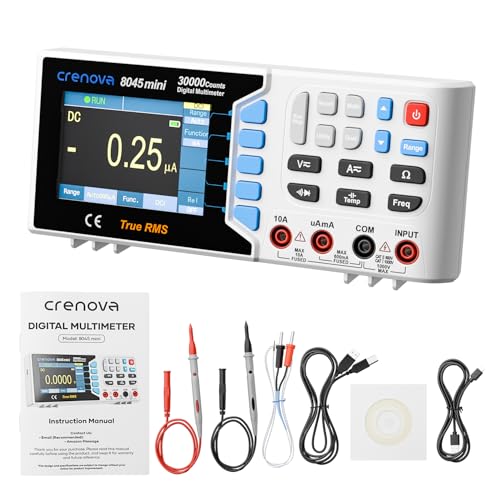
Crenova 30000 Count Bench Multimeter Best Portable Bench Meter
A bench form factor with a ten hour battery is an unusual and useful combination. A conventional bench meter chains you to a socket, which is fine on a bench and useless when the equipment under repair is on the floor, in a rack or in another room. This gives you bench class resolution that can be carried to the work.
The dBW and dBmW functions point at audio and radio frequency work, where levels are routinely expressed in decibels relative to a reference, and having the meter do that conversion saves a step. Relative mode is the other function bench users reach for constantly: null out a lead resistance or a standing offset and measure the difference, which is how small changes are actually observed. At 30,000 counts it resolves well below what a 6,000 count handheld can show.
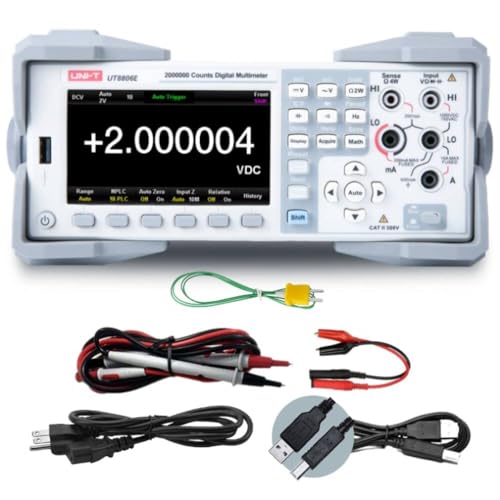
When the thing you are chasing is smaller than a handheld's last digit, this is the class of instrument required. At 6.5 digits a 5 volt rail reads to the microvolt, which makes visible a supply drifting as the room warms, a reference settling after power on, or two resistors differing by less than their marked tolerance.
The histogram display is the mode bench users end up relying on and few instruments offer. It shows the distribution of readings rather than a single value, which distinguishes random noise from a systematic shift, and tells you at a glance whether a measurement is unstable or simply wrong. A supplied calibration report and an RS232 interface alongside USB point clearly at a rack environment rather than a hobby bench.
Strengths
6.5 digits with a published 0.0035 percent accuracy
Supplying sensor measurement software turns this from a voltmeter into a small data acquisition system. A thermocouple, an RTD or a transducer produces a small electrical signal that has to be converted into a physical unit, and doing that conversion in the instrument rather than in a spreadsheet afterwards makes long unattended recordings genuinely usable.
For electronics work specifically, that matters when you are characterising something over temperature: put a sensor on a heatsink, log the electrical parameter and the temperature together, and the relationship appears without post processing. The scanner card variant extends the same idea to several channels, which is how one expensive meter covers a test rig that would otherwise need many. The listing publishes resolution but not accuracy, so read the datasheet for that.
Automatic identification is more useful on a repair bench than it sounds. Board work involves constant switching between checking a rail, buzzing out a track and measuring a resistor, and a meter that works out which of those you are doing removes a rotary switch movement from every single measurement. Over a session that is a meaningful amount of friction removed.
At 9999 counts it resolves better than the 6,000 count meters most people own without approaching bench territory, and rechargeable operation over Type-C removes the battery that always dies mid-diagnosis. This is the sensible choice for a hobbyist or for a technician who wants one meter that lives on the bench but can be picked up and carried to the equipment.
Strengths
Auto identification removes constant switch changes
Short answer: the Labloot LB1041 is the best bench meter for repair work because it pairs 55,000 counts and a published 0.05 percent DC accuracy with logging and SCPI control; the UNI-T UT8806E is the one to buy if you genuinely need 6.5 digits; and the FNIRSI DMT-99 is the sensible cheap option that lives on a hobby bench.
A bench meter solves different problems from a field meter
A field multimeter is designed around surviving a drop, being rated for mains distribution and being readable in a dark plant room. None of those matter on a bench. What matters instead is resolution fine enough to see the thing you are chasing, stability good enough that a reading does not wander while you look at it, and a route to get numbers into a computer. That is why the meters on this page look so different from the ones an electrician carries, and why almost none of them states a safety category rating.
Counts and accuracy are different claims
This confusion costs people money. Counts describe how finely a display divides its range, so a 55,000 count meter shows more decimal places than a 6,000 count one. Accuracy describes how close the displayed number is to the true value. A meter can have enormous resolution and mediocre accuracy, in which case it shows you differences precisely while getting the absolute value wrong, which is still useful for comparisons and useless for calibration.
Only two listings on this page publish both. When a manufacturer quotes counts and stays silent on accuracy, the specification sheet will have it, and it is worth reading before assuming the last two digits mean anything.
Relative mode is what you will actually use
On a bench, most interesting measurements are differences rather than absolutes. Is this resistor the same as that one? Has this supply moved since it warmed up? What is the resistance of the track itself, once the leads are subtracted? Relative mode answers all of those: null the reading at a reference point and the display then shows the difference. It is the single most used function on a bench meter and it appears across this whole group, which is a good reason not to buy a meter that lacks it.
Interfaces turn a meter into part of a test setup
A meter with a computer interface stops being a thing you read and becomes a thing you can instruct. SCPI, the standard command language on the Labloot, lets a script set the function, trigger a reading, store it and repeat. The Siglent takes a different route by supplying sensor measurement software, which converts a transducer signal into a physical unit inside the instrument so a long recording arrives in useful form.
Both approaches address the same need: measurements taken over hours, or across many parts, that nobody wants to sit and transcribe. If your work never involves that, the interface adds nothing and a simpler meter is the better buy.
Warm it up, and mind your connections
Two practical habits separate reliable bench measurement from frustrating bench measurement. First, let the instrument warm up: precision electronics drift until they reach thermal equilibrium, and manufacturers specify a warm-up period because of it. Second, be aware of thermal EMF, the small voltages generated wherever dissimilar metals meet. At high resolution those become visible, which is why a reading can shift after you have just handled the terminals. Consistent connections and a few minutes of patience remove most of the mystery. For the field meters this page deliberately excludes, see the multimeter roundup.
How We Research
Meters were compared on display counts or digits, stated accuracy where published, logging depth and export route, computer interfaces and remote control support, display modes, additional functions relevant to electronics work, and power arrangement. We did not run laboratory tests and publish no measurements of our own.
A close reading of the Klein Tools RT110 listing, covering the published specifications, the missing fault-code table, and where a three-light tester stops being the right tool.
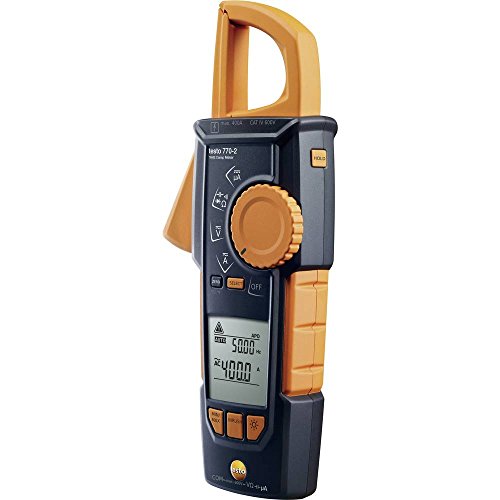
A mechanism-first review of the Testo 770-2 hook-clamp meter, including what the listing states, what it omits, and where the hook design stops being the right answer.