As an Amazon Associate, Akermin earns from qualifying purchases. Product links on this page are affiliate links.
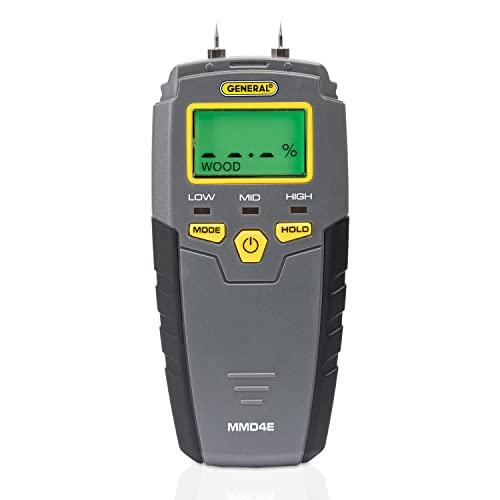
General Tools · General Tools MMD4E Moisture Meter for Wood, Walls & Water Leak Detection | Pinless wood moisture meter for drywall & walls. Detects mold & humidity. Water leak detector for home moisture testing.
View on AmazonPrice and availability are shown on Amazon and can change at any time.
Verdict
The General Tools MMD4E is one of the most widely bought moisture meters, and the reasons are practical rather than technical. The listing states 8 mm stainless steel pins with spares supplied, low, medium and high moisture tones with on-screen icons, large 0.3 inch digits in a backlit LCD, a hold button, a 9 V battery and a protective cap that doubles as a calibration checker. For timber, framing, subfloor and any material where two small holes do not matter, it does the job and tells you it is working before it does.
Documented Specifications
| Item | Manufacturer listing |
|---|---|
| Method | Pin, 8 mm stainless steel |
| Feedback | Low, medium and high tones with on-screen icons |
| Display | 0.3 inch digits, backlit LCD, hold button |
| Calibration check | Built into the protective cap |
| Supplied | Spare pins, 9 V battery |
| Materials | Wood, walls, water leak detection |
The listing does not publish measurement ranges or accuracy. Check the datasheet if you need a species-corrected timber figure.
A Calibration Check Is Rarer Than It Should Be
Every instrument can fail quietly. A moisture meter with a flat battery reads low, a meter with a corroded pin socket reads erratically, and neither failure announces itself. The consequence is somebody deciding a wall is dry when it is not.
The cap on this meter contains a check contact. Press the pins to it, confirm the expected reading appears, and you know the electronics and the battery are working. It takes two seconds and it converts a reading from a hope into a measurement. Use it at the start of every session, not just when something looks odd.
Audible Feedback Changes How You Work
Probing along a joist, around a window reveal or under a bath means your eyes are on where the pins are going, not on the display. Tones that change with moisture level let you work by ear and only look at the screen when something changes. It sounds small and it roughly doubles the speed of a survey along a run of timber.
What Pin Readings Actually Tell You
A pin meter passes a small current between two electrodes and infers moisture from the resistance it encounters. That means it measures the wettest path between the pins at the depth they reach, which is why pin readings are specific and repeatable in a way pinless readings are not. Mark a point, measure it today and next week, and the change is real.
It also means readings are affected by what is dissolved in the water, by the species and density of timber, and by the temperature. Salt contamination reads as high moisture, which is a known trap in coastal and flood work. Treat readings on such material with caution.
Practical Technique
- Push the pins in with steady pressure, parallel to the grain in timber, and read when the value settles.
- Take a reading on known dry material of the same type as a reference.
- Work in a grid across a suspect area rather than one heroic reading in the middle.
- Replace bent pins. A pin with a kink does not reach full depth and reads low.
- On finished surfaces, use a pinless meter instead.
Strengths
- Calibration check built into the cap.
- Tones that let you work without watching the screen.
- Large backlit digits, readable in a crawlspace.
- Spare pins and battery supplied.
Limitations
- Leaves two small holes, ruling out finished surfaces.
- No range or accuracy published.
- Slow for searching, since each reading is a separate operation.
- No species correction stated for timber.
How It Compares
The Klein ET140 is the pinless alternative for finished surfaces, and the choice between them is set out in MMD4E versus ET140. The Extech MO265 combines both methods, compared in MMD4E versus MO265. Our ranking is in the pin moisture meter roundup.
How We Research
All figures come from the manufacturer listing. We did not run laboratory tests and publish no measurements of our own.
Recommended Tools

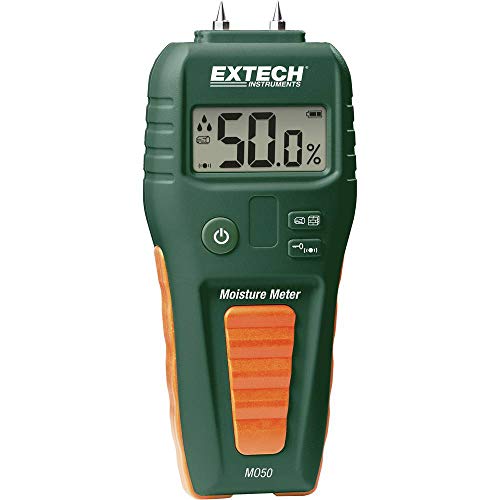
Products shown because their documented specifications fit this guide. Price and availability are on Amazon and can change.
Frequently Asked Questions
What is the cap calibration check?
The listing states the protective cap doubles as a calibration checker. Pressing the pins against the check point confirms the meter and battery are working before you trust a reading, which is the step most people skip.
Does it leave marks?
Yes. Pin meters push two 8 mm stainless steel pins into the material. On framing, subfloor and unfinished timber that is harmless. On finished surfaces it is not acceptable.
What do the tones do?
The listing states low, medium and high moisture tones with matching on-screen icons. Audible feedback means you can probe along a joist while watching your hands rather than the display.
Are spare pins included?
Yes. The listing states extra 8 mm stainless steel pins and a 9 V battery are supplied. Pins bend in hard material, so spares matter more than they sound.
Affiliate disclosure: Akermin earns a commission from qualifying Amazon purchases made through links on this page. Our editorial picks are based on documented specifications and owner feedback, not commissions.
Related Guides

FLIR One USB-C Thermal Imaging Camera Review: The Phone-Attachment Baseline
A detailed review of the FLIR One USB-C thermal camera for Android, explaining its Vivid IR upscaling, MSX image blending, stated accuracy and the practical limits of a phone-attachment design.
Read More→
Wagner Meters Orion 950 Pinless Wood Moisture Meter: A Review for Thermal Inspection Work
A review of the Wagner Meters Orion 950 pinless wood moisture meter, explaining its dual depth measurement, Bluetooth reporting, and where it stops being the right instrument next to a thermal camera.
Read More→
Tramex Moisture Encounter ME5 Review: The Dual-Depth Pinless Meter
A detailed look at the Tramex ME5 pinless moisture meter, centered on its dual-depth measurement and its practical limits.
Read More→