As an Amazon Associate, Akermin earns from qualifying purchases. Product links on this page are affiliate links.

KLEIN TOOLS · Klein Tools ET140 Pinless Moisture Meter, Detects up to 3/4-Inch Deep | For Non-Destructive Moisture Detection in Drywall, Wood, and Masonry
View on AmazonPrice and availability are shown on Amazon and can change at any time.
Verdict
The Klein ET140 is a straightforward pinless moisture meter, and its virtue is that it does one job with no ambiguity. The listing states non-destructive detection up to three quarters of an inch below the surface in drywall, wood and masonry using electromagnetic field technology, and describes the output as relative moisture content. For a trade that checks moisture occasionally and must not mark surfaces, that is exactly the right amount of instrument.
Documented Specifications
| Item | Manufacturer listing |
|---|---|
| Method | Pinless, electromagnetic field |
| Depth | Up to three quarters of an inch below the surface |
| Materials | Drywall, wood, masonry |
| Output | Relative moisture content |
| Purpose | Detecting moisture from leaks and flooding |
The listing does not publish a scale range, accuracy or calibration method, which is consistent with an instrument that reports relative rather than absolute values.
Relative Moisture Is the Honest Description
A pinless meter does not measure water content directly. It creates an electromagnetic field in the material and responds to how that material’s electrical properties change with moisture. The result is mapped to a scale, and that scale depends on the material, its density and what else is within the sensing field.
Klein using the phrase relative moisture content repeatedly deserves credit, because it tells you how to use the readings. Compare a suspect area with a known dry area of the same material, in the same construction, and act on the difference. A wall reading twice its dry baseline is wet whatever the number says in absolute terms. A number on its own, without a reference, means very little.
Working With a Pinless Meter
- Always take a baseline on the same material in an area you are confident is dry.
- Keep the sensor flat against the surface. A tilted sensor reads low because part of the field is in air.
- Be alert to metal. Foil-backed plasterboard, metal studs, pipes and cables all sit within the field and raise readings.
- Sweep continuously to find the boundary of a wet area, then take individual readings inside and outside it.
- Mark the boundary as you find it. A mapped area is evidence; a remembered one is not.
Three Quarters of an Inch, Understood
Pinless depth is not a hard edge. The field weakens with distance, so a reading at the stated depth is a weak contribution mixed with everything nearer the surface. This has two consequences. Moisture deep in an assembly may be invisible, which is why a dry reading on a suspect wall is not proof. And on thin materials the meter may partly read whatever is behind them, which is why a plasterboard wall with a wet cavity can read high even though the board face is dry.
When to Reach for Pins Instead
Pins measure between two points at a known depth, which makes readings specific and repeatable. That matters for documentation: a marked point measured on Monday and Friday shows drying progress in a way a swept pinless reading cannot. It also matters where a pinless sensor is unreliable, such as thin panels with metal behind them. Most people doing moisture work regularly end up with both, using pinless to find and pins to record. See pin versus pinless moisture meters.
Strengths
- Leaves no mark, so it works on finished surfaces.
- Fast sweeping to find the extent of a wet area.
- Honest description of what the reading represents.
- Covers drywall, wood and masonry with one instrument.
Limitations
- No scale range, accuracy or calibration method published.
- Relative readings need a dry reference to interpret.
- Metal within the sensing field distorts readings.
- Limited depth, so deep moisture can be missed.
How It Compares
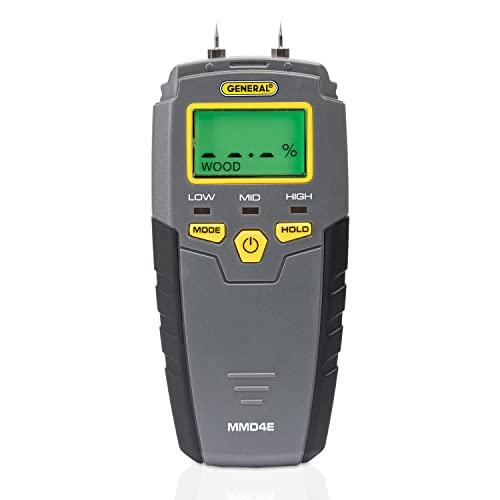
The General Tools MMD4E is the pin equivalent, with a calibration check in its cap. The Extech MO265 combines both methods in one instrument, as covered in that comparison, and the MMD4E against the ET140 sets out the pin and pinless choice directly. Our ranking is in the pinless moisture meter roundup.
How We Research
All figures come from the manufacturer listing and Klein’s published documentation. We did not run laboratory tests and publish no measurements of our own.
Recommended Tools

Products shown because their documented specifications fit this guide. Price and availability are on Amazon and can change.
Frequently Asked Questions
How deep does it read?
The listing states up to three quarters of an inch below the surface, using electromagnetic field technology. That is enough for drywall, most timber surfaces and the face of masonry.
Does it give a moisture percentage?
The listing describes relative moisture content rather than an absolute percentage, which is an honest description of what a pinless meter actually measures. Use readings to compare locations rather than as absolute values.
Will it damage the surface?
No. There are no pins, so nothing is pushed into the material. That is the reason to choose a pinless meter for finished floors, decorated walls and joinery.
Can it find a leak behind a wall?
It can find where a wall is wetter than the surrounding area, which is usually how a leak is located. It reads only to about three quarters of an inch, so moisture deeper in an assembly may not register.
Affiliate disclosure: Akermin earns a commission from qualifying Amazon purchases made through links on this page. Our editorial picks are based on documented specifications and owner feedback, not commissions.
Related Guides

FLIR One USB-C Thermal Imaging Camera Review: The Phone-Attachment Baseline
A detailed review of the FLIR One USB-C thermal camera for Android, explaining its Vivid IR upscaling, MSX image blending, stated accuracy and the practical limits of a phone-attachment design.
Read More→
Wagner Meters Orion 950 Pinless Wood Moisture Meter: A Review for Thermal Inspection Work
A review of the Wagner Meters Orion 950 pinless wood moisture meter, explaining its dual depth measurement, Bluetooth reporting, and where it stops being the right instrument next to a thermal camera.
Read More→
Tramex Moisture Encounter ME5 Review: The Dual-Depth Pinless Meter
A detailed look at the Tramex ME5 pinless moisture meter, centered on its dual-depth measurement and its practical limits.
Read More→