
What Does PPM Mean on a Gas Detector? Reading Parts per Million Without Guesswork
PPM is parts per million: gas molecules per million molecules of air. 10,000 ppm is 1 percent by volume, and 50,000 ppm of methane is its explosive limit.
Read More→Editorial desk
The Akermin Gas Detection Desk researches gas leak detectors, carbon monoxide detectors and multi-gas meters. Every guide is written from manufacturer documentation, datasheets and published standards; Akermin does not run a test laboratory and never claims hands-on testing.
PPM is parts per million: gas molecules per million molecules of air. 10,000 ppm is 1 percent by volume, and 50,000 ppm of methane is its explosive limit.
Read More→
A heated-diode refrigerant detector with stated sensitivity under 0.03 oz/yr, a 300 hour sensor, IP54, 17-inch probe, tracer gas coverage and 18 hour battery.
Read More→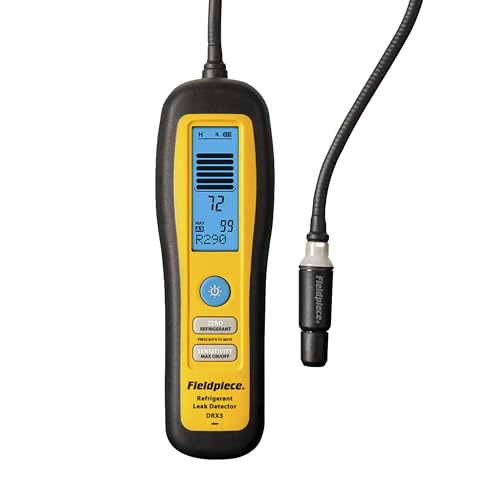
A heated-diode detector documented for A3, A2L and A1 refrigerants and combustible gases, with a replaceable sensor, three sensitivity levels and app support.
Read More→
A single-gas monitor watches one known hazard; a four-gas monitor watches O2, LEL, CO and H2S in unassessed spaces. Confined-space entry needs four-gas.
Read More→
Refrigerant detectors sense halogenated refrigerants; combustible gas detectors sense methane and propane. Only a dual-chemistry unit like the DRX3 does both.
Read More→Both are heated-diode units. The DR58 states 0.03 oz/yr, a 300 hour sensor and 18 hour battery; the DRX3 adds A3, combustible gas and a replaceable sensor.
Read More→
The PT520A adds a 17-inch gooseneck, a 50 to 10,000 ppm range, a mute and a case. The PT199 is pocket-sized, tops out at 1,000 ppm and costs less shelf space.
Read More→
Both cover 50 to 10,000 ppm of methane on a gooseneck. The ET120 wins on volume and two switchable ranges; the PT520A on mute, auto power-off and finer bars.
Read More→A two-range gas sniffer and a ppm carbon monoxide meter, the pair an inspector needs to document a gas appliance, plus a 4-gas monitor for crawl spaces.
Read More→
Pumped H2 analyzers for leak tracing, a wall-mount battery-room monitor with relay outputs and a 0.1 ppm handheld, compared from manufacturer documentation.
Read More→
Portable NH3 meters compared from manufacturer documentation: 0 to 100 and 0 to 200 ppm ranges, temperature and humidity, alarm records and battery life.
Read More→
Single-gas oxygen monitors compared from manufacturer documentation: 19.5 percent low and 23.5 percent high set points, self test, certificates and battery.
Read More→