
How to Compare Thermal Camera Resolution
Find the native array, compute the pixel patch at your working distance, and ignore every other number.
Read More→Editorial desk
The Akermin Thermal Imaging Desk researches thermal cameras and infrared thermometers. Every guide is written from manufacturer documentation, datasheets and published standards; Akermin does not run a test laboratory and never claims hands-on testing.
Find the native array, compute the pixel patch at your working distance, and ignore every other number.
Read More→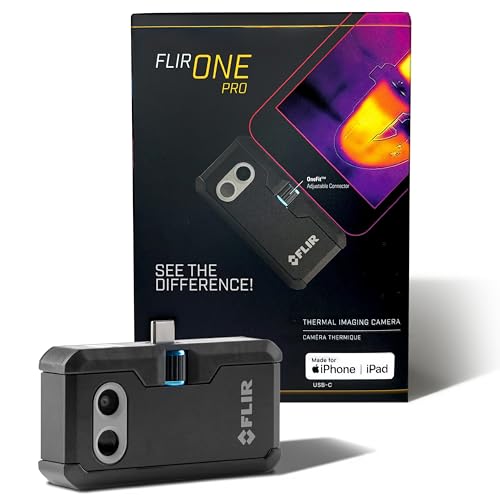
Connector, native resolution, whether it has its own battery, and an app that keeps the images. The phone does the rest.
Read More→Sensitivity for airflow and coil patterns, a wide lens for ducts and ceilings, and a range that covers compressors and flues.
Read More→
Higher temperature range, tighter accuracy, small spot size at distance, and the discipline to stay clear of the arc-flash boundary.
Read More→Native 160×120 or better, NETD under 70 mK, manual span, visible overlay, and a workflow you will actually use.
Read More→
Match the tool to the question: damp, heat loss, air, electrics, hidden spaces. A core kit and what to add.
Read More→
Ten wall scanners compared on sensor count, stated scan depth, live AC wire detection and display type.
Read More→
Cameras that show a hot cell or warm connector on a sunlit array: the FLIR E8 Pro, the phone-based Thermal Master P4 (NETD under 35 mK) and the MiLESEEY TR20.
Read More→Hot-spot cameras for panels and motors: the FLIR E8 Pro to 550 C, the Thermal Master Thor002 with six spot readings and a big screen, and the pocket FLIR C8.
Read More→Three 320x240 cameras for heat-loss surveys: the FLIR E8 Pro for reports, the compact FLIR C8 and the MiLESEEY TR20 with a stated NETD under 40 mK.
Read More→Right conditions, locked span, square-on framing and a visible reference. The camera is the easy part.
Read More→Sun, wind, rain and the inside-outside difference all rewrite what a wall looks like in infrared.
Read More→