As an Amazon Associate, Akermin earns from qualifying purchases. Product links on this page are affiliate links.
P1 is the pick for general live troubleshooting because its fork jaw opens 17.8 mm and swallows conductors up to AWG 4/0 while reading AC voltage and current simultaneously, which is the fastest way to confirm a circuit is both live and loaded. P4 is the pick for leakage work: it is the only listing here that publishes a 1 microamp minimum resolution, and leakage current is a milliamps-and-below measurement, not an amps measurement. P5 is the slim-jaw option for tight panels at a CAT III 300 V rating. P2 and P3 are here for different reasons: P2 adds wireless logging and an iFlex probe, P3 is a rechargeable U-jaw fork meter whose listing claims contactless AC/DC current recognition.
Why the jaw opening decides the job before the range does
An open-jaw meter, sometimes called a fork meter, replaces the hinged clamp with a fixed U or fork shape. You do not squeeze a trigger and you do not need a free end of wire. You push the conductor into the slot. That is the whole appeal: the wire stays terminated, the panel cover stays on, and your hand stays further from the live parts.
The cost of that convenience is geometry. A fork only accepts conductors up to the width of its slot. P1 publishes a 17.8 mm (0.7 inch) jaw opening and states it fits wires up to AWG 4/0 (120 mm2). That is a genuinely large service conductor, and it is the number that tells you whether the tool will close around your feeder. P5 takes the opposite approach with a 10 mm thin jaw, which is narrow but slim enough to slide into crowded enclosures where a fat fork will not physically enter. Neither number is better in the abstract. They suit different panels.
There is a second geometric trap nobody mentions. A fork meter measures the current in the conductor that passes through the slot. If two conductors share the slot, the magnetic fields partially cancel and the reading is meaningless. On a single-phase circuit, putting the hot and neutral in the same fork gives you near zero, not the load current. That is exactly the behaviour you want for leakage testing, and exactly the mistake that makes a fork meter look broken during ordinary load testing.
Resolution, not range, is what separates a leakage meter from a load meter
Most clamp listings advertise a maximum current, and maximum current is the least interesting number on the page. A 600 A meter and a 1000 A meter both measure a 12 A lighting circuit perfectly well. What differs is the bottom of the scale.
P4 is the outlier in this group because its listing publishes a 1 microamp minimum resolution against a 60 A maximum, with True-RMS conversion for complex signals. One microamp is a thousandth of a milliamp. Leakage current in insulation faults and protective conductor currents sits in the milliamp and sub-milliamp region, so a meter that cannot resolve below an amp is not a leakage meter at all, whatever the marketing says. If you are chasing nuisance tripping on an RCD or RCD/GFCI, the floor of the scale is the specification that matters.
The other listings here do not publish a minimum resolution. That is not a defect in them; it is a defect in the listing. Absence of a published resolution figure means you cannot compare them on leakage work from the listing alone, and you should not assume a low floor just because the maximum is modest. If leakage diagnosis is the job, buy the meter that publishes the figure.
The comparison table: jaw size, current range and safety rating as published
| Pick | Jaw or fork opening | Published current range | Published resolution floor | Safety rating as stated | Wireless |
|---|---|---|---|---|---|
| P1 | 17.8 mm (0.7 inch), fits AWG 4/0 (120 mm2) | Not stated in the listing bullets | Not stated in the listing bullets | Not stated in the listing bullets | Not stated in the listing bullets |
| P2 | Not stated in the listing bullets | 1000 A AC/DC, from the product title | Not stated in the listing bullets | Not stated in the listing bullets | Bluetooth to Apple or Android devices |
| P3 | U-type open jaws, dimension not stated | Not stated in the listing bullets | Not stated in the listing bullets | Not stated in the listing bullets | Not stated in the listing bullets |
| P4 | 61 mm jaw | 60 A maximum | 1 microamp minimum | Not stated in the listing bullets | Fluke Connect compatible |
| P5 | 10 mm thin jaw | 600 A AC/DC, from the product title | Not stated in the listing bullets | CAT III 300 V | Not stated in the listing bullets |
Two rows stand out. P4 publishes both ends of its scale, which is unusual and useful. P5 publishes a safety category, which is the only overvoltage rating in this group. Everything else in the safety column is silence, and silence is not the same as a low rating, but you cannot plan a measurement around a figure that was never printed.
The five open-jaw meters, and what each is for
Fluke T6-1000 PRO Electrical Tester
Fork geometry and simultaneous voltage and current readout make it the default open-jaw tool for live troubleshooting.
Fluke 376 FC Clamp Meter with iFlex
Wireless logging plus a flexible probe, for intermittent faults and conductors the jaw cannot reach.
MAXRIENY Digital Open-Jaw Fork Meter
A rechargeable U-jaw fork meter claiming contactless AC/DC current recognition and no gear selection.
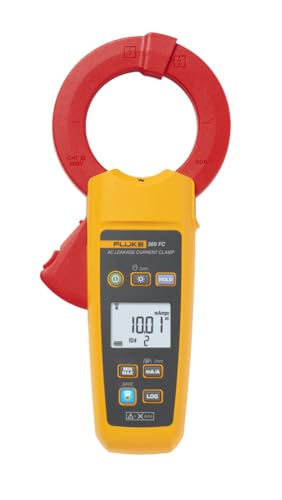
Fluke 369 FC Leakage Current Clamp Meter
The only listing here with a published 1 microamp resolution, which is what leakage work requires.
Fluke 301D/ESP 600A Clamp Meter
A 10 mm thin jaw that fits where a fork will not, at a CAT III 300 V rating.
Open jaw versus flexible probe: when the fork cannot reach the conductor
An open jaw solves access from one direction. It still needs the conductor to be reachable with the fork slot. Busbars, bundled neutrals, and conductors buried behind other wiring defeat it, and that is where a flexible current probe earns its place. P2 is listed with an iFlex probe and Bluetooth transmission to a phone or tablet, which means the measurement head can be a thin, bendable loop threaded around a conductor you cannot see clearly, while the display sits outside the arc flash zone.
The trade is accuracy and repeatability. A flexible probe is a Rogowski coil, and Rogowski coils are excellent at AC and poor at DC unless the electronics compensate. A closed iron jaw is the reverse. If your work is DC battery or drive output, a flexible probe needs a meter that explicitly handles DC on that probe, and the listing has to say so. P2’s title states 1000 A AC/DC, but the bullets do not break out which ranges apply to the iFlex head and which to the jaw, so treat the combined figure as the headline and not as a per-probe guarantee.
For ordinary panel work with accessible single conductors, the fork is faster every time. Reach for the flexible probe only when the geometry, not the current level, is the obstacle. There is more on that split in our guide to clamp meters generally.
The maintenance and setup nobody mentions
Fork meters have no trigger mechanism, which removes the most common mechanical failure of a clamp meter, but it does not make them maintenance free. The jaw faces are part of the magnetic circuit. Ferrous dust, swarf and filings stick to them, and a gap or a lump in the mating surfaces changes the flux path and biases the reading. Wipe the fork faces with a dry cloth before a measurement campaign, not after.
Batteries are the second quiet failure. P3 is listed as rechargeable with a built-in lithium battery, which removes the disposable cell problem but adds a charging habit: a meter left flat in a van for a month is a meter that reads nothing when you need it. The other four listings do not publish their power source, so you cannot tell from the bullets whether they take disposable cells or something else. Check before you rely on one.
Zeroing matters more on the low ranges. A leakage meter reading microamps will drift with temperature and with residual magnetism in the jaw. Most such instruments have a zero or relative function; use it with the jaws closed and empty, in the position you intend to measure. Skipping that step turns a 3 microamp insulation trend into noise.
Where an open-jaw meter stops being the right instrument
A fork meter is not an alarm and it is not a substitute for a full test procedure. It tells you a number when you hold it in the right place. It does not watch a circuit while you are elsewhere, it does not trip anything, and it does not certify an installation.
It is also not a general-purpose multimeter. P3’s listing claims a broad function set including capacitance, diode, frequency, duty cycle and continuity, and P5 lists voltage, resistance, continuity and capacitance. Those functions are genuinely useful for troubleshooting, but a fork meter’s test leads are short and its input protection is built for a specific category, not for every measurement in a panel. Where a function needs a proper probe and a proper CAT rating, use a multimeter built for it. Our electrical testers page covers that split.
Finally, none of these listings publishes a calibration interval or an accuracy specification in the bullets. Accuracy is the figure that decides whether a reading is evidence or an indication. If you need to record a value and defend it, ask the supplier for the accuracy statement and the calibration certificate before you buy, because you will not find either in the product bullets.
Recommended Tools



Products shown because their documented specifications fit this guide. Price and availability are on Amazon and can change.
Frequently Asked Questions
Can an open-jaw meter read DC current?
Only if the listing says so. P3 claims contactless automatic recognition of AC and DC current, and P2's title states 1000 A AC/DC. The other listings here do not publish a DC current capability in their bullets, so you cannot assume it. DC measurement needs a Hall-effect or fluxgate sensor in the jaw, which is a different and more expensive design than a simple AC current transformer.
What is the smallest current these meters can measure?
Only P4 publishes a floor: 1 microamp minimum resolution, against a 60 A maximum. The other four listings do not state a minimum resolution, and that silence matters. If you are chasing insulation leakage or nuisance RCD tripping, buy the meter that prints the figure.
Is a fork meter safe to use on a live panel?
Safety here is a combination of the meter's overvoltage category, your test procedure and the panel. Only P5 publishes a rating in this group, CAT III 300 V. The others do not state a category in their bullets. Never treat an unstated rating as permission; check the product documentation and follow your site's live-work rules.
Why does my fork meter read near zero when I know the circuit is loaded?
Almost always because two conductors are inside the jaw at once. The magnetic fields of the outgoing and returning current cancel, so the meter sees the difference, which is near zero. Put a single conductor in the slot for load current. If you deliberately want the difference, that is leakage measurement, and it is what P4 is built for.
Do I need the flexible probe version?
Only when the conductor cannot be reached with a rigid jaw. P2 is the listing here with an iFlex probe and wireless transmission, which lets you measure from outside the arc flash zone. If every conductor you touch is an accessible single wire in an open panel, a fork meter is faster and simpler.
Which of these is best for tight spaces?
P5, on published geometry: a 10 mm thin jaw is the smallest opening listed here, and it is the one designed to slide into crowded enclosures. P1's 17.8 mm fork is the opposite trade, accepting large service conductors up to AWG 4/0 but needing more room to land.
Affiliate disclosure: Akermin earns a commission from qualifying Amazon purchases made through links on this page. Our editorial picks are based on documented specifications and owner feedback, not commissions.
Related Guides

Battery Internal Resistance Testers for Maintenance: 3 Picks
Three four-wire AC internal resistance testers compared on published range, resolution and measurement method, with the gaps in each listing made explicit.
Read More→
Milliohm Meters for Low-Resistance Testing: Four Picks Compared
A comparison of four low-resistance instruments, three true four-wire milliohm meters and one logging multimeter, judged on what their listings state.
Read More→
Clamp Meters With DC Power Measurement: Four Picks for Solar and DC Loads
A comparison of four instruments that publish DC power measurement, covering jaw access, safety category, logging depth and where each one stops being the right tool.
Read More→