As an Amazon Associate, Akermin earns from qualifying purchases. Product links on this page are affiliate links.
Short answer: the DR82 publishes more of what buyers ask about: a leak rate, a sensor life and an ingress rating. The D-TEK 3 publishes the operating features that make a hard leak easier to find, notably four sensitivity levels, manual zero and stated A2L coverage.
What Each Listing States
| Item | Inficon D-TEK 3 | Fieldpiece DR82 |
|---|---|---|
| Sensor type | Not stated in the bullets | Infrared |
| Sensor life | Not stated in the bullets | 10 years |
| Stated leak rate | Not stated in the bullets | Below 0.03 oz per year |
| Sensitivity settings | Low, medium, high, super | Not stated in the bullets |
| Zeroing | Automatic and manual | Not stated in the bullets |
| Refrigerant coverage | All CFCs, HCFCs, HFCs, HFOs and blends including A2Ls | CFC, HCFC, HFC, HFO and blends |
| Ingress protection | Not stated in the bullets | IP54, resists moisture and oil |
Two Different Kinds of Specification
Notice what each manufacturer chose to put in its bullets. Fieldpiece publishes outcomes: this small a leak, this long a sensor life, this much ingress protection. Inficon publishes controls: this many sensitivity levels, these zeroing modes, this breadth of refrigerant coverage. Neither approach is more honest, but they answer different questions, and a buyer who only compares headline numbers will conclude the DR82 is better specified when in fact the two listings are describing different things.
Finding a Hard Leak
Easy leaks are found by any detector. The ones that consume a morning are small, intermittent, inside a coil, or in a room where refrigerant has been accumulating for weeks. In those situations the operator’s ability to control the instrument matters more than its ultimate sensitivity, because the problem is not detecting refrigerant, it is detecting where there is more of it than everywhere else. That is the case the D-TEK 3 feature set is built for, and it is a strong argument for anyone who does this work daily.
Cost of Ownership
The DR82’s stated 10 year infrared sensor life is the plainest financial statement either listing makes. Compared with a heated diode detector and its consumable element, the arithmetic over a working life is clear, and it is the reason many technicians moved to infrared. Since the D-TEK 3 bullets do not publish a sensor life, that comparison needs the datasheet before you can make it properly.
Practical Advice Whichever You Buy
- Zero the instrument in clean air away from the equipment, not next to it.
- Sweep slowly. Moving faster than the sample can reach the sensor is the most common reason a leak is missed.
- Work from the bottom of a system upward where the refrigerant is heavier than air, and expect pooling in low points.
- Confirm any find with a second method, bubbles or a soap solution, before you cut anything.
Who Buys Which
- Daily service work on mixed equipment: D-TEK 3, for the sensitivity control and A2L statement.
- Buyer who wants published numbers to compare: DR82.
- Wet, oily plant rooms: DR82, for the stated IP54 rating.
- Anyone weighing a heated diode instead: see DR58 versus DR82.
How We Research
Specifications are quoted from the manufacturer listings. We did not run laboratory tests and publish no measurements of our own. Where one listing states a figure and the other is silent, this page reports the silence rather than filling it. Ranking in the refrigerant leak detector roundup.
Recommended Tools


Products shown because their documented specifications fit this guide. Price and availability are on Amazon and can change.
Frequently Asked Questions
Which has the longer sensor life?
The DR82 listing is the one that states a figure: a 10 year sensor life. The D-TEK 3 bullets quoted here do not publish a sensor life, so check the current datasheet if that is your deciding factor.
Which is better for A2L refrigerants?
The D-TEK 3 listing names A2Ls explicitly. The DR82 listing names CFC, HCFC, HFC, HFO and blends, which covers much of the same chemistry without using the A2L label.
Do both work in a dirty environment?
The DR82 states IP54 construction resisting moisture and oil. The D-TEK 3 bullets do not state an ingress rating. Both are professional tools intended for plant rooms, but only one publishes a figure.
Which finds the smaller leak?
The DR82 publishes below 0.03 oz per year. The D-TEK 3 listing publishes sensitivity settings rather than a rate, so the two cannot be compared directly from the listings.
Affiliate disclosure: Akermin earns a commission from qualifying Amazon purchases made through links on this page. Our editorial picks are based on documented specifications and owner feedback, not commissions.
Related Guides

Elitech ILD-100H vs Fieldpiece DR58: Two Heated Diode Leak Detectors
Both use heated diode sensors. The Elitech states maximum sensitivity of 0.1 oz per year with three sensitivity levels and a TFT screen; the Fieldpiece states below 0.03 oz per year, IP54 and a 300 hour sensor life.
Read More→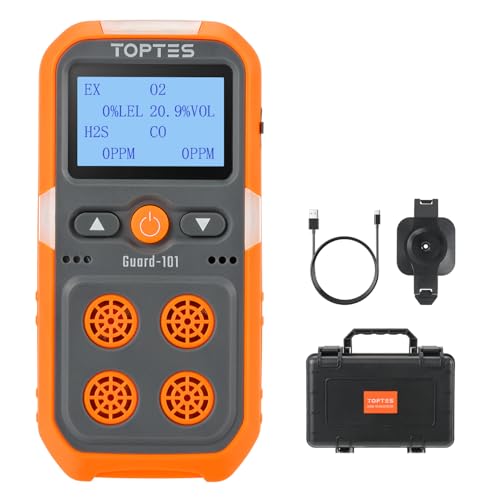
TopTes Guard-101 vs Forensics Detectors 4 Gas Meter: Which Four Gas Monitor?
Both monitor oxygen, carbon monoxide, hydrogen sulfide and combustibles. The Guard-101 states a 14 hour battery and alarm record storage; the Forensics unit states NIST calibration and zero and span calibration options.
Read More→
Klein ET120 vs TopTes Guard-101: A Leak Finder and a Personal Monitor Are Not the Same Tool
The ET120 finds combustible gas leaks from 50 to 10,000 ppm. The Guard-101 is a wearable four gas monitor for H2S, CO, LEL and oxygen with a stated 14 hour battery.
Read More→