As an Amazon Associate, Akermin earns from qualifying purchases. Product links on this page are affiliate links.
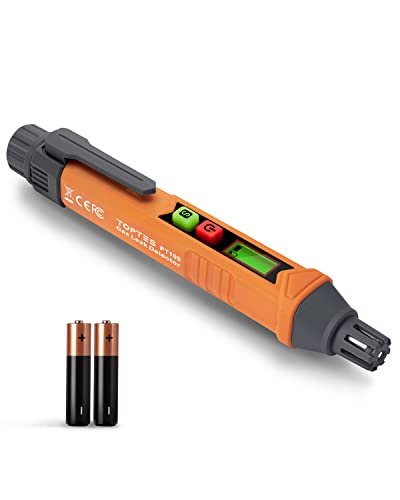
Short answer: the CD100A is the tool if your gas fittings are behind, above or inside something, which in most homes they are. The PT199 is the better buy if the connections you check are accessible and you want a simple, fast, unambiguous alarm.
What Each Listing States
| Item | UEi CD100A | TopTes PT199 |
|---|---|---|
| Probe | 18 inch flexible gooseneck with tip light | Compact handheld body |
| Gases named | Acetone, ammonia, butane, methane, natural gas, LPG, jet fuel | Natural gas, methane, propane, butane, LPG |
| Alarm behaviour | Audible and visual, tic rate rises with concentration | Audio and visual within 0.5 seconds, screen turns red at high level |
| Warm-up | About 10 seconds in open air | 30 seconds |
| Power | Not detailed in the bullets | Two AAA cells supplied, auto off after 5 minutes |
Reach Decides More Purchases Than Sensitivity
Walk through a typical house and look at where the gas fittings actually are. The range connector is behind the range. The water heater union is above the tank against a wall. The furnace gas valve is inside the cabinet. The meter is often in a confined enclosure. Every one of those is a place where an 18 inch flexible probe reaches and a hand holding a rigid detector does not, and pulling an appliance out to check a joint is exactly the work that a gooseneck saves.
The tip light matters for the same reason. These are dark places, and a detector that alarms tells you gas is present without telling you which of the three fittings in front of you it came from. Light plus a probe you can aim is how you narrow it down.
Where Simplicity Wins
For the accessible cases, the PT199 is the easier tool to own. It is small enough to keep in a kitchen drawer, it arrives with batteries, it powers down by itself so it is charged when you need it, and its alarm escalates in a way that needs no training to read. For a homeowner who wants to check a connection after a delivery, or confirm a smell is or is not gas, that is a better fit than a professional sniffer with a long probe to store.
Technique Applies to Both
- Warm up in clean air, never inside the cabinet you are about to test.
- Sweep slowly, roughly an inch per second, with the probe close to the joint.
- Work upward for natural gas, which rises, and downward for propane, which sinks.
- Confirm any alarm with soapy water on the joint before you cut or tighten anything.
- A strong smell of gas means leave the building and call the utility. Do not go looking with a sniffer.
Who Buys Which
- Trade or serious DIY with appliances to pull: CD100A.
- Homeowner, RV, barbecue and accessible connections: PT199.
- Anyone tracing a leak to a specific joint among several: a detector with sensitivity modes such as the Klein ET120.
How We Research
All figures come from the manufacturer listings. We did not run laboratory tests and publish no measurements of our own. Ranking in the handheld gas leak detector roundup.
Recommended Tools

Products shown because their documented specifications fit this guide. Price and availability are on Amazon and can change.
Frequently Asked Questions
Does the CD100A detect propane?
The listing names butane and LPG among its detectable gases, alongside methane, natural gas, acetone, ammonia and jet fuel. LPG is the category propane belongs to.
Is a gooseneck necessary?
It depends entirely on where your gas fittings are. Behind a range, above a water heater or inside a cabinet, a flexible probe reaches what a rigid pocket unit cannot. On an exposed meter or a barbecue connection, it adds nothing.
Which one is easier for an untrained person?
The PT199. It alarms within half a second, the alarm intensifies with concentration and the screen turns red at high levels, so no interpretation is required.
Do either of them replace a fixed alarm?
No. Both are handheld locating tools that are switched off most of the time. A property with gas appliances still needs a fixed alarm on the wall.
Affiliate disclosure: Akermin earns a commission from qualifying Amazon purchases made through links on this page. Our editorial picks are based on documented specifications and owner feedback, not commissions.
Related Guides

Elitech ILD-100H vs Fieldpiece DR58: Two Heated Diode Leak Detectors
Both use heated diode sensors. The Elitech states maximum sensitivity of 0.1 oz per year with three sensitivity levels and a TFT screen; the Fieldpiece states below 0.03 oz per year, IP54 and a 300 hour sensor life.
Read More→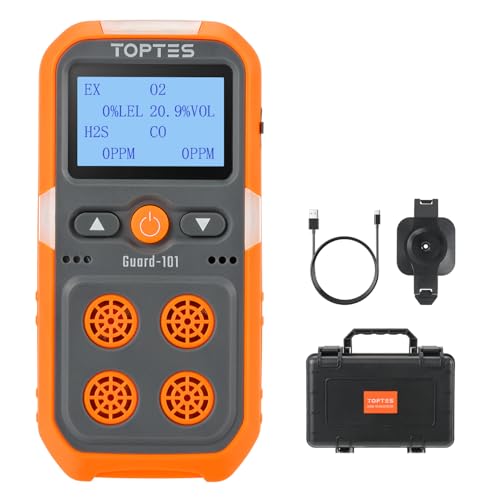
TopTes Guard-101 vs Forensics Detectors 4 Gas Meter: Which Four Gas Monitor?
Both monitor oxygen, carbon monoxide, hydrogen sulfide and combustibles. The Guard-101 states a 14 hour battery and alarm record storage; the Forensics unit states NIST calibration and zero and span calibration options.
Read More→
Klein ET120 vs TopTes Guard-101: A Leak Finder and a Personal Monitor Are Not the Same Tool
The ET120 finds combustible gas leaks from 50 to 10,000 ppm. The Guard-101 is a wearable four gas monitor for H2S, CO, LEL and oxygen with a stated 14 hour battery.
Read More→