As an Amazon Associate, Akermin earns from qualifying purchases. Product links on this page are affiliate links.
Short answer: take the D-TEK 3 for the stated A2L coverage and the four sensitivity levels, which make it easier to localise a leak in a contaminated space. Take the DR58 if you want a published leak rate and stated tracer gas support, and accept a sensor with a stated 300 hour life.
What Each Listing States
| Item | Inficon D-TEK 3 | Fieldpiece DR58 |
|---|---|---|
| Sensitivity control | Low, medium, high and super settings | Not stated in the bullets |
| Stated leak rate | Not stated in the bullets | Below 0.03 oz per year |
| Zeroing | Automatic and manual zero modes | Not stated in the bullets |
| Refrigerants | All CFCs, HCFCs, HFCs, HFOs and blends, including A2Ls | HFC, CFC, HCFC, HFO, H2N2 tracer gas and blends |
| Sensor life | Not stated in the bullets | 300 hours |
| Construction | Not stated in the bullets | IP54, resists moisture and oil |
Why Four Levels Beat One
A leak detector that is maximally sensitive at all times sounds ideal and is not. Walk a highly sensitive instrument into a plant room where a system has been leaking for months and it alarms everywhere, which tells you nothing about where the hole is. The standard technique is to drop the sensitivity until the alarm stops, then sweep, then drop again, closing in on the source. Four discrete levels make that method quick and repeatable. Without them you are relying on zeroing alone to do the same job.
Automatic and Manual Zero Are Both Needed
Automatic zeroing continuously re-baselines the instrument against the air around it. That keeps the detector usable as background changes, and it hides a leak that is filling the whole space evenly, because the detector treats the contaminated air as normal. Manual zeroing lets you take a deliberate baseline in air you have chosen, typically outside or well away from the equipment, and then sweep with that reference. Having both, as the D-TEK 3 listing states, is the sign of an instrument designed by people who have hunted leaks in real rooms.
A2L Coverage Is Not a Detail
New equipment increasingly uses A2L refrigerants, and the D-TEK 3 listing names them explicitly. Any detector you buy now should still be useful in five years, and a stated A2L capability is the clearest signal that it will be. The DR58 listing names HFO and blends, which covers much of the same chemistry, but does not use the A2L label directly. If you service new systems, check the datasheet rather than inferring.
A Published Leak Rate Is Worth Something Too
The DR58 states below 0.03 oz per year. That is a specification you can hold a manufacturer to, and it is the one figure most directly connected to whether you find the leak you are looking for. The D-TEK 3 bullets quoted here do not publish an equivalent number, which does not mean it is less sensitive, only that the comparison cannot be made from the listings. For a broader picture of the category, see infrared versus heated diode leak detectors.
Who Buys Which
- Technician servicing new A2L equipment: D-TEK 3, for the stated coverage.
- Leak hunting in contaminated plant rooms: D-TEK 3, for the four levels and manual zero.
- Anyone pressure testing with H2N2 tracer gas: DR58.
- Heavy daily use: consider the DR82 and its stated 10 year sensor life.
How We Research
All figures are quoted from the manufacturer listings. We did not run laboratory tests. Where one listing publishes a figure and the other does not, this page says so rather than comparing across the gap. Ranking in the refrigerant leak detector roundup.
Recommended Tools


Products shown because their documented specifications fit this guide. Price and availability are on Amazon and can change.
Frequently Asked Questions
Does the D-TEK 3 handle A2L refrigerants?
The listing states it detects all CFCs, HCFCs, HFCs, HFOs and blends including A2Ls. That is a direct statement, which matters because A2L refrigerants are now common in new equipment.
What do four sensitivity settings achieve?
They let you work at the right scale. On the highest setting the detector responds to traces and helps prove a system is clean. On a lower setting it stops screaming in an already contaminated space so you can walk a leak down to a specific joint.
What is manual zero for?
Resetting the baseline deliberately in air you know is dirty, so the instrument reports what is above that background rather than reacting to the whole room. Automatic zeroing does this continuously, which is convenient but can mask a slow, steady leak.
Does the DR58 state a sensitivity number?
Yes. The listing states it finds leaks below 0.03 oz per year and describes that as twenty times more sensitive than bubbles. The D-TEK 3 bullets quoted here do not publish an equivalent figure.
Affiliate disclosure: Akermin earns a commission from qualifying Amazon purchases made through links on this page. Our editorial picks are based on documented specifications and owner feedback, not commissions.
Related Guides

Elitech ILD-100H vs Fieldpiece DR58: Two Heated Diode Leak Detectors
Both use heated diode sensors. The Elitech states maximum sensitivity of 0.1 oz per year with three sensitivity levels and a TFT screen; the Fieldpiece states below 0.03 oz per year, IP54 and a 300 hour sensor life.
Read More→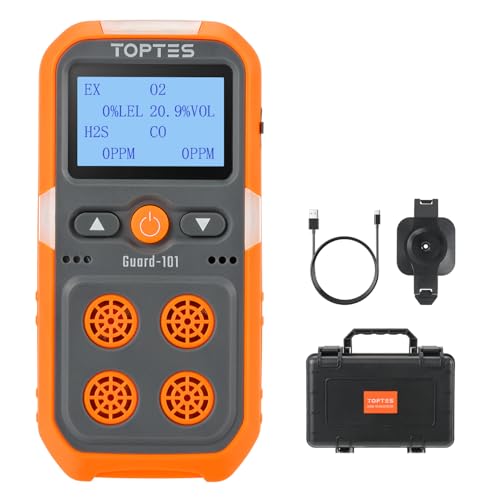
TopTes Guard-101 vs Forensics Detectors 4 Gas Meter: Which Four Gas Monitor?
Both monitor oxygen, carbon monoxide, hydrogen sulfide and combustibles. The Guard-101 states a 14 hour battery and alarm record storage; the Forensics unit states NIST calibration and zero and span calibration options.
Read More→
Klein ET120 vs TopTes Guard-101: A Leak Finder and a Personal Monitor Are Not the Same Tool
The ET120 finds combustible gas leaks from 50 to 10,000 ppm. The Guard-101 is a wearable four gas monitor for H2S, CO, LEL and oxygen with a stated 14 hour battery.
Read More→