As an Amazon Associate, Akermin earns from qualifying purchases. Product links on this page are affiliate links.

P3 · P3 P4400 Kill A Watt Electricity Usage Monitor
View on AmazonPrice and availability are shown on Amazon and can change at any time.
Verdict
The Kill A Watt P4400 does one job: it tells you what a single plugged-in device is actually using, and it accumulates that over time so you can see a real figure rather than a guess. The listing states four settings and cumulative monitoring by day, week, month or year with an easy-to-read screen. There is no app, no account and no connectivity, which is precisely why it keeps being recommended. For finding standby loads, comparing an old appliance with a new one or settling a disagreement about which device is expensive, it is the simplest tool that works.
Documented Specifications
| Item | Manufacturer listing |
|---|---|
| Type | Plug-in electricity usage monitor |
| Settings | Four selectable measurement settings |
| Accumulation | Usage by day, week, month or year |
| Display | Easy-to-read screen |
| Connectivity | None stated |
The listing does not publish accuracy, maximum current or the exact parameters shown. Check the rating printed on the unit before connecting a high draw appliance.
Accumulated Energy Is the Number That Matters
Instantaneous power tells you very little. A fridge drawing 120 watts sounds modest until you realise it cycles all day; a kettle drawing 3,000 watts sounds alarming until you realise it runs for two minutes. The only number that translates into money is energy accumulated over time, and that is what this device is built to collect.
The practical method is to leave it in place for a week rather than watching it for a minute. A week captures a full cycle of use for most appliances, including the periods when they are idle, and the accumulated figure can be multiplied out to a year with confidence. Our electricity cost calculator turns that figure into a cost at your own tariff.
Finding Standby Loads
The most common surprise is not the appliance you were suspicious of. It is the collection of devices that never turn off: set top boxes, games consoles left in standby, older printers, network equipment, chargers with no load, and anything with a display that stays lit. Individually each is small. Together, running continuously, they often exceed the appliance everyone was worried about.
Testing for this is simple. Plug the monitor in, plug the device into it, leave the device in its normal standby state overnight and read the accumulated energy in the morning. Multiply by 365 and the annual cost of standby becomes a concrete number instead of a suspicion.
What a Plug-In Monitor Cannot Do
It cannot see anything hard wired: the heating system, an electric shower, most air conditioning, immersion heaters, lighting circuits, an oven or an electric vehicle charge point. In many homes those are the largest loads in the house, so a plug-in monitor tells you about the smaller half of your consumption. For the rest you need a panel-level monitor with clamp sensors, which is what the Emporia Vue 3 does.
It also cannot be trusted at the top of its range or beyond it. A monitor rated for domestic outlet loads should not be used for a space heater beyond its rating or any appliance whose plug does not fit comfortably.
A Note on Odd Readings
Devices with switch mode power supplies and motors draw current that is out of step with the voltage, so the product of the volts and amps shown can be noticeably higher than the watts displayed. That is not a fault; it is the difference between apparent power and real power. Your meter bills you on the real power figure, which is the one to use for cost. If the device displays both, use watts and accumulated kilowatt hours rather than multiplying volts by amps.
Strengths
- No app, no account, no connectivity to fail.
- Accumulates energy over time, which is the number that maps to cost.
- Simple enough that anyone in the household can use it.
- Long established and widely understood.
Limitations
- One outlet at a time, and nothing hard wired.
- No accuracy figure or current rating in the listing bullets.
- No logging or export beyond reading the screen.
- Bulky in a crowded outlet or behind furniture.
How It Compares
The Emporia Vue 3 monitors the whole panel including hard wired circuits and solar, at the cost of an installation in the consumer unit. Smart plugs with energy reporting cover the same outlet-level job with an app and a network dependency. For the fastest honest answer about one appliance, the plug-in monitor still wins. See plug-in versus whole home monitoring.
How We Research
All figures come from the manufacturer listing. We did not run laboratory tests and publish no measurements of our own.
Recommended Tools
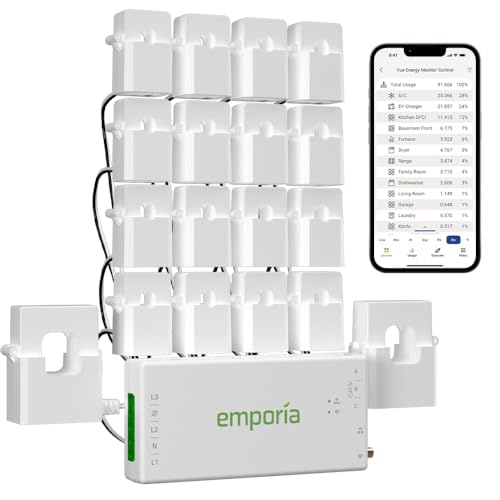
Products shown because their documented specifications fit this guide. Price and availability are on Amazon and can change.
Frequently Asked Questions
What does the Kill A Watt actually measure?
The listing states four settings for monitoring electrical usage and the ability to monitor usage by day, week, month or year. In practice these devices report voltage, current, power and accumulated energy for whatever is plugged into them.
Can it measure a whole house?
No. It measures one outlet. Whole house measurement needs a panel-mounted monitor with clamp sensors, such as the Emporia Vue 3.
Does it need WiFi or an app?
No. It has a screen and nothing else, which is a significant part of its appeal. There is no account, no app and nothing to stop working.
Will it work with a high draw appliance?
Check the current rating on the unit against the appliance. Large heating loads, some air conditioners and electric vehicle charging are beyond a plug-in monitor of this type and should not be tested with one.
Affiliate disclosure: Akermin earns a commission from qualifying Amazon purchases made through links on this page. Our editorial picks are based on documented specifications and owner feedback, not commissions.
Related Guides

Fluke 289 Review: The Logging Multimeter for Faults You Cannot Watch
A stand-alone logging True RMS multimeter with TrendCapture graphing, up to 14 times zoom on logged data and a selectable AC smoothing filter.
Read More→
AstroAI 6000 Count Multimeter Review: True RMS at the Entry Level
An auto-ranging True RMS meter with a 6000 count display covering AC and DC voltage and current, capacitance, frequency, duty cycle, resistance, diode, continuity and temperature.
Read More→
Klein MM420 Review: Auto-Ranging True RMS With Lead-Alert LEDs
A 600 V auto-ranging True RMS multimeter stating 10 A AC and DC current, 50 megohm resistance, temperature, capacitance and frequency, with LEDs that confirm lead placement.
Read More→