As an Amazon Associate, Akermin earns from qualifying purchases. Product links on this page are affiliate links.

UNI-T · UNI-T UT503PV Solar PV Insulation Resistance Tester DC 1000V
View on AmazonPrice and availability are shown on Amazon and can change at any time.
A photovoltaic insulation resistance tester that measures on energised strings up to DC 1000 V with no array shutdown and no module short circuiting, offering test voltages of 125, 250, 500 and 1000 V, a range to 4000 megohms, a stated accuracy of plus or minus 1.5 percent plus 5 counts, automatic discharge, a high voltage alarm, stepped voltage testing with comparison, 1000 stored result sets, USB and Bluetooth transfer, IP54 sealing and a weight of about 1.1 lb. The live string capability is the real feature. The measurement category rating is the line to read against the headline.
Testing a string that is still live is the real feature
The first bullet is the reason to consider this instrument, and the reason is physics rather than convenience.
An insulation test applies a direct voltage between the conductors of a circuit and earth, then measures the small current that leaks across whatever insulation is in between. On almost any other circuit you begin by isolating it, which makes the measurement straightforward because the only voltage present is the one your instrument supplies.
A photovoltaic array does not cooperate. Sunlight on a module produces voltage, there is no upstream switch that changes that, and the array keeps generating while you work. The conventional response is to isolate the string and in many procedures to short circuit the modules first, so the array presents a defined condition to the tester. That is extra connections, extra sequence to get right, and frequently a visit at first light.
The listing states that neither shutdown nor panel short circuiting is required, and that the instrument works even after dark. Those two claims together say something specific: the measurement does not depend on the array being in a particular electrical state, bright or dark, live or quiet. For anyone commissioning or fault finding on occupied roofs, that removes the most awkward part of the job. Our page on choosing a solar PV tester covers where this sits among the test instruments a string needs.
A DC 1000 V test voltage against a CAT III 600 V rating
The headline figure is DC 1000 V. The build bullet gives the safety rating as CAT II 1000 V and CAT III 600 V. Those two statements need to be read together rather than separately.
A measurement category is not a quality mark. It describes where in an electrical system an instrument may be connected, graded by how much energy is available behind a fault and how little a transient will have been attenuated by the time it reaches you. CAT II covers equipment level connections. CAT III covers fixed distribution, panels and permanently wired installations. The category is always paired with a voltage, and the pair is the rating.
So this instrument is rated for 1000 V when it is connected in a CAT II environment, and for 600 V when it is connected in a CAT III one. The 1000 V capability and the CAT III capability do not overlap.
That matters on a photovoltaic installation for a reason specific to solar. String open circuit voltage rises as cell temperature falls, so a system designed to sit comfortably below a 1000 V ceiling on a warm day can approach it on a cold bright morning, which is also when a technician is most likely to be commissioning. A buyer should establish which side of the array, and which side of the combiner, this instrument is intended to be used on before taking it up a ladder. Our page on CAT ratings sets out the categories in full.
Plus five counts of a digit whose size is not published
Publishing an accuracy figure at all puts this listing ahead of most of its category, so the criticism that follows is about completeness rather than honesty.
The figure given is plus or minus 1.5 percent plus 5, applied to a measurement range reaching 4000 megohms. The form is standard for a digital instrument and it has two terms. The percentage scales with the reading. The second term is a fixed number of counts of the least significant digit on the display, and it dominates at the bottom of any range.
Its magnitude therefore depends entirely on display resolution, and the listing does not state the resolution anywhere. Without it, plus 5 cannot be converted into megohms. On a range reading to four digits it is a small addition. On a coarser display it could be the larger of the two terms over much of the span.
That is worth knowing because insulation testing on photovoltaic systems is frequently a comparison against a limit value rather than an absolute measurement, and a reading near the limit is exactly where a fixed count term decides the outcome.
The standard reference has a gap of its own. The listing cites IEC 62446 without a part number, and the parts of that standard address different things. Naming the number without the part leaves the claim shy of checkable.
Automatic discharge is the feature you notice only once
The safety bullet lists automatic discharge after each test and a high voltage alarm on live leads. Both belong to a class of feature nobody shops for and everybody relies on.
An insulation test puts a substantial direct voltage across whatever capacitance exists in the circuit, and a photovoltaic string with long cable runs has a meaningful amount of it. When the test ends, that charge does not disappear. It sits on the conductors, available to the next person who touches a lead, and the only way it leaves is through something. Automatic discharge makes that something be the instrument.
The high voltage alarm addresses the opposite error: connecting to a string that is live when you expected it not to be. On an array that is a routine situation rather than an unusual one, and an audible warning that the leads are hot is worth more here than on almost any other circuit.
Stepped voltage testing with a comparison function is the third item in that bullet and it is a diagnostic tool rather than a safety one. Sound insulation gives a similar resistance at 250 V and at 1000 V. Failing insulation often does not, because a weak path begins to conduct as the stress rises. Running the same point at several voltages and comparing separates dirt from damage.
A thousand stored result sets is what makes a report possible
| Specification | Published in the listing |
|---|---|
| Function | Insulation resistance on energised PV strings |
| Maximum PV voltage | DC 1000 V |
| Test voltages | 125, 250, 500 and 1000 V |
| Measurement range | Up to 4000 megohms |
| Accuracy | Plus or minus 1.5 percent plus 5 counts |
| Standard cited | IEC 62446, part not given |
| Safety functions | Automatic discharge, high voltage alarm on live leads |
| Diagnostics | Stepped voltage testing with comparison |
| Memory | 1000 result sets on board |
| Transfer | USB, Bluetooth app |
| Measurement category | CAT II 1000 V, CAT III 600 V |
| Ingress protection | IP54 |
| Weight | About 1.1 lb |
| Display resolution | Not stated in the listing bullets |
| Test current | Not stated in the listing bullets |
| Battery type and run time | Not stated in the listing bullets |
| Operating temperature range | Not stated in the listing bullets |
| Continuity or bonding test | Not stated in the listing bullets |
| App name and supported platforms | Not stated in the listing bullets |
The memory figure in that table is the feature that changes what the instrument is for. A thousand result sets is enough to hold the insulation results for a substantial installation, every string, at every test voltage, without transcribing anything onto paper on a roof. Combined with USB and Bluetooth transfer, that turns a day of testing into a file rather than a notebook.
The value of that is not convenience, it is defensibility. Commissioning records exist to be read by somebody else later, and a set of readings captured by the instrument that took them is a stronger document than a set typed up afterwards from memory. The unnamed app and unlisted platforms are a reasonable thing to check before relying on the workflow.
Two blank rows are worth chasing. Test current is absent, and it governs how the instrument behaves on a circuit with significant capacitance and how long a reading takes to settle. Battery life is absent too, which on a 1.1 lb rooftop instrument running a high voltage generator is not a trivial omission.
The arrays this fits, and the one that needs more rating
For residential and light commercial photovoltaic work this is a well chosen instrument. Four test voltages cover the common limit values, the live string capability removes the most awkward step in the procedure, the accuracy figure is published, the discharge and alarm functions address the two real hazards, and a thousand stored results with a transfer path turns testing into records. At about 1.1 lb with an IP54 body it is also an instrument you will actually carry up a ladder. Our comparison of solar insulation resistance testers places it against the alternatives.
Before committing, settle two things in writing. The measurement category question, because the DC 1000 V headline and the CAT III 600 V rating describe different working envelopes and the distinction decides where on an installation the instrument belongs. And the display resolution, because without it the plus 5 counts in the accuracy figure cannot be evaluated against a limit value.
It is the wrong instrument for utility scale arrays running above 1000 V, which need a tester specified for that ceiling, and it is more instrument than a homeowner checking panel output will ever use. The buyer it fits is the installer or maintenance technician who has to produce an insulation result somebody else will read.
Recommended Tools
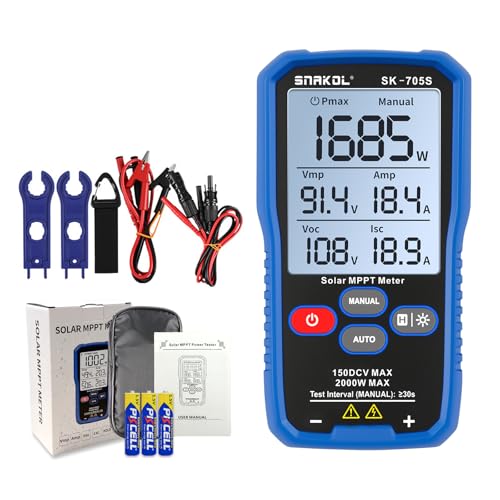


Products shown because their documented specifications fit this guide. Price and availability are on Amazon and can change.
Frequently Asked Questions
Why does testing an energised string matter?
Because a photovoltaic array is a source that cannot be switched off while light falls on it. The conventional way to insulation test one is to isolate the string and often short circuit the modules first, which means extra connections, extra risk of error and frequently working at dawn or dusk. A tester that measures on a live string removes that preparation. The listing adds that it works even after dark, which together means the method does not depend on the array being in any particular state.
What do CAT II 1000 V and CAT III 600 V mean together?
They describe two different working environments and the voltage allowed in each. A measurement category reflects how much energy is available to turn a fault into an arc at the point of connection, with CAT II at equipment level and CAT III at fixed distribution. This instrument is rated to 1000 V in a CAT II environment and to 600 V in a CAT III one. The headline test voltage of DC 1000 V therefore sits inside the CAT II half of that pair, not the CAT III half.
What does the plus 5 in the accuracy figure mean?
It is five counts of the least significant digit on the display, and it is the part of an accuracy specification people skip. A figure of plus or minus 1.5 percent plus 5 means the error is one and a half percent of the reading plus a fixed five display steps, so the fixed term dominates at the low end of a range. Its size depends entirely on the display resolution, which this listing never publishes, so the term cannot be converted into megohms from the page alone.
What is stepped voltage testing for?
It is a diagnostic rather than a pass or fail check. Insulation that is sound returns a similar resistance regardless of the test voltage applied. Insulation that is damaged, damp or contaminated often behaves differently as the voltage rises, because a weak path starts to conduct once the stress crosses some threshold. Testing at several voltages and comparing the results separates insulation that is merely dirty from insulation that is beginning to break down.
Does IP54 make this a wet weather instrument?
No. IP54 means dust protected and protected against splashing water from any direction, which is a realistic rating for a dusty roof, a gritty ground mount or an accidental splash. It is not a rating for working in rain, and nothing about an insulation test in wet conditions is a good idea anyway, since surface moisture across terminals and connectors produces leakage paths that have nothing to do with the insulation you are trying to measure.
Affiliate disclosure: Akermin earns a commission from qualifying Amazon purchases made through links on this page. Our editorial picks are based on documented specifications and owner feedback, not commissions.
Related Guides

ANCEL BA101 Review: The Exclusion List Is the Most Useful Bullet
A 12 volt battery, cranking and charging system tester covering 100 to 2000 CCA that reports state of health, state of charge, voltage, current and CCA, drawing its own power from the battery under test.
Read More→
Tenmars Solar Power Meter Review: One Accuracy Figure, Two Very Different Jobs
A handheld solar irradiance meter reading 0 to 1999 watts per square metre or 0 to 634 BTU per square foot per hour, with a selectable 199.9 or 1999 scale, maximum and minimum tracking, data hold and manual zeroing.
Read More→
HT Instruments Solar I-Ve Review: Rear Side Irradiance Is the Whole Point
A single phase photovoltaic installation and efficiency tester with I-V curve tracing on modules and strings to 1500 V and 40 A, front and rear side irradiance measurement for bifacial modules, open circuit voltage and short circuit current measurement, and a module performance database.
Read More→