As an Amazon Associate, Akermin earns from qualifying purchases. Product links on this page are affiliate links.

allsun · ALLOSUN Digital Multimeter Pocket Size DC AC Voltage Current Tester NCV Ohm Capacitance Frequency Diode and Continuity Test Auto Range (EM3085A (Upgraded))
View on AmazonPrice and availability are shown on Amazon and can change at any time.
A pocket multimeter with a 3 3/4 digit auto ranging display, measuring AC and DC voltage and current, resistance, continuity, diode, capacitance and frequency, with non contact alternating voltage detection, data hold and automatic power off, running from a single AAA cell that is not supplied, in a box shaped case with a built in 500 mA 250 V fuse and a stated design to IEC 61010 at CAT II 600 V with pollution degree 2. The fifth bullet is the one that defines the instrument, and it contains two figures that do not describe the same envelope.
The fuse is the specification that defines the meter
Most listings in this format never mention the fuse. This one names it precisely, 500 mA and 250 V, and in doing so tells you more about the instrument than the rest of the feature list combined.
A fuse in a multimeter is not a convenience. The current terminals are a deliberate short circuit: when the meter is set to measure amps it offers almost no resistance, because anything else would alter the circuit it is measuring. Connect those terminals across a voltage source by accident, which is the single most common mistake made with a multimeter, and the only thing between the mistake and an arc inside your hand is that fuse.
So the two numbers printed on it are both load bearing. The current figure sets what you may measure. The voltage figure sets the conditions under which the fuse can be relied upon to interrupt rather than to sustain an arc across its own gap.
A 250 volt part inside a 600 volt rating
The same bullet states CAT II 600 V and a 250 V fuse. Those two figures sit uneasily together, and the reason is in how interruption works.
When a fuse element melts, the current does not stop at that instant. A plasma arc bridges the gap, and whether it extinguishes depends on the voltage trying to maintain it against the fuse construction, which is why interrupting parts carry a voltage rating at all. Applied above its rating, a fuse can continue to conduct through an arc after it has nominally blown. The convention in instrument design is therefore straightforward: the fuse voltage rating should be at least the highest voltage the instrument can be connected to.
Here the instrument is offered for 600 V circuits and the stated fuse is a 250 V part. The listing does not reconcile that, and it is not the kind of difference a buyer can resolve by inference. What it means in practice is that the safest way to use this meter is to keep the current function well away from anything approaching its voltage ceiling, and to treat the current ranges as belonging to low voltage work regardless of what the voltage function will accept. If the figures are a transcription error, the manufacturer can correct them in writing, and that is worth asking for before the first measurement rather than after.
Note also what the categories themselves encode. They are not a quality scale but a statement about available fault energy, which is why our explainer on meter category ratings describes them as a map of the installation rather than a league table.
Three and three quarter digits is a count, not a flourish
The first bullet opens with 3 3/4 digits, which looks like decoration and is actually a specification.
Digit counting is an old convention for describing how far a display can go. Three full digits each run from zero to nine. The fractional part describes a leading digit that cannot reach nine, so the maximum reading stops short of the round number. In practice a three and three quarter digit instrument tops out close to 4000 and shows four characters, where a three and a half digit instrument stops near 2000.
What that controls is where the meter has to change range, and therefore how fine the smallest step is in the range you are actually working in. On a 4000 count instrument the smallest step is about a thousandth of the full scale, so a reading near the bottom of a range loses a great deal of resolution. The practical consequence for electronics work is that small voltages and small capacitances are reported coarsely unless the auto ranging drops to a lower range, and nothing in the bullets states where those range boundaries fall.
As with any instrument, finer steps are not the same as closer to truth, and no accuracy figure is published for any function here.
What the five bullets contain, and what they do not
| Specification | Published in the listing |
|---|---|
| Display | 3 3/4 digits, auto range |
| Functions | DC and AC voltage, DC and AC current, resistance, continuity, diode, capacitance, frequency |
| Extra features | Non contact AC voltage detection, data hold, automatic power off |
| Fuse | 500 mA, 250 V, built in |
| Safety design | To IEC 61010, CAT II 600 V, pollution degree 2 |
| Power | One 1.5 V AAA cell, not included |
| Form | Pocket size, box type case |
| Accuracy, any function | Not stated in the listing bullets |
| Voltage and current ranges | Not stated in the listing bullets |
| Capacitance and frequency ranges | Not stated in the listing bullets |
| True RMS or average responding | Not stated in the listing bullets |
| Input impedance | Not stated in the listing bullets |
| Continuity threshold and buzzer | Not stated in the listing bullets |
| Battery life | Not stated in the listing bullets |
| Independent safety listing or certificate | Not stated in the listing bullets |
Two rows deserve comment. The first is true RMS, because its absence is informative on an instrument that measures alternating current. A meter that responds to the average of a rectified waveform reads correctly only on a clean sine wave, and anything driven by a dimmer, a switching supply or a speed controller is not that. For bench electronics this rarely matters. For anything with a modern power supply in it, it does.
The second is the phrase designed according to IEC 61010. That describes the standard the design follows. It is not the same statement as a test certificate issued by an independent body, and the listing does not mention one. A design claim is better than silence and weaker than a listing mark.
The pocket this belongs in
This is a second meter, and a good idea as one. It is the instrument that lives in a bag or a glovebox for the checks that do not justify fetching the real one: is this cell flat, is this fuse intact, is this socket live, is that capacitor the value printed on it, is this cable continuous end to end. Capacitance and frequency on something this size are genuinely useful, non contact detection saves a probe, and running from a single AAA cell means it will still work after months in a drawer. There are more options of this kind in our guide to multimeters for electronics repair.
It is not a meter for a distribution board, for a three phase supply or for anything upstream of a socket outlet, and the fuse voltage figure is a second reason for that beyond the CAT II rating. It is also not the meter for measuring the current drawn by an appliance, because half an amp is the ceiling. Treat the non contact function as a hint rather than a verification, as our note on non contact voltage detection explains, and keep a properly rated instrument for anything that matters.
Recommended Tools


Products shown because their documented specifications fit this guide. Price and availability are on Amazon and can change.
Frequently Asked Questions
What does the 500 mA fuse limit?
Current measurement, severely. A multimeter measures current by placing itself in series with the circuit, so all of the current flows through the meter and through its fuse. A 500 mA fuse means half an amp is the ceiling, which covers electronics, sensor loops, small motors in control gear and parasitic drain hunting. It rules out almost everything with a plug on it. The absence of a separate ten amp input is consistent with this: the listing describes one fuse, so there is no high current path, and nothing in the bullets states the actual current ranges.
What does CAT II 600 V permit?
The categories describe how much transient energy an instrument and its leads are built to survive, which rises the closer you get to the incoming supply. CAT II covers circuits taken from a socket outlet: appliances, plug in equipment, local loads and the wiring between them. CAT III covers fixed installation and distribution, meaning panels, feeders and hard wired equipment. CAT IV covers the service entrance and the overhead or underground supply. A CAT II 600 V instrument belongs on the appliance side of the wall socket, and the 600 V figure is the voltage within that category, not permission to work upstream of it.
What does 3 3/4 digits mean?
It is a shorthand for display span. Three full digits can each show zero to nine, and the leading digit cannot reach nine, so the maximum reading stops short of a round four digit number. A three and three quarter digit meter typically tops out near 4000, where a three and a half digit meter tops out near 2000 and a four and a half digit meter near 20000. The practical effect is where the meter has to change range: a 4000 count instrument can show tenths of a volt up to about 400 V and then has to move to whole volts.
Is auto ranging only a disadvantage?
It is a trade. Auto ranging removes the step where you choose a range before measuring, which makes a pocket meter quicker for casual checks and harder to misread. The drawback appears on unstable signals, because a reading that wanders across a range boundary makes the instrument hunt, and each change takes a moment before the display settles. A meter with manual range selection can be locked onto one range and watched. The listing describes auto range with data hold and no manual range selection, which is a reasonable choice for the format.
How much can non contact voltage detection be trusted?
It tells you something is probably live, and nothing more. The detector senses the alternating electric field around a conductor through capacitive coupling, so it responds to voltage without a circuit being completed. That makes it useful for picking which cable is energised before you touch anything. It also makes it prone to responding to a neighbouring cable, to induced voltage on a disconnected conductor, and to nothing at all through a screened or armoured cable. It is a first look, never a proof that something is dead.
Affiliate disclosure: Akermin earns a commission from qualifying Amazon purchases made through links on this page. Our editorial picks are based on documented specifications and owner feedback, not commissions.
Related Guides

Fluke 1AC II VoltAlert Review: Two Detection Thresholds in One Listing
A pocket sized non contact voltage tester whose tip glows red and beeper sounds when voltage is detected, with a continuous self test and a choice of audible or silent operation.
Read More→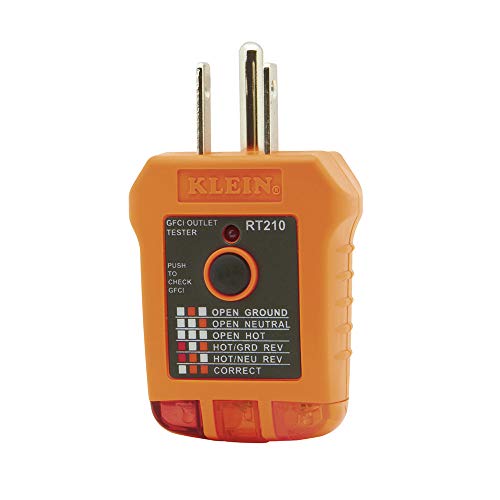
Klein Tools RT210 Review: A Fault Finder That Does Not List Its Faults
A three wire receptacle tester for standard and GFCI North American outlets, specified for 110 to 125 volts AC at 50 or 60 Hz, a 6.6 foot drop and an operating range of 32 to 140 degrees Fahrenheit.
Read More→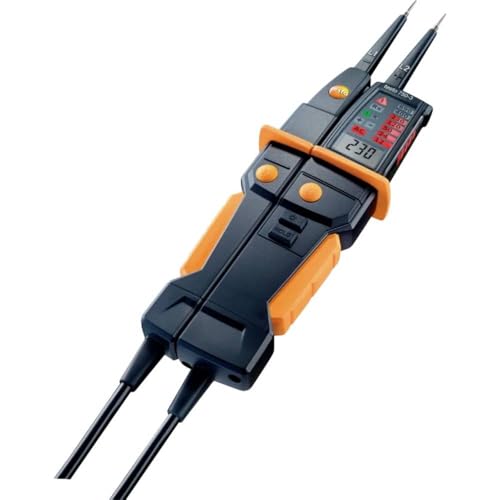
Testo 750-3 Review: Four Bullets, and No Published Category Rating
A two pole voltage tester with a three digit LCD showing measured voltage, a patented LED voltage bar viewable from any angle, polarity detection on DC and a GFCI test function for AC outlets.
Read More→