Skip to content
AkerminMeasure. Monitor. Improve. Compare Products

Best Hydrocarbon Refrigerant Leak Detectors: 7 Picks for R290 and R600a

Most refrigerant sniffers sold to HVAC techs are halogen detectors, and halogen sensors are blind to hydrocarbons. R290 and R600a are hydrocarbons. If you point a standard freon sniffer at a propane or isobutane circuit, it will read clean while the charge leaks out. The seven picks below are the ones whose listings state hydrocarbon coverage, and the page explains what to check before you buy.

  • Independent Research
  • Verified Specifications
  • Honest Recommendations

Measure It
Compare It
Buy Once

As an Amazon Associate, Akermin earns from qualifying purchases. Product links on this page are affiliate links.

Our Top Picks

This comparison was assembled from the manufacturer listings supplied for each product. Only products whose listings state or strongly imply hydrocarbon coverage were included as picks for R290 and R600a work; the Inficon 718-202-G1 (P1), Inficon 705-202-G1 (P6), Elitech ILD-200 (P5), Elitech ELD-270's sibling listing (P4) and the RectorSeal Better Bubble (P10) were excluded because their listings describe halogen-only.

Best overall for hydrocarbons
Aprvtio ALD-200

Aprvtio ALD-200

A heat diode sniffer whose listing explicitly covers A3 refrigerants R290 and R600.

  • Listing states a next-generation heat diode sensor covering A1 (R410A), A2L (R32, R454B) and A3 (R290, R600) refrigerants
  • Sensitivity adjustable up to 0.14 oz/yr for micro leak detection
  • 2.8 inch TFT colour display showing concentration level, with beep frequency rising as the leak intensifies
  • 16 inch probe, rechargeable, with a mute button for quiet environments
View on Amazon Read Full Review→
Best value hydrocarbon coverage
Elitech ELD-270

Elitech ELD-270

Heated diode unit with the tightest stated sensitivity here and explicit R290 and R600a coverage.

  • Listing states detection of R11, R22, R404A, R410A, R600A, R1234YF and all halogenated refrigerants including CFCs, HCFCs, HFCs, HCs, HFOs and blends
  • Stated sensitivity as small as 0.07 oz/yr (2 g/year) with three adjustable sensitivity levels
  • Visual, audible and vibration alerts with a digital leak level display from 0 to 9
  • Automatic and manual environment zeroing modes, 30 second warm-up, 3 second response
View on Amazon Read Full Review→
Best for ppm and %LEL readouts
Simbow WJL-6000PRO

Simbow WJL-6000PRO

Reads both ppm for locating and %LEL for flammable-atmosphere awareness.

  • Listing states dual PPM and %LEL detection modes
  • Universal compatibility claimed for CFCs, HCFCs, HFCs, HFOs, blends and PFCs
  • Solid metal, dirt-resistant flexible probe intended for cramped engine bays and AC vents
  • Audible and visual alarms with a mute function
View on Amazon Read Full Review→
Same tool, second listing
Aprvtio WJL-6000PRO

Aprvtio WJL-6000PRO

Functionally the same instrument as the Simbow WJL-6000PRO under a different brand listing.

  • Listing states dual PPM and %LEL detection modes
  • PPM described as ultra-sensitive micro leak detection, %LEL for A2L refrigerant safety
  • All-metal, dirt-proof, wear-resistant probe
  • Audible and visual alarms with a mute button
View on Amazon Read Full Review→
Best stated sensor life
Wale&Morn LD200

Wale&Morn LD200

Heated diode unit with a stated 500 hour sensor life and R290 and R600A named in the title.

  • Listing states high-precision heated diode sensor with over 500 hours life and max sensitivity 0.05 oz/yr, normal sensitivity 0.1 oz/yr
  • Title names R290 and R600A alongside R22, R410A, R134A, R1234yf and SF6
  • Five-key design with fast reset, mute, power, sensitivity adjustment and peak value marking
  • 2.8 inch colour display, USB-C charging, 3000mAh battery stated for 8 hours continuous work
View on Amazon Read Full Review→
Best for long runtime
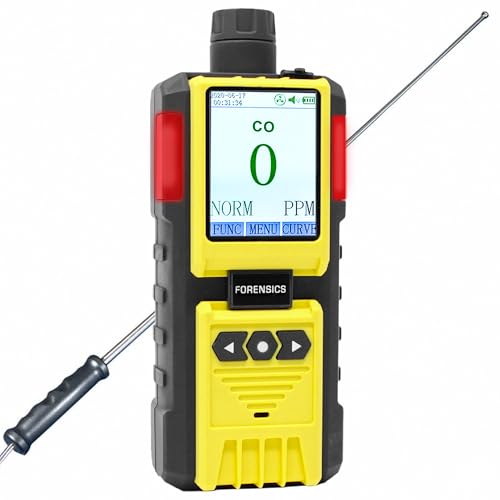
SENSYX HVAC Refrigerant and Combustible Gas Detector

SENSYX HVAC Refrigerant and Combustible Gas Detector

Metal-oxide sensor with a stated 24 hour battery and a combustible gas claim.

  • Listing states a Japan-made metal-oxide semiconductor sensor responding to the full halogenated refrigerant family
  • Selectable High and Low sensitivity for broad sweep then close-in
  • 2500mAh built-in lithium battery stated for up to 24 hours continuous work, USB-C charging
  • Listing advises running the unit for several hours in clean air before first use to reach full sensitivity
View on Amazon Read Full Review→
Budget halogen unit, hydrocarbon coverage unstated
Elitech CLD-100

Elitech CLD-100

Corona sensor unit with a long probe, but the listing does not name R290 or R600a.

  • Listing states a traditional corona sensor with updated analogue circuit, triggering on R11, R22, R134A, R404a, R410A and all halogenated refrigerants including HFCs, CFCs, HCFCs and blends
  • 6 second preheating time and instantaneous response
  • 6 adjustable sensitivity levels with stated sensitivity of 0.21 oz/yr
  • Flexible probe around 8.26 inches for hard-to-reach areas
View on Amazon Read Full Review→

Comparison Table

View Full Comparison→
PickSensor typeR290 / R600a statedStated sensitivityReadoutBattery
Heat diodeYes, A3 R290 and R600 named0.14 oz/yr adjustableConcentration on 2.8 inch TFTRechargeable, runtime not statedView
Heated diodeYes, R600A named0.07 oz/yr0 to 9 leak levelNot stated in the listing bulletsView
Not stated in the listing bulletsNot named in supplied bulletsNot stated in the listing bulletsPPM and %LELNot stated in the listing bulletsView
Heated diodeYes, named in title0.05 oz/yr max, 0.1 oz/yr normalLCD leak level with peak hold3000mAh, 8 hours statedView
Metal-oxide semiconductorNot named in supplied bulletsNot stated in the listing bulletsHigh and Low sensitivity, no numeric scale stated2500mAh, 24 hours statedView
CoronaNo, halogenated refrigerants only0.21 oz/yrNot stated in the listing bulletsNot stated in the listing bulletsView

Sensitivity figures are quoted exactly as the listings publish them and are not directly comparable across sensor types. A detector that does not name R290 or R600a in its listing should not be relied on for those gases without written confirmation from the seller.

How to choose a hydrocarbon leak detector

Six things to settle before you buy, in the order they will affect whether the tool works on the job.

Confirm the sensor chemistry

Halogen sensors look for chlorine or fluorine. R290 and R600a have neither. Buy a heated diode, infrared or metal-oxide sensor and make sure the listing names the gas.

Decide whether you need %LEL

A locating tool tells you where the leak is. A %LEL readout tells you whether the air around you is approaching a flammable concentration. On R290 these are different jobs.

Read the sensitivity figure carefully

A stated maximum sensitivity is not the everyday figure. Where a listing gives both, as P9 does, the normal setting is the number to plan around.

Check the probe and the warm-up

A long flexible probe reaches compressor compartments and evaporator boxes. A metal wand survives being pushed into them. Warm-up time tells you how long you stand around before the first reading is valid.

Match the battery to the shift

Rechargeable is now standard, but runtime varies widely. A stated 8 hour figure covers a normal day; a stated 24 hour figure covers a long one. Disposable cells are a mid-job failure waiting to happen.

Plan for sensor replacement

Heated diode and metal-oxide sensors are consumables. A stated life, like the 500 hours on P9, lets you schedule replacement instead of discovering drift on a call-back.

Frequently Asked Questions

View All FAQs→
Why will my normal refrigerant sniffer not find an R290 leak?

Most sniffers sold for HVAC work are halogen detectors. They respond to the chlorine or fluorine atom in refrigerants like R410A and R134a. R290 is propane and R600a is isobutane; neither contains a halogen, so the sensor has nothing to react to. The instrument reads clean because it genuinely cannot see the gas, not because the system is tight.

Can I use a combustible gas detector instead of a refrigerant leak detector for R290?

A combustible gas detector will respond to R290, because propane is a combustible gas. But it is built to warn you about a flammable atmosphere, not to pinpoint a 2 gram per year weep at a flare. The two jobs need different sensitivity and different probe behaviour. Some tools here, like P7 and P8, offer both modes in one housing, which is the practical compromise.

What does %LEL actually mean on a leak detector?

LEL is the lower explosive limit, the concentration in air below which a gas will not ignite because there is not enough fuel. %LEL is the reading expressed as a percentage of that threshold. A reading of 10 percent LEL means you are a tenth of the way to a flammable mixture. It is a safety number, not a leak size.

Is a heated diode or an infrared sensor better for hydrocarbons?

Both respond to hydrocarbons. Heated diode sensors are generally more sensitive to small concentrations, which suits leak locating. Infrared sensors are less prone to contamination and drift, which suits repeatable readings over a long service life. The listings here do not publish a direct comparison, so choose on the stated sensitivity and sensor life you can actually verify.

Reviews

Aprvtio ALD-200

Aprvtio ALD-200 Best overall for hydrocarbons

The ALD-200 is the only pick here whose listing names R290 and R600 as covered refrigerants rather than leaving the reader to infer it from a generic 'all refrigerants' phrase. That matters because the sensor type is the whole game. A heat diode sensor works by heating a ceramic element and measuring the change in conductivity when a gas breaks down on its surface. Hydrocarbon molecules break down on that element, so the sensor responds. A halogen sensor looks for the chlorine or fluorine atom instead, and R290 and R600a contain neither, which is why a halogen sniffer passes over a propane leak without a sound.

The listing quotes sensitivity adjustable up to 0.14 oz/yr, which is the practical floor for finding a weeping flare or a pinhole in a brazed joint before it becomes a call-back. The 16 inch probe is long enough to reach a compressor compartment on a reach-in or a rooftop unit without putting your face into the refrigerant stream, and the rechargeable battery removes the disposable cell problem that catches techs mid-job.

The display shows concentration rather than a bare yes or no, and the beep rate rises with it. That lets you sweep a joint and watch the number climb as you close in, which is faster than the hunt-and-peck you do with an alarm-only unit. The mute is a genuine convenience indoors, but remember that muting the buzzer does not mute the display, and it does not change the sensor's response time.

Strengths

  • Listing states A3 coverage including R290 and R600
  • Adjustable sensitivity to 0.14 oz/yr
  • Concentration display rather than alarm only
  • Rechargeable with a long 16 inch probe

Limitations

  • Battery runtime is not stated in the listing bullets
  • Sensor life and replacement interval are not published
  • No %LEL readout for flammable-atmosphere monitoring
  • Heat diode sensors can be poisoned by exposure to silicone or heavy contamination
View on Amazon
Elitech ELD-270

Elitech ELD-270 Best value hydrocarbon coverage

The ELD-270 lists R600A by name and includes HCs in its coverage string, which is the signal you are looking for. Its stated 0.07 oz/yr sensitivity is the tightest figure published across this set, and for R290 work that headroom is useful because hydrocarbon charges are small. A domestic fridge might hold 50 to 150 grams of R600a in total. A leak of 2 grams a year is a slow weep, but on a charge that size it is still worth finding before the system short-cycles.

The 0 to 9 leak level display gives you a relative scale rather than a concentration in ppm, so you cannot use it to judge whether an atmosphere is approaching a flammable limit. It is a locating tool, not a safety monitor. The three sensitivity levels let you sweep broadly on the low setting and then drop to the high setting once you have a direction, which reduces the false triggers you get from background solvent or exhaust fumes.

Automatic and manual zeroing is the feature most people ignore until they need it. Automatic zeroing drifts the baseline as you work, which is fine in clean air but can mask a slow leak in a contaminated space. Manual zeroing lets you fix the reference point yourself. The 30 second warm-up and 3 second response are both stated, and both are realistic for a heated diode element.

Strengths

  • R600A named explicitly in the coverage list
  • 0.07 oz/yr stated sensitivity, the tightest here
  • Three sensitivity levels and a 0 to 9 leak display
  • Automatic and manual zeroing modes

Limitations

  • No ppm or %LEL readout
  • Sensor life is not stated in the listing bullets
  • Battery type and runtime are not published
  • Vibration alert is useful but not a substitute for watching the display
View on Amazon
Simbow WJL-6000PRO

Simbow WJL-6000PRO Best for ppm and %LEL readouts

The WJL-6000PRO is the only tool in this set whose listing advertises a %LEL mode, and that changes what the instrument is for. PPM mode is a locating mode: you sweep a joint and watch the number climb as you close in. %LEL mode is a safety mode: it tells you what fraction of the lower explosive limit is present in the air around the probe. For R290, which is flammable, that second number is the one that decides whether you keep working or ventilate and step back.

One caution on the coverage claim. The listing says it sniffs CFCs, HCFCs, HFCs, HFOs, blends and PFCs. It does not name R290 or R600a in the bullet text supplied. The %LEL mode is the strongest hint that hydrocarbon response is intended, since %LEL is only meaningful for flammable gases, but a buyer should confirm hydrocarbon coverage with the seller before relying on this as the primary R290 instrument. If the seller confirms it, the dual readout makes it the most informative tool here.

The metal probe is a real durability point. Plastic probe tips snap when they are pushed past a fan shroud or into a tight evaporator box, and a snapped tip usually means a whole new instrument. A metal wand that bends and holds its shape survives that treatment. The mute is handy indoors, and the alarm tone changes to a siren rather than just speeding up, which is easier to notice when you are head-down in a cabinet.

Strengths

  • %LEL mode gives flammable-atmosphere awareness
  • PPM mode for locating micro leaks
  • Metal probe resists the breakage that kills plastic wands
  • Audible and visual alarms with mute

Limitations

  • R290 and R600a are not named in the supplied bullet text
  • Sensor type is not stated in the listing bullets
  • Stated sensitivity figure is not published
  • Calibration interval and method are not stated
View on Amazon
Aprvtio WJL-6000PRO

Aprvtio WJL-6000PRO Same tool, second listing

This is the same instrument as P7 with a different brand name on the listing. The feature set is identical: PPM and %LEL modes, a metal probe, audible and visual alarms with mute. If you are choosing between them, choose on availability and on which seller will actually answer a question about hydrocarbon coverage, not on any imagined difference in performance. There is no basis in the supplied listings for claiming one is more sensitive than the other.

The one wording difference worth noting is that this listing frames the %LEL mode around A2L refrigerant safety rather than around flammability generally. A2L refrigerants are mildly flammable; A3 refrigerants like R290 are more so. The %LEL principle is the same either way, but the listing's own framing points at A2L, so a buyer who needs it specifically for R290 should treat the coverage as something to confirm rather than assume.

As with P7, the metal probe is the durability feature that separates this from the plastic-wand crowd, and the mute is a convenience rather than a capability. Neither listing publishes a sensitivity figure in oz/yr or a sensor type, so if you need a documented sensitivity number to satisfy a customer or a procedure, this is not the tool that gives you one.

Strengths

  • Dual PPM and %LEL readout
  • Metal probe built for tight spaces
  • Alarm tone changes to a siren on detection
  • Mute for quiet indoor work

Limitations

  • Identical to P7, so there is no reason to pay more for this listing
  • R290 and R600a not named in the supplied bullets
  • No stated sensitivity figure
  • Sensor type and life not published
View on Amazon
Wale&Morn LD200

Wale&Morn LD200 Best stated sensor life

The LD200 is the only pick here that publishes a sensor life figure: over 500 hours. That number matters because heated diode sensors are consumable. They degrade with use and with contamination, and a sensor that has drifted will under-read a small leak without telling you. A stated life gives you a replacement interval you can plan around instead of discovering the problem on a job.

The stated sensitivity is 0.05 oz/yr at maximum and 0.1 oz/yr at normal setting. Those are the tightest numbers in this set, and the listing is honest that the headline figure is the maximum rather than the everyday one. For R290 and R600a work, where the whole charge is small, that resolution is the difference between finding a weep and writing it off as background.

The peak value function is more useful than it sounds. When you sweep a joint, the reading rises and falls as the probe passes over the leak. Holding the peak lets you go back and confirm the same spot gives the same number, which is how you separate a real leak from a transient puff of solvent. The USB-C port and the stated 8 hour runtime cover a full shift, and the 3000mAh battery is a figure you can compare against other tools rather than a vague claim.

Strengths

  • Stated 500 hour sensor life
  • 0.05 oz/yr maximum sensitivity, 0.1 oz/yr normal, both stated
  • R290 and R600A named in the product title
  • Peak value hold and USB-C charging

Limitations

  • The listing's coverage sentence is cut off mid-word, so the full gas list is not readable
  • No %LEL or ppm readout
  • Heated diode sensors are poisoned by silicone and heavy contamination
  • Calibration interval is not stated
View on Amazon
SENSYX HVAC Refrigerant and Combustible Gas Detector

SENSYX HVAC Refrigerant and Combustible Gas Detector Best for long runtime

The SENSYX is the odd one out here because it is the only pick whose sensor type is metal-oxide rather than heated diode or infrared. Metal-oxide sensors respond to a broad range of gases, which is why the listing can call it a combustible gas detector as well as a refrigerant sniffer. That breadth is an advantage for R290 and R600a, because hydrocarbons are exactly the kind of gas a metal-oxide sensor is good at. It is also a disadvantage, because a sensor that responds to everything will respond to cleaning solvent, exhaust and alcohol too.

The listing is unusually candid about the warm-up. Metal-oxide sensors need to run hot for a period before they stabilise, and the listing says several hours in clean air when new or after storage. That is not a defect, it is how the chemistry works, but it means you cannot unbox this and trust the first reading. It also means the stated 24 hour runtime has to be read alongside that burn-in requirement.

The probe speed advice in the listing, no faster than 1 inch (25 mm) per second, is the single most useful sentence on the page. Every sniffer in this category has a response time, and moving the probe faster than the sensor can respond is the most common reason a tech declares a system leak-free when it is not. Whatever detector you buy, slow down.

Strengths

  • Metal-oxide sensor responds to hydrocarbons as well as halogens
  • Stated 24 hour runtime on a 2500mAh battery
  • Selectable High and Low sensitivity
  • Listing gives explicit probe speed guidance

Limitations

  • Metal-oxide sensors cross-react with solvents, exhaust and alcohol
  • Several hours of clean-air burn-in required before first use
  • R290 and R600a are not named in the supplied bullet text
  • No stated sensitivity figure in oz/yr
View on Amazon
Elitech CLD-100

Elitech CLD-100 Budget halogen unit, hydrocarbon coverage unstated

The CLD-100 is included here as a caution rather than a recommendation for hydrocarbon work. Its listing describes a corona sensor and lists only halogenated refrigerants: HFCs, CFCs, HCFCs and blends. R290 and R600a are hydrocarbons, not halogenated, and they are not named. A corona sensor detects the halogen content of a gas, so a hydrocarbon leak gives it nothing to react to. On an R290 system this instrument is not a leak detector, it is a decoration.

That is not a criticism of the tool on its own terms. For R410A, R134a and R404A work, a corona sensor is a proven approach, and the stated 0.21 oz/yr sensitivity and six sensitivity levels are reasonable for general service. The 8.26 inch flexible probe reaches into places a rigid wand will not. The 6 second preheat is quick.

But if you are reading this page because you have R290 or R600a equipment, this is the wrong instrument, and the listing itself tells you so by omission. The absence of a hydrocarbon claim is the signal. Do not buy a halogen sniffer and hope; buy a sensor type that responds to hydrocarbons, and confirm the coverage in writing before you spend.

Strengths

  • Stated 0.21 oz/yr sensitivity
  • Six adjustable sensitivity levels
  • Long 8.26 inch flexible probe
  • Fast 6 second preheat

Limitations

  • Corona sensor detects halogens, not hydrocarbons
  • R290 and R600a are not named in the listing
  • Not suitable as a primary instrument on A3 refrigerant systems
  • No concentration or %LEL readout
View on Amazon

Buying Guide

Short answer: For R290 and R600a work, the deciding factor is sensor chemistry, not brand. The Aprvtio ALD-200 (P2) is the most complete pick here because its listing states a heat diode sensor covering A1, A2L and A3 refrigerants including R290 and R600, with sensitivity adjustable to 0.14 oz/yr. The Elitech ELD-270 (P3) is the strongest value alternative, with a heated diode sensor, 0.07 oz/yr stated sensitivity and three sensitivity levels. If you want a detector that also reports concentration in ppm and %LEL rather than just alarming, the Simbow WJL-6000PRO (P7) and the Aprvtio WJL-6000PRO (P8) are functionally the same tool under two listings. The Inficon 705-202-G1 (P6) and the Inficon 718-202-G1 (P1) are halogen-only units; their listings do not claim hydrocarbon detection, so they should not be your primary instrument on an R290 system.

Why halogen sensors cannot see R290 or R600a

A halogen leak detector works by looking for a halogen atom. Chlorine and fluorine are the halogens that appear in the refrigerants the HVAC trade has used for decades: R22, R410A, R134a, R404A, R1234yf. The sensor, whether it is a corona discharge, a heated diode or an infrared cell, is tuned to react when those atoms pass over it. That is why a freon sniffer is so good at its job, and it is exactly why it fails on a hydrocarbon.

R290 is propane. R600a is isobutane. Both are hydrocarbons, made of carbon and hydrogen only. There is no chlorine and no fluorine in either molecule, so a halogen sensor has nothing to detect. Point a standard sniffer at a leaking R290 flare and it will sit silent. The tech concludes the joint is tight, tops up the charge, and the call-back is booked before the van leaves the street.

This is not a sensitivity problem you can fix by buying a more expensive halogen detector. It is a chemistry problem. The instrument is answering a different question from the one you asked. The fix is to choose a sensor type that responds to hydrocarbons: a heated diode, an infrared cell or a metal-oxide semiconductor. All three appear in the picks above. If you want the longer version of that sensor argument, it is covered in infrared versus heated diode refrigerant leak detectors.

What the sensitivity figure actually tells you

Sensitivity is quoted in ounces per year, which is a mass flow rate. A stated 0.07 oz/yr means the sensor can register a leak that loses about two grams of refrigerant over twelve months. That sounds absurdly small, and it is, which is why the figure is worth reading carefully.

Two things distort the number. First, many listings quote the maximum sensitivity, achieved on the highest sensitivity setting, in still air, with a freshly calibrated sensor. The everyday figure is usually looser. P9 is unusually honest here: it states 0.05 oz/yr maximum and 0.1 oz/yr normal, so you can see the gap. Second, the figure is a detection threshold, not an accuracy. A detector that trips at 0.07 oz/yr does not tell you the leak is 0.07 oz/yr; it tells you it found something at least that big.

For R290 and R600a the small numbers matter more than they do on a large A1 system. A domestic refrigerator might hold 50 to 150 grams of R600a in total. A leak of a few grams a year is a slow loss, but on a charge that size it is a meaningful fraction of the whole. A detector that only trips at 0.25 oz/yr will miss it. That is the practical reason the tighter stated figures in this set are worth paying attention to.

The mistake almost everyone makes with a sniffer

The most common failure in leak detection is not a bad instrument. It is probe speed. Every sensor in this category has a response time, and if you move the probe past the leak faster than the sensor can react, you get a clean reading over a real leak. The listing for P11 states the rule plainly: no faster than 1 inch (25 mm) per second. That is slower than most people naturally sweep.

The second mistake is skipping the warm-up. Heated diode sensors need 30 seconds or so to stabilise, which most listings state. Metal-oxide sensors need far longer, and the P11 listing says several hours in clean air when the unit is new or has been in storage. Starting a job before the sensor is ready gives you a baseline that drifts while you work, and a drifting baseline hides slow leaks.

The third mistake is zeroing in contaminated air. If you zero the instrument next to a solvent rag or in a room full of exhaust, the baseline is set wrong and every subsequent reading is offset. Zero in clean air, away from the system, then walk to the leak. The automatic and manual zeroing modes on P3 exist precisely so you can take control of this rather than letting the instrument decide.

Maintenance that nobody mentions

Heated diode and metal-oxide sensors are consumables. They degrade with use, and they degrade faster when they are exposed to contamination: silicone sealants, compressor oil mist, cleaning solvents, exhaust. A sensor that has drifted does not fail loudly. It under-reads. You sweep a joint, get a low number, and conclude the leak is small or absent when the sensor has simply lost its edge.

The defence is a known-leak check. Keep a small cylinder or a charged fitting with a deliberate, controlled leak, and confirm the instrument still trips on it before you trust a clean sweep. Do this at the start of a job, not after you have already declared the system tight. P9 is the only pick here that publishes a sensor life figure, over 500 hours, which gives you a replacement interval to work to. Where no figure is published, treat the sensor as a consumable and replace it when the known-leak check starts to look weak.

Probe care matters too. A plastic wand that snaps leaves you with an instrument you cannot use. The metal probes on P7, P8 and P9 are built for the way techs actually work, bending into tight evaporator boxes and engine bays without breaking. Wipe the probe after use and store it capped.

When a leak detector is the wrong tool

A leak detector finds leaks. It does not make a flammable atmosphere safe, and it does not replace a gas monitor. If you are working on an R290 system in an enclosed space, the question you need answered is not where the leak is but whether the air around you is approaching a flammable concentration. That is a %LEL measurement, and only P7 and P8 offer it in this set. Even then, a handheld sniffer is not a fixed gas detection system and should not be treated as one.

Nor is a leak detector a substitute for pressure testing or for a proper evacuation and charge procedure. A sniffer helps you find a leak you already suspect. It is poor at proving a system tight, because a clean sweep has too many ways to be wrong. If you need to certify a system, use the detector to locate and a pressure or vacuum test to confirm.

And if your work is entirely on A1 or A2L refrigerants, you do not need a hydrocarbon-specific tool at all. A good halogen detector will serve you better and often costs less. The hydrocarbon requirement is specific, and it is worth buying for only when you actually have R290 or R600a equipment in front of you. For the broader category, see best refrigerant leak detectors, and for the A3 context specifically, A3 refrigerant leak detectors and compatible tools. If you are weighing a sniffer against a combustible gas monitor for general work, refrigerant leak detector versus combustible gas detector sets out where each one stops being the right answer.

How We Research

This comparison was assembled from the manufacturer listings supplied for each product. Only products whose listings state or strongly imply hydrocarbon coverage were included as picks for R290 and R600a work; the Inficon 718-202-G1 (P1), Inficon 705-202-G1 (P6), Elitech ILD-200 (P5), Elitech ELD-270's sibling listing (P4) and the RectorSeal Better Bubble (P10) were excluded because their listings describe halogen-only detection or, in the case of the bubble solution, a different method entirely. Where a listing does not publish a figure, the table says so rather than estimating. No laboratory testing was performed and no measurements of our own are published.

Read our full review methodology→