Best True RMS Multimeters: 9 Professional Picks for Accurate Measurements
True RMS is the specification that decides whether a meter reads a distorted waveform correctly or reads it low. This page compares nine instruments on that question and reports something uncomfortable: eight of the nine manufacturer listings never mention true RMS at all, so the page explains what to do with that silence rather than inventing a claim.
Independent Research
Verified Specifications
Honest Recommendations
Distorted Wave
Averaging Reads Low
True RMS Reads Right
As an Amazon Associate, Akermin earns from qualifying purchases. Product links on this page are affiliate links.
Our Top Picks
Every product here was checked for an explicit true RMS statement on its own manufacturer listing. One of the nine makes that claim. The rest were compared on stated display resolution, any published accuracy figure and the measurement functions named, with the true RMS column reading Not stated wherever the manufacturer does not claim it. We invent no specifications and publish no measurements of our own.
Best Overall
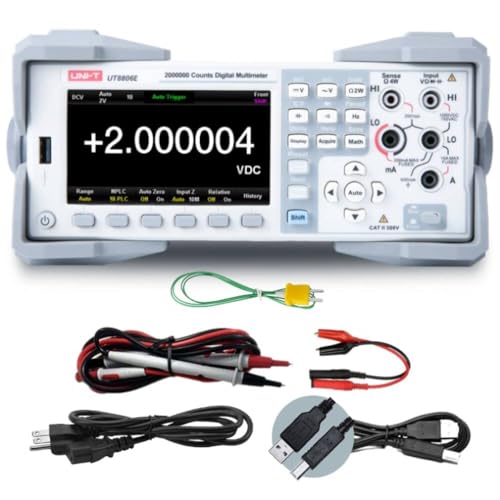
UNI-T UT8806E 6.5 Digit Benchtop Multimeter
The only instrument here whose listing states TRMS, and the only one stating accuracy.
True RMS stated explicitly on the listing as TRMS
0.0035 percent accuracy stated, the only accuracy figure in this group
6.5 digit display with 1,999,999 counts, auto-ranging
Dual display on a 4.3 inch TFT with USB and RS232 interfaces
The true RMS column records only what each manufacturer listing explicitly claims. One of the nine claims it. A Not stated entry means the listing is silent, not that the instrument averages, and the specification may well appear in the manual. We did not measure any of these instruments and will not assert a capability a manufacturer has not published.
How to Choose a True RMS Multimeter
Four points, and the first is about the listings themselves:
Look for the Words
True RMS is cheap to print and manufacturers who have it say so. On this page one listing does. Treat silence as unverified and check the manual before buying for that reason.
Know Your Waveform
On a clean sine wave, averaging and true RMS meters agree closely. The difference appears on drives, inverters, dimmers and switching supplies, where an averaging meter reads low.
Accuracy Still Applies
True RMS describes the measurement method, not how correct it is. A true RMS meter with unstated accuracy is still an unspecified instrument. Only one listing here states both.
Or Just Look at It
A scope meter sidesteps the question. If the waveform on screen is a clean sine, the method does not matter. If it is chopped or pulsed, you know not to trust any averaged number.
Only one of nine states true RMS. Are the others averaging meters?
Unknown, and that is the honest answer. A listing that does not mention the measurement method is telling you nothing about it either way, and several of these instruments are from manufacturers whose documentation does describe it. What can be said is that true RMS is a selling point, it costs nothing to print, and manufacturers who have it usually say so. If the capability is the reason for your purchase, confirm it in the manual before ordering.
What actually goes wrong with an averaging meter?
It reads low on a distorted waveform, silently. An averaging meter rectifies the signal, takes the mean and multiplies by a constant of about 1.11, which is the correct ratio for a pure sine wave and only for that. On a phase-controlled dimmer output, a variable frequency drive, an LED driver or a switched-mode supply the real RMS value can be substantially higher than the reading, with nothing on the display indicating a problem.
When does it not matter?
On clean sine wave mains feeding a resistive load, and on any DC measurement. If you are reading a socket outlet on an unloaded circuit, checking a transformer secondary or measuring a battery, the two methods agree closely or the question does not arise at all. The difference appears the moment a semiconductor is chopping the waveform somewhere upstream.
Does a bench meter need true RMS?
It depends entirely on what goes into it. Four of the nine here are 6.5 digit bench instruments, and bench work is often DC or clean AC where the method is irrelevant. But a bench meter used to characterise a switching supply, an inverter output or a motor drive is measuring exactly the waveforms that defeat averaging, so the specification matters just as much as it does in the field.
Is a scope meter a genuine substitute?
For diagnosis, often a better one. Seeing the waveform tells you whether the RMS question applies at all, and a scope with RMS measurement computes the value from the captured samples. For a reading that goes on a certificate, a specified meter with a published accuracy figure and a stated safety rating is still the right instrument, and none of the scope meters here publishes either.
Reviews
UNI-T UT8806E 6.5 Digit Benchtop Multimeter Best Overall
On a page about true RMS measurement, one instrument out of nine actually claims it, and that fact alone decides the ranking. UNI-T states TRMS on the listing alongside 6.5 digits, 1,999,999 counts, auto-ranging and a 0.0035 percent accuracy figure. Every other product here is silent on the measurement method, and silence is not evidence either way.
What true RMS gives you is a correct reading on a waveform that is not a clean sine. An averaging meter multiplies the rectified average by a fixed constant, and that constant is only correct for a pure sine wave. Put an averaging meter on a variable frequency drive output, a phase-controlled dimmer, an LED driver or a switched-mode supply and the reading comes out low, sometimes by tens of percent, with nothing on the display to suggest anything is wrong. A true RMS converter computes the actual heating value of the waveform and does not care about its shape.
Combining that with a published accuracy figure is what makes this the bench reference of the group. The caveats are the same as for every instrument here: no CAT rating, no maximum input voltage, no temperature coefficient and no calibration interval stated on the listing. It is a bench instrument for low-energy work, not something to take to a distribution board.
Strengths
True RMS stated explicitly, unlike the other eight
Published accuracy of 0.0035 percent
6.5 digits and 1,999,999 counts of resolution
USB and RS232 logging with leads supplied
Limitations
No CAT rating or maximum input voltage stated
Mains powered bench format, not portable
Calibration interval and temperature coefficient not stated
Siglent SDM3065X 6.5 Digit Digital Multimeter Best Bench Alternative
Siglent sells into laboratories and the SDM3065X is a recognised bench instrument, which makes the thinness of this listing frustrating rather than damning. What it states is a 6.5 digit display and a 4.3 inch TFT-LCD at 480 by 272 pixels. What it does not state is accuracy, counts, input ranges, functions, interfaces or measurement method, and that last omission is the one that puts it second on a page about true RMS rather than first.
The reason to consider it anyway is what a 6.5 digit bench meter is for. Resolution at that level lets you watch a value drift rather than just read it, which is how you characterise a reference, verify a supply is stable over hours, or measure a component across a temperature range. The colour display is a genuine improvement over the segment displays of older bench meters when you are reading dual values or a trend.
If true RMS measurement is the reason for the purchase, the honest advice is to confirm it in the Siglent documentation before ordering rather than assuming it from the brand. A well-known name is a reasonable basis for expecting good engineering and a poor basis for assuming a specific specification.
Strengths
6.5 digit resolution from a recognised laboratory brand
Colour 4.3 inch display at 480 by 272
Bench format suited to long observation rather than spot readings
Same platform as the scanner card variant if automation is added later
Limitations
True RMS not claimed on the listing
No accuracy, counts, function or interface list published
Premium price with very little published to justify it
OWON HDS242 Handheld Oscilloscope Multimeter Best Value
There is a pragmatic answer to a meter that will not tell you whether it is true RMS, which is to buy an instrument that shows you the waveform. If you can see that the signal is a clean sine, the averaging and true RMS methods agree and the distinction stops mattering. If you can see that it is a chopped, pulsed or distorted waveform, you know immediately not to trust an averaged number from any meter, whatever it claims.
The HDS242 does that for roughly the price of a mid-range field meter. The scope side states 40 MHz across two channels, enough for control signals, buses and switching supplies. The meter side states 20000 counts with AC and DC voltage, current and resistance, which is more display resolution than most 6000 count field meters offer.
It does not claim true RMS, and that claim should not be assumed. It also publishes no accuracy figure and no CAT rating, and the listing notes a lithium battery shipping restriction. As a value purchase for someone who needs to understand what a circuit is doing rather than certify what it measured, it is the most informative instrument per pound on this page.
Strengths
Seeing the waveform tells you whether the RMS question even applies
20000 counts and a 40 MHz two channel scope
Handheld, so it goes to the circuit
Lowest price on this page
Limitations
True RMS not claimed on the listing
No accuracy figure and no CAT rating stated
Lithium battery shipping restriction noted on the listing
Short answer: the UNI-T UT8806E is the only instrument on this page whose listing actually states true RMS, and it also publishes the only accuracy figure here at 0.0035 percent; the Siglent SDM3065X is the bench alternative if you want a laboratory brand, though its listing claims nothing about measurement method; and the OWON HDS242 is the value answer to the whole problem, because a 40 MHz scope lets you see whether the waveform is distorted rather than trusting a number to handle it.
An uncomfortable finding about this category
This page was supposed to compare true RMS multimeters. Of the nine instruments that survived the category check, exactly one states true RMS on its manufacturer listing: the UNI-T UT8806E, which prints TRMS alongside its digit count and accuracy figure. The other eight listings never use the term. That is not a small gap in a table, it is the central fact about this group, and it would be dishonest to fill a true RMS column with confident ticks based on brand reputation or on what similar models usually do. A Not stated entry in that column means the manufacturer has not claimed the capability on the listing. It does not mean the instrument averages, and in several cases the specification almost certainly appears in the manual. But we will not assert it on their behalf.
Why this page lists nine and not ten
Thirteen listings were supplied and four of them are not multimeters. The HANMATEK HO52 is a two-channel 50 MHz oscilloscope whose listing states no multimeter function at all. The Morning Group unit is a shunt-based battery monitor, wired into a system and left there to display voltage, current, power and accumulated capacity, which is monitoring rather than testing. The Proster item is an LCR meter measuring inductance, capacitance and resistance but neither voltage nor current. The parasitic drain tester is a single-purpose automotive tool for reading dark current at the battery terminals. All four are useful and none is a multimeter, so the count is nine.
What true RMS actually fixes
An averaging meter does not measure RMS at all. It rectifies the input, takes the mean value and multiplies by a fixed constant of roughly 1.11, which happens to convert average to RMS correctly for one waveform only: a pure sine. That was a reasonable engineering shortcut when almost everything on a mains circuit was resistive or inductive. It is a poor assumption now, because the modern electrical environment is full of semiconductors chopping the waveform. A variable frequency drive feeding a motor, a phase-controlled dimmer, an LED driver, a switched-mode power supply, a UPS output and an inverter all produce current and voltage waveforms that are nothing like a sine, and on every one of them an averaging meter reads low. The failure is silent: there is no warning symbol, no flashing digit, just a number that is wrong by an amount that depends on how distorted the waveform happens to be. What true RMS means on a multimeter works through the arithmetic.
When the distinction does not matter
It is worth being equally clear about the other side, because true RMS is often sold as though it improved every measurement. It does not. On DC there is no RMS question at all. On a clean sine wave feeding a resistive load, an averaging meter and a true RMS meter agree to within their respective accuracy specifications. Checking a socket outlet on an unloaded circuit, reading a transformer secondary, measuring a battery or testing a heating element are all measurements where the method is irrelevant. The specification earns its price the moment there is a switching device anywhere upstream of the point you are probing, which on a modern installation is most of the time but by no means all of it.
Resolution is not the same question
Four of these nine publish a resolution figure: 1,999,999 counts at 6.5 digits on the UNI-T, 20000 counts on the OWON, 19999 on the FNIRSI, and 6.5 digits on the three other bench instruments without a count figure. One publishes accuracy. Those are three separate properties and they can vary independently. A true RMS meter with poor accuracy gives you a correctly computed but imprecise number. A high resolution meter using averaging gives you a precisely displayed wrong number. An instrument that publishes all three, as the UNI-T does, is telling you something the others are not, and that transparency is worth as much as the specifications themselves. What resolution means on a digital meter separates the concepts.
The scope meter answer
Four of these nine are handheld scope meters, and they offer a genuinely different route through this problem. Instead of trusting a meter to handle a waveform correctly, you look at the waveform. If the trace on screen is a clean sine, the averaging and true RMS methods agree and the question is moot. If it is a chopped, pulsed or spiky trace, you know immediately that no averaged number from any instrument should be trusted, and you can take the measurement from the scope instead. The OWON HDS242 offers 40 MHz across two channels, the FNIRSI 2C53P 50 MHz with 250 MS/s sampling and a DDS signal generator, the ZOTEK 702S 10 MHz with a 2.8 inch IPS display, and the IMARS unit 1 MHz on a single channel. For fault finding this is often more informative than a better number would be. For anything that goes on a certificate it is not a substitute, because none of these publishes an accuracy figure or a safety rating.
The rating none of them prints
As on every multimeter page in this category, not one of these nine listings states a CAT safety category or a maximum input voltage. That is a whole-group omission worth stating rather than hiding in Not stated cells. CAT II, CAT III and CAT IV describe how much transient energy an instrument is built to withstand at different points in an installation, and the distinction exists because available fault energy rises enormously as you move from a wall socket toward a distribution transformer. The rating is normally in the manual. Until it has been read, treat every instrument here as a low-energy tool, and never use any meter above its stated category or voltage rating. Understanding CAT II, CAT III and CAT IV ratings covers what each level means.
Each product was checked for an explicit true RMS claim on its own manufacturer listing, and only explicit claims were recorded. Instruments were then grouped as benchtop, clamp or handheld scope meters and compared on stated display resolution, any published accuracy figure and the measurement functions named. Four products supplied with this group were excluded as off-category and the reasons are given on the page. We ran no laboratory tests, measured no waveforms and will not infer an unpublished specification from a brand name.
Seven three phase power analyzers compared on channels, harmonic order, transient capture and logging, with guidance on what a clamp meter cannot show you.